| |
 |
Sojourner Truth (born Isabella Baumfree, but went by the name she believed God had given her as a symbolic representation of her mission in life) set out from New York City on a journey across America, preaching about the evils of slavery and promoting women's rights. She had been a slave with several owners but was legally free when slavery was abolished in New York state. |
 Read
more about Sojourner Truth Read
more about Sojourner Truth |
|
America’s worst race massacre, begun the day before over the threat of a lynching, culminated in the complete destruction of the African-American neighborhood of Greenwood in Tulsa leaving nearly 10,000 homeless.
|
 |
The ruins of Tulsa Oklahoma's Greenwood District following the assault by the white community. |
Death in a Promised Land: The Tulsa Race Massacre of 1921 read more |
Meet The Last Surviving Witness To The Tulsa Race Riot Of 1921 |
|
Gay
rights organizer Henry Gerber published an article in Modern Thinker magazine attacking the view that homosexuality
is a neurosis.
In 1924, Henry Gerber, a postal worker in Chicago, started the Society for Human Rights, America's first known gay rights organization.
|

|
| "The Society for Human Rights is formed
to promote and protect the interests of people who are abused
and hindered in the legal pursuit of happiness which is guaranteed
them by the Declaration of Independence, and to combat the
public prejudices against them." |
After having created and distributed a newsletter called “Friendship and Freedom,” Gerber was arrested and held for 3 days without a warrant or being charged with any infractions. Upon release he lost his job for "conduct unbecoming a postal worker.”
Following the last of his three trials, in which the charges were ultimately dismissed, Gerber moved to new York City and re-enlisted in the U.S. Army, serving another 17 years. He lived until 1972, passing away at the the U.S. Soldiers' and Airmen's Home in Washington, D.C., living long enough to see the Stonewall Rebellion
[see June 28, 1969], the beginning of the modern gay rights movement. |
More on Henry Gerber |
|
 |
On the advice of Nazi propaganda minister Joseph Goebbels, German Chancellor Adolf Hitler ordered all Jews in occupied Paris to wear an identifying yellow star on the left side of their coats.
The following month 13,000 French Jews were deported to the Auschwitz-Birkenau concentration camps. |
 |
|
Senator Margaret Chase Smith (R-Maine), then the only woman in the Senate, and just the second in U.S. history, denounced Senator Joseph McCarthy (R-Wisconsin) and his “red-baiting” tactics on the floor of the U.S. Senate, in a speech called “A Declaration of Conscience.” |
|

|
“Those of us who shout the loudest about Americanism in making character assassinations are all too frequently those who, by our own words and acts, ignore some of the basic principles of Americanism—the right to criticize;
the right to hold unpopular beliefs;
the right to protest;
the right of independent thought.” |
Text of the Senator Smith’s Declaration |
|
|
The U.S. Supreme Court ruled that recitation of the Lord’s Prayer and readings from the Bible in public schools violated the establishment clause of the first amendment to the U.S. Constitution in School Dist. Of Abington Township v. Schempp. The Court reasoned that the daily practice was unconstitutional because a public institution was conducting a religious exercise and “that public funds, though small in amount, are being used to promote” a particular religion. “It is not the amount of public funds expended; as this case illustrates, it is the use to which public funds are put . . . .”
|
The decision |
|
| The Vietnam Veterans Against War (VVAW) was founded in New York City after six Vietnam vets marched together in a peace demonstration. The group was organized to give voice to the growing opposition to the escalating war in Indochina among returning servicemen and women. |
|

|
VVAW, through open discussion of soldiers’ first-hand experiences, revealed the truth about the nature of U.S. involvement in Southeast Asia.
|
 |
| VVAW demonstrating against Iraq war 2004 |
| The
VVAW today |
|
At the urging of General George Washington, the United States Congress agreed to gradually disband the Revolutionary army following the end of the war. Subject only to the signing of a final peace treaty with Great Britain, all soldiers and non-commissioned officers were discharged; additionally, a full pardon was granted to privates
and non-coms in confinement. |
|
|
Abolitionist and former slave James Montgomery led 300 African-American troops of the Union Army's 2nd South Carolina Volunteers on a raid of plantations along the Combahee River. Meanwhile, backed by three gunboats, Harriet Tubman's forces set fire to the plantations and freed 750 slaves.
|
 |
| More
on General Tubman |
| Harriet
Tubman |
|
|
General Anastasio Somoza, head of the U.S. Marine-trained National Guard, forced the resignation of Nicaragua’s elected President, Juan Bautista Sacasa. This followed a seven-year U.S. occupation of the country and was followed by Somoza family control of the country for the next four decades.
|
 |
More about Somoza and other
U.S.-friendly Central American dictators
|
|
The U.S. Supreme court ruled illegal President Truman's order two months earlier for the Army to seize the nation's steel mills in order to avert a strike during the Korean war.
|
The decision |
|
|

|
The International Ladies’ Garment Workers Union (ILGWU), a consolidation of seven smaller east coast needle trades unions, was founded.
|
| Read
more |
 |
| Herman Grossman, ILGWU president |
|
| In Irene Morgan v. Virginia, the U.S. Supreme Court ruled that racial segregation in interstate travel was unconstitutional as “an undue burden on commerce.” |
 |
The southern states refused to enforce it, however, and Jim Crow (the term for laws, local and state, that enforced segregation) continued as the way of life in the South.
Eleven years before Rosa Parks refused to give up her seat on a city bus in Montgomery, Alabama, a young woman named Irene Morgan rejected that same demand on an interstate bus headed to Maryland from Gloucester, Virginia. |
Read more about Irene Morgan |
| Recovering from surgery and already sitting far in the back, she defied the driver’s order to surrender her seat to a white couple. Like Parks, Morgan was arrested and jailed. But her action caught the attention of lawyers from the NAACP, led by (future Supreme Court justice) Thurgood Marshall, and two years later her case reached the Court. |
 |
| Headlines when Irene Morgan
won out over Jim Crow (JC) segregation law |
|
Thousands
of scientists, led by Barry Commoner and Nobel laureate
Linus Pauling, issued a call for banning nuclear weapons
testing: “As scientists we have knowledge of the
dangers involved and therefore a special responsibility
to make those dangers known.”
“...Then on May 15, 1957, with the help of some of the scientists in Washington University, St. Louis, I wrote the Scientists' Bomb Test Appeal, which within two weeks was signed by over two thousand American scientists and within a few months by 11,021 scientists, of forty-nine countries....” –Linus Pauling
|

|
Linus Pauling at a disarmament demonstration
photo: Robert Carl Cohen |
Read “An
Appeal by American Scientists to the Governments and People
of the World.”
|
Pauling is the only person to win two unshared Nobel Prizes, for Chemistry in 1954;
for Peace in 1962. Read his acceptance speech, “Science and Peace”
|
|
|
Conscientious objection, the refusal to bear arms in time of war on the grounds of moral or religious principles, became legally recognized in Belgium.
|
A
history of European conscientious objection |
|
| During what became known as the "Voyage of the Damned," the SS St. Louis, carrying more than 900 Jewish refugees from Germany to the U.S., was turned away from the Florida coast. The ship, also denied permission to dock in Cuba, eventually returned to Europe; many of the refugees later died in Nazi concentration camps. |
 |
The reality of what happened |
The movie based on the history |
|
| Angela Y. Davis, a former philosophy professor at the University of California, outspoken black leader and self-proclaimed communist, was acquitted on charges of conspiracy, murder, and kidnapping by an all-white jury in San Jose, California. |
|
 |
New
Zealand passed legislation declaring itself nuclear-free.
In 1986, New Zealand had banned the entry of U.S. Navy
ships from their ports in the belief that they were carrying
nuclear weapons or were nuclear-powered. U.S. government
protests of the policy led to breakup of the ANZUS (Australia-New
Zealand-United States) defense alliance. |
|
The
New Zealand Nuclear Free Zone, Disarmament and Arms Control
Act of 1987 (which ratified the Nuclear Non-Proliferation Treaty)
prohibits the:
•
manufacture, acquisition, possession, control of
any nuclear explosive device
•
aiding, abetting or procuring any person to manufacture,
acquire, possess, or have control over any nuclear explosive
device
•
transport, stockpiling, storage, installation,
or deployment of any nuclear explosive device. |
|
|
Hundreds of civilians were shot dead by China’s People’s Liberation Army during a bloody military operation in Beijing’s Tiananmen Square. Students and workers had become part of a growing pro-democracy movement, gathering there continuously for weeks. The Chinese government still officially denies any deaths occurred; thousands who were arrested “disappeared” and remain unaccounted for.
"... deaths from the military
assault on Tiananmen Square range from 180 to 500; thousands
more have been injured . . . thousands of civilians stood
their ground or swarmed around military vehicles. APCs [armored
personnel carriers] were set on fire, and demonstrators besieged
troops with rocks, bottles, and Molotov cocktails."* |


|
*From a comprehensive overview prepared by the National Security Archive
based on formerly classified U.S. Government documents |
|
|
Uncle Tom's Cabin or, Life Among the Lowly began to appear in serial form in
the Washington National Era, an abolitionist weekly.
The novel
by Harriet Beecher Stowe, a tear-jerking tale of the hardships
of slavery, became a central reference point in the national
debate over the issue. |
 |
| Read more |
|

|
World Environment Day was established by the U.N. General Assembly to commemorate the opening of the Stockholm Conference on the Human Environment in Sweden.
The United Nations Environment Program (UNEP) was established as a result of the conference. |
The 1972 Stockholm conference |
|
UNEP’s
mission: To provide leadership and encourage partnership
in caring for the
environment by inspiring, informing, and enabling nations
and peoples to improve their quality of life without
compromising that of future generations. |
Each
year World Environment Day adopts a different theme. |
|
Just a few days before the first fission reaction was to be allowed at New Hampshire’s Seabrook Station nuclear power plant, hundreds breached the security fence, leading to 627 arrests. They carried signs reading, “In Mourning for the Late, Great State of New Hampshire,” and “Remember Chernobyl.”
Led by the Clamshell Alliance, their concern was for the safety of local residents in the event of a nuclear accident, as well as environmental pollution and the unsolved problem of safe disposal of nuclear waste generated by the reactor. There were also concerns for increased electricity rates to cover the costs of the project. Repeated significant protests occurred as early as 1976 at the beginning of construction when sometimes more than a thousand would be arrested.
Ron Sher, a Seabrook spokesman, termed the demonstrators “very vocal but a small minority . . . They don't represent the millions of people in New England that recognize that nuclear energy is a viable energy option.” The plant was projected to produce up to 1.15 gigawatts, enough for one million homes. |
|
| Thousands
marched to protest neo-Nazi violence against foreigners,
particularly ethnic Turks, living in Germany. |
|

First
issue of Peace News published in England. |
PeaceNews home page |
|
George
Orwell's dystopian novel, Nineteen Eighty-Four, was published.
It described a world in which totalitarian government controls the behavior
of all, including the way one thinks.
This was summed up in the government’s slogans: War Is Peace, Freedom
Is Slavery, Ignorance Is Strength.
|
 |
 |
More about George Orwell |
| George
Orwell |
|
| James
H. Meredith, the first African American ever to attend
the University of Mississippi,
was shot by a sniper in the back and legs while on a lone "March
Against Fear." |
 |
|
| He
was walking the 220 miles from Memphis, Tennessee,
to Jackson, Mississippi, to encourage others to stand
up for their rights and self-respect, and to register
to vote. Law enforcement officers and reporters following
him witnessed the attack, and the shooter was arrested. |

|
| Read
more |
|
|
|
| 40 members of
the American Indian Movement camped in the sacred Black Hills,
or Paha Sapa, atop Mount Rushmore; 20 were arrested.
They were demanding the U.S. honor the terms of the 1868
treaty with the Sioux Nation granting them the Black Hills
territory. |
| Read more |
|
|
The FBI and the Department of Energy, tipped off by plant workers,
raided the Rocky Flats nuclear production facility. They found
numerous violations of federal anti-pollution laws including
massive contamination of water and soil. Rockwell International,
the operator of the facility, was fined $18.5 million. |
|
The Pennsylvania Assembly banned
the importation of slaves
into the colony. |
|
| Homer Plessy, a Creole of European and African descent, was arrested and jailed for sitting in a Louisiana railroad car designated for white people only. Plessy had violated an 1890 state law, the Louisiana Separate Car Act, that called for racially segregated rail facilities. He then went to court, claiming the law violated the 13th and 14th amendments, but Judge John Howard Ferguson found him guilty anyhow. |
| The U.S. Supreme Court allowed Plessy’s guilty verdict to stand by an 8-1 majority. The decision, Plessy v. Ferguson established the doctrine of “separate but equal” [separate facilities for white and black people] institutionalizing and legalizing segregation in the United States public transportation until 1946 in Morgan v. Virginia [see June 3, 1946]. |
| More
about Homer Plessy |
Read
the decision |
|
|
|
|
Seven
activists are arrested for distributing copies of the
Bill of Rights outside the Bradbury Science Museum, part
of Los Alamos National Laboratory in New Mexico, the
primary nuclear research facility
in the U.S.
|
|
Air Force Tech Sergeant Richard B. Fitzgibbon, of North Weymouth, Massachusetts is listed by the U.S. Department of Defense as being the first U.S. military casualty of the Vietnam War.
His name is listed on The Wall (the Vietnam Veterans Memorial in Washington, DC) with that of his son, Marine Corps Lance Colonel Richard B. Fitzgibbon III, who died September 7, 1965. |
 |
|

|
270 walked out of graduation ceremonies at New York University (NYU) to protest the presentation of an honorary degree to Robert McNamara, then the Secretary of Defense and responsible for U.S. forces waging war in Vietnam.
|
|
| Two-thirds of the graduating class of Brown University (Providence, Rhode Island) turned their backs on Secretary of State Henry Kissinger as he gave the commencement address, silently expressing their opposition to U.S. foreign policy and the war in Vietnam. |
|
1500 Israeli and other peace activists demonstrated peacefully in front of the Prime Minister’s Jerusalem residence in opposition to 35 years of Israeli occupation of Palestinian territory.
“The occupation is hurting us all,” said advertising placed by the organizers, “draining billions of shekels from us, forcing cutbacks in social and educational programs.” |
 |
Coalition of Women for a
Just Peace leading a demonstration against the
continued
Israeli occupation of Palestine. |
They also claimed the occupation inculcates the belief that “violence is the only way to solve problems” and “allows militarism to run rampant in our lives.” Buses with banners saying “End the Occupation” and “The Occupation is Hurting Us All” started out from four locations throughout Israel, arriving in Jerusalem together.
A choir of Israeli and Palestinian children had been scheduled to close the action but their conductor feared government retribution; the demonstration ended in silence instead of with children’s voices. |
|
Julia Ward Howe, an abolitionist and the composer of “Battle Hymn of the Republic,” tried to establish the Mothers’ Peace Day Observance on the second Sunday in June. In 1872 the first such celebration was held and the meetings continued for several years. Her idea was widely accepted, but she was never able to get the day recognized as an official holiday. Mothers' Peace Day was the predecessor of the Mothers’ Day holiday in the United States now celebrated on the third Sunday of May.
|
 |
| Julia Ward
Howe ca.1898 |
Her
proclamation read in part:
“As men have often forsaken the plough and the
anvil at the summons of war,
Let women now leave all that may be left of home
For a great and earnest day of counsel.
Let them meet first, as women, to bewail and commemorate the dead.
Let them solemnly take counsel with each other as to the means
Whereby the great human family can live in peace....” |
|
| Special Counsel for the U.S. Army Joseph N. Welch confronted Senator Joseph P. McCarthy (R-Wisconsin) during hearings into alleged communist infiltration of the Army Signal Corps. |
McCarthy had attacked a member of Welch's law firm, Frederick G. Fischer, among many others, as a communist. This was alleged due to Fischer’s prior membership in the National Lawyers Guild.
The Guild was the nation’s first racially integrated bar association. |

Army
counsel Joseph N. Welch (l) confronts Senator Joseph McCarthy
(r) |
Welch
was outraged by the attempt to destroy the reputation
and career of someone of whose integrity he had no doubt: “Until this moment, senator, I think I never gauged your cruelty or recklessness . . . . Have you no sense of decency, sir? At long last, have you left no sense of decency?”
The entire hearings and this encounter were seen live on television, the first congressional committee hearings ever to be broadcast. McCarthy’s ability to make such accusations was soon greatly diminished. |
Watch
the confrontation |
National Lawyers Guild, since 1937 and today |
|
|
150,000 marched in London, England, for nuclear disarmament, protesting the presence of U.S. cruise missiles on British soil.
|
|
|
Police banned a vigil by Women in Black (Zene u Crnom) in Belgrade, Serbia.
Who are the Women in Black?
Women
in Black demonstrations combine art & politics
|
 |
|
|
The Women's Peace Crusade in Scotland launched a three-week campaign of street meetings and demonstrations in dozens of towns to build support for peace in the midst of what was then called The Great War (now known as World War I). |
More about the Womens's Peace Crusade |
|
The mayor of Monroe, Michigan, organized a citizens’ posse of some 1400 vigilantes, armed with baseball bats and tear gas, to combat the union organizing drive at local Newton Steel. The mob threw a dozen of the picketers’ cars into the River Raisin.
|
 |
| Steelworkers' cars were rolled into Monroe, Michigan's River Raisin by strike breakers recruited by the mayor. |
The 120 striking steelworkers and their supporters were working to form unions in the “Little Steel” companies which, unlike U.S. Steel, continued to resist unionization. Newton had just been purchased by Republic Steel [see Chicago’s Memorial Day Massacre[May 30, 1937]. |
The
whole story |
|
| The “Equal Pay Act of 1963” was passed and signed into law; it guaranteed women equal pay for equal work. The legislation was a result of the recommendations of President John F. Kennedy’s Commission on the Status of Women. |
 |
| The law itself |
|
Nelson Mandela's first writings, and those of other imprisoned anti-apartheid leaders, were smuggled out and made public while they were imprisoned on South Africa’s Robben Island. |
|

|
"As I read these fascinating essays, I was struck so forcibly by the importance of memory, of history, for both the individual and the community. . . . I pray that our people and especially our children will, by reading this collection of essays, remember the very high price that has been paid to achieve our freedom." – Desmond Tutu, from the foreword |
 |
| |
Nelson
Mandela's cell on Robben Island
where
he spent 17 years |
Review of Reflections
in Prison |
Portions of the book |
|
|

|
Students for a Democratic Society (SDS) held its founding convention in Michigan and issued The Port Huron Statement, laying out its principles and program.
“In social change or interchange, we find violence to be abhorrent because it requires generally the transformation of the target, be it a human being or a community of people, into a depersonalized object of hate. It is imperative that the means of violence be abolished and the institutions—local, national, international—that encourage non-violence as a condition of conflict be developed.” |
|
Complete text of the Port Huron Statement |
| Students for a Democratic Society: A Graphic History: Paul Buhle, Editor |
|
|
Thich Quang Duc, a Buddhist monk from the Linh-Mu Pagoda in Hue, Vietnam, burned himself to death (self-immolation) in front of the U.S. embassy in downtown Saigon (now known as Ho Chi Minh City) to protest the the South Vietnamese regime the U.S. supported, and the war the Americans were waging.
|
 |
A painting of the scene on the street as Thich Quang Duc self-immolates
in protest of the government and war in Vietnam |
|

|
Alabama Governor George C. Wallace stood in the doorway of the University of Alabama in order to prevent the admission of two negro students in a failed attempt to maintain segregation in educational opportunities. |
Vivian Malone (later Jones) preparing to enroll at Alabama
with Deputy Attorney Gen, Nicholas Katzenbach (L) at her side. |
He was forced to step aside later in the day when Vivian Malone and James Hood were registered as students. |
|
|
Daniel Cohn-Bendit, known as Danny the Red, arrived in Britain, stirring up fears of campus unrest. The 23-year-old Paris law student had been given permission to remain in the U.K. just 24 hours, but immediately threatened to defy the authorities and out-stay his official welcome [his visit was later legally extended to 14 days]. Cohn-Bendit, a German citizen, had been expelled from France in May for being an organizer of the French student and worker demonstrations which almost brought that country to a standstill the previous month
|

|
Daniel Cohn-Bendit and a Paris policeman in 1968. |
"I don't know how long I will stay. I think it's a free country" -Daniel Cohn-Bendit |
He currently sits as a Green Party deputy in the European Parliament. |
The news at the time |
Daniel Cohn-Bendit today |
|
Representative Martha Griffiths (D-Michigan) filed a discharge petition signed by a majority of all members of the U.S. House of Representatives, a seldom used parliamentary move, to bring the Equal Rights amendment to the House floor for consideration. |
| She saw this as the only way to get the constitutional amendment out of the Judiciary Committee where it had been held by its chairman, Emmanuel Cellar (D-New York), who had refused to even hold hearings on the matter. Representative Griffiths had introduced the amendment every year since 1948. |
 |
| Representative Martha Griffiths from
Detroit's west side |
|
100,000 marched from United Nations headquarters in New York City to Central Park during the 3rd U.N. Special Session on Disarmament. Though there had been progress in recent years on disarmament, the U.N. meeting yielded nothing but stalemate. |
Read more |
|
Scientists studying the scale of the then-ongoing BP oil spill in the Gulf of Mexico doubled the previous estimate of the scale of the flow of oil into the Gulf. Initially, BP and the government had said that no more than 1000 barrels (42 U.S. gallons per barrel) per day were leaking, later raised to 5000.
The fine for oil spills was $4300 per barrel. |
 |
The new estimate was between 20,000 and 40,000 barrels per day.
If the spill had been stopped that day (the well was not capped until early August), it would have exceeded the Exxon Valdez spill by a factor of eight. |
|
 |
In the driveway outside his home in Jackson, Mississippi, civil rights leader Medgar Evers was shot to death by white supremacist Byron De la Beckwith, who was not convicted until 1994 after an extensive investigation by Jackson, Mississippi’s Clarion-Ledger newspaper. He was tried and acquitted twice by with all-white juries, members of which had been influenced by the Ku Klux Klan. Following one of the trials, then-Mississippi Governor Ross Barnett stood by Beckwith's side and shook his hand. |
The
whole sad story |
The role of the Clarion-Ledger |
|
|
Nelson Mandela, a 46-year-old lawyer and a leader of the opposition to South Africa’s racially separatist apartheid system, was convicted of sabotage in the Rivonia Trial and sentenced to life imprisonment. |
 Nelson
Mandela, 1963 Nelson
Mandela, 1963 |
From
Mandela’s statement to the court prior to sentencing:
“ I
have fought against white domination, and I have fought
against black domination. I have cherished the ideal
of a democratic and free society in which all persons
live together in harmony and with equal opportunities.
It is an ideal which I hope to live for and to achieve.
But if needs be, it is an ideal for which I am prepared
to die.” |
| The trial of Mandela and seven other African National Congress compatriots |
|
| The U.S. Supreme Court in Loving v. Virginia struck down state miscegenation laws, those that prohibited interracial marriage, as violations of a person’s right to equal protection under the law, as guaranteed under the 14th amendment. |
|

Mildred
and Richard Loving
|
In June of 1958, Richard Loving and Mildred Jeter, a white man and an African-American woman, had married in Washington, D.C. Upon return to their home state of Virginia, the couple was arrested, convicted of a felony, and sentenced to a year in prison. The appeal of their conviction led to the decision. |
| Contemporary thoughts on the case |
"The freedom to marry has long been recognized as one of the
vital personal rights essential to the orderly pursuit of happiness by free
men.”
From Chief Justice Earl Warren’s majority opinion
in Loving v. Virginia |
| Watch trailer for th movie "Loving" (recommended) |
|
 |
In the world’s largest-ever peace demonstration (until the U.S. invasion of Iraq), one million rallied in New York City’s Central Park to support the newly formed Nuclear Freeze Campaign which called for a halt to all nuclear weapons testing worldwide.
|
 |
The
biggest demonstration on earth
(until the global anti-Iraq war march of Feb 15 2003)
took place in New
York on June 12, 1982, when one million people gathered in support of
the second UN Special Session on Disarmament and to protest nuclear weapons. |
| The origins of the Nuclear Freeze Campaign |
The
demonstration |
|
 |
Thurgood Marshall was nominated for justice of the Supreme Court by President Lyndon Johnson. Marshall was then Solicitor General of the United States, and had been the lead attorney in the Brown v. Board of Education case that ended legal segregation in the schools. He would be the first African American on the Court. |
| Juan Williams’s biography of Justice Thurgood Marshall |
|
|

|
The New York Times began publishing the Pentagon Papers, a series of excerpts from the Defense Department’s classified history of the Vietnam War, giving details of U.S. involvement in Vietnam from the end of World War II to 1968. Publication was interrupted after the Nixon administration went to court to block it, asserting its power to exercise prior restraint over public release of what it considered classified material. The Washington Post then began publishing the papers. On June 30 the Supreme Court, 6-3, allowed publication to resume. |
| What started that day and how Nixon’s people dealt with it |
|
| Jeffrey Collins was awarded a $5.3 million settlement from Shell Oil which had fired him for being gay. Collins had offered to settle out of court for $50,000, but Shell refused. |
|
|
The Society for the Promotion of Universal and Permanent Peace, often known as the London Peace Society, was founded. Nearly all of the members of the Society came from Protestant Christian denominations, especially Quakers, or Society of Friends. |
Read
more from the Swarthmore College Peace Collection |
|
The U.S. Supreme Court decided a West Virginia case [Barnette v. Board of Education] by upholding the constitutional right of children in public schools to refuse to salute the American flag when it is in conflict with their religious beliefs. |
|

|
A group of Jehovah’s Witnesses had objected to the mandatory salute as a violation of the Judeo-Christian third commandment (Exodus 20:4) which prohibits worshipping a graven image. |
| “To sustain the compulsory flag salute, we are required to say that a bill of rights, which guards the individual's right to speak his own mind, left it open to public authorities to compel him to utter what is not in his mind.” – from the 6-3 decision |
| School
children, in this undated Library of Congress photo, are
saluting the flag during the recitation of the Pledge of
Allegiance. This type of salute was changed to the “hand
over the heart” salute in the Flag Code of 1942. This
change came about because of the similarity of this salute
with the Nazi salute. |
Barnette v. Board of Education |
|
| Members of Women Against the Bomb called for complete nuclear disarmament during a visit to Moscow, capital of Russia and the U.S.S.R. (Union of Soviet Socialist Republics). |
|
Dr.
Benjamin Spock, the pediatrician, author and peace activist,
was found guilty of aiding draft resisters during the
Vietnam War. |
|

|
A Federal District Court jury in Boston
convicted Dr. Spock and three others, including Yale
University Chaplain William Sloane Coffin, Jr., of conspiring
to “aid, abet, and counsel draft registrants to
violate the Selective Service Act.”
"What is the use of physicians like myself trying to help parents to bring up children healthy and happy, to have them killed in such numbers for a cause that is ignoble?" – Dr. Spock
"You can't duck the issue; it's a moral one." –Rev. Coffin |
Read
A Call to Resist Illegitimate Authority co-authored by
Dr. Spock (1967) |
More about Dr. Spock |
|
Two days after a million marched in New York City calling for a freeze on all nuclear testing, there were 1,665 arrested at a War Resisters League (WRL)-organized civil disobedience action. The WRL protested at each of the U.N. missions of the five then-declared nuclear weapons powers: the United States, the Soviet Union, Great Britain, France
and China. |
|
| 60,000 marched to Central Park demanding economic sanctions against South Africa for their apartheid regime because it enforced a white supremacist society that disenfranchised the vast majority of the population who were categorized as black or colored (other non-white or mixed race). |
|
With 400,000 Tunisian citizens not yet registered to vote and a July election leaving insufficient time to deal with this and other electoral issues, the provisional government agreed to postpone the election for a constituent assembly until October 23. The prime minister, Béji Caïd Essebsi, announced the delay which had been agreed upon by the major parties. 82 parties had already registered following the fall of the Ben Ali regime in Tunis, the birthplace of the revolution known by many as the Arab Spring. |
"Learning democracy is like learning to walk," said Sophie Bessis, a historian and deputy head of the International Human Rights Federation. "Compromise is part of peaceful conflict management." |
 |
| Sophie Bessie |
|
Emma Goldman and Alexander Berkman were arrested and charged with conspiracy to obstruct the draft for America’s recent declaration of war with Germany in World War I. They held a number of rallies to discourage young men vulnerable to the new draft from cooperating. They laid out their position in the nearly 100,000 fliers they distributed with their NoConscription League Manifesto.
“. . . this democratic country makes no such provision for those who will not commit murder at the behest of the war profiteers. Thus the ‘land of the free and the home of the brave’ is ready to coerce free men into the military yoke." |
| The Emma Goldman Papers |
| The No-Conscription League Manifesto |
Alexander Berkman biography |
|
| The Congress of Racial Equality (CORE) was founded in Chicago by a group of students including James Farmer and Bayard Rustin. They found inspiration in Mahatma Gandhi—and his nonviolent victory over British colonial rule of India—for their struggle to achieve full legal rights for African Americans. |
 |
| CORE history |
Read more about CORE |
|
| The James Meredith March Against
Fear [see June
6, 1966] arrived in Granada, Mississippi, and was met by hundreds of members of the local Negro (African-American) community. A rally was then held in the town square to encourage voter registration. During the rally, a representative of the Southern Christian Leadership Conference (SCLC) placed a small American flag on a Confederate War Memorial (it was later removed, considered a desecration by the local white population). |
 |
Grenada County had recently hired four Negro voter registrars and, following the rally, and again following a speech that night by Reverend Martin Luther King, Jr., ßhundreds lined up at the courthouse to register to vote, 160 just on this day, a total of 1300 over the next two.
Shortly thereafter, however, the Negro registrars were fired, and 700 registrations were invalidated for alleged technical violations of the local ordinance. |
A collection of photos of the 1966 March Againts Fear |
|
The U.S. Supreme Court ruled in U.S. v. Sisson that conscientious objectors, those who refuse military service or to bear arms for moral or religious reasons, need not base their beliefs on the tenets of an organized religion. |
Visit
the Central Committee for Conscientious Objectors |
|
| Three months after the meltdown at the local nuclear power plant, the Fukushima, Japan, city government announced it would give dosimeters (devices that measure the intensity of radiation) to 34,000 preschool, elementary and junior high school students. |
|
|
Following a meeting between South Vietnamese envoy Nguyen Dinh Thuan and President John F. Kennedy, the United States agreed to increase the presence of American military advisors in Vietnam from 340 to 805, and to provide direct training and combat supervision to South Vietnamese troops.
The number of U.S. personnel rose to 3,200 by the end of 1962. |
 |
| President
Ngo Dinh Diem and President Eisenhower in DC, five years
earlier |
|
A planned civil disobedience turned into a five-hour teach-in on the steps and inside the Pentagon about the escalating war in Vietnam.
In two days, more than 50,000 leaflets were distributed without interference at the building that houses the U.S. Department of Defense. A World War II artillery officer, Gordon Christiansen,
turned in his honorable discharge certificate in protest. |
|
 |
South African police opened fire on black students peacefully protesting the requirement to learn Afrikaans, the language of the small white minority that enforced the racially separatist regime known in Afrikaans as apartheid.
Neither black nor colored (other non-white or mixed race) South Africans could vote or live where they chose.
|
|
Over 150 South African children were killed and hundreds more were injured in the shooting—what became known as the Soweto Massacre.
|
 |
fact: Soweto stands for
SOuth WEst TOwnships |
The History of Apartheid in South Africa |
Read
more on Soweto |
|
Former Reagan Defense Secretary Caspar Weinberger was indicted for his participation in the Iran-Contra affair, charged with four counts of lying to Congress and prosecutors.
He had concealed the secret arrangement to provide funds to the Nicaraguan insurgent contra rebels with profits from selling arms to Iran, which in turn were to encourage the release of hostages held by groups allied with Iran. |
|

|
The Reagan administration (1981-1989) had been circumventing the legal ban on material support for the terrorist activities of the contras. Iran had needed the weapons for its war with Iraq, and it was hoped that Iran would respond by encouraging the release of hostages being held by Islamist groups in Lebanon.
|
President
Ronald Reagan with Caspar Weinberger, George Shultz, Ed
Meese, and Don Regan
discussing the President's remarks
on the Iran-Contra affair. |
President Reagan had publicly and repeatedly promised never to negotiate with terrorists, and had maintained the break in diplomatic relations with the Iranian revolutionary government.
Weinberger and the five others charged were all pardoned by President George H.W. Bush six months later, days before the trial was to start, and shortly before President Bush would be leaving office. |
More
on Iran-Contra pardons |
|
|

|
The Cherokee Nation began the 1950-kilometer (1200-mile) forced march later known as the Trail of Tears. Their removal from ancestral land in the southeast U.S. had been ordered by President Andrew Jackson as the result of a treaty signed by a small minority of the tribe, and approved in the Senate by a one-vote margin.
|
Ordered to move on the Cherokee, General John Wool resigned his command in protest; General Winfield Scott and 7000 troops moved in to enforce the treaty. |
|
“The Trail Where They Cried” (Nunna daul Tsuny in the Cherokee language) led from northern Georgia to Oklahoma. Along the way, an estimated 4,000 died from hunger, exposure and disease.
Brief History of The Trail of Tears
|
Listen
to Sarah Vowell’s contemporary take on this history:
"History
repeats itself. The first time as tragedy. The second
time as farce.
The third time as tourist trap."
|
|
|
| The trial began for Susan B. Anthony, charged with voting (knowingly casting an illegal vote) without the right to do so because of her being a woman. It was tried in Judge Ward Hunt’s Canandaigua, New York, federal courtroom with, among others, former President Millard Fillmore in attendance. |
Anthony thought she could vote, however, because she registered four days before the election and, no objections being raised, was added to the voter rolls. She based her right to vote on the 14th amendment to the constitution, passed and ratified recently in the wake of the Civil War. It established the citizenship of all U.S.-born persons (which she was, though the new protections had been intended for former slaves), and prohibited states from denying equal protection of the laws to any citizen. The Supreme Court, however, had ruled that its provisions didn’t necessarily protect women’s rights [Bradwell vs. Illinois: women in Illinois could be prohibited from practicing law].
|
 |
| When the defense called Ms. Anthony as a witness, District Attorney Richard Crowley objected, “She is not a competent as a witness on her own behalf.” |
 |
Judge Hunt sustained the objection and her counsel, Henry Selden, rested.As soon as the DA had finished his response for the prosecution following the defense counsel closing, the judge read from an opinion he had pulled from his pocket, and directed the jury to find her guilty; they never conferred or voted as jurors. |
At her sentencing, the judge asked if the prisoner had anything to say:
“Yes, your honor, I have many things to say; for in your ordered verdict of guilty, you have trampled under foot every vital principle of our government. My natural rights, my civil rights, my political rights, my judicial rights, are all alike ignored. Robbed of the fundamental privilege of citizenship, I am degraded from the status of a citizen to that of a subject; and not only myself individually, but all of my sex, are, by your honor's verdict, doomed to political subjection under this, so-called, form of government.”
She continued having her say, repeatedly interrupted by the judge:
“The Court must insist—the prisoner has been tried according to the established forms of law. The prisoner must sit down—the Court cannot allow it.”
Susan B. Anthony was fined $100 plus court costs. She told the court her only asset was a $10,000 debt, and she neither could nor would pay it:
“May it please your honor, I shall never pay a dollar of your unjust penalty.”
The judge chose not to jail her for non-payment; she never paid the fine. |
|
More about the Susan B. Anthony trial |
Ken Burns project on Susan B. Anthony and Elizabeth Cady Stanton, “Not for Ourselves Alone.” |
|
| The Supreme Court struck down rules requiring the recitation of the Lord's Prayer or the reading of Bible verses in public schools as a violation of the first amendment’s prohibition on establishment of religion [Murray v. Curlett]. From Mr. Justice Tom Clark’s opinion: “It is not the amount of public funds expended; as this case illustrates, it is the use to which public funds are put that is controlling. For the First Amendment does not say that some forms of establishment are allowed; it says that ‘no law respecting an establishment of religion’ shall be made. What may not be done directly may not be done indirectly lest the Establishment Clause become a mockery.” |
|
In the early morning five men were arrested for breaking into the Democratic National Committee headquarters at the Watergate complex in Washington, D.C. They had been hired by President Richard Nixon’s Committee to Re-Elect the President (CREEP) to install bugging devices and copy documents.
The abuse of power and obstruction of justice involved in the cover-up of this crime eventually led to the resignation of the President, at the time on the verge of impeachment by the House or Representatives. |

left
to right: James McCord, Jr., Roman Gonzalez, Frank Sturgis,
Eugenio Martinez, and Bernard Baker. |
|
| King Sebastian of Portugal enacted penalties for violation of censorship legislation. The fines could be as much as a quarter or half of the violator’s legal possessions, plus the threat of exile to Brazil or an African colony. Death sentences were also not uncommon. Seized books were burned and burnings were supervised by Roman Catholic priests. |
|
|
The Oberlin Non-Resistance Society was formed at the Ohio college by students who believed “that the Gospel of Jesus Christ inculcates the duty of peace and good-will.” They were inspired by abolitionist William Lloyd Garrison’s New England group of similar name.
They rejected all use of violence even in the name of duty to country. “We must submit to the ‘powers that be,’ and ‘obey magistrates,’ except when their requirements conflict with God’s laws; when we are meekly to endure the penalty of disobedience ‘threatening them not.’ ”
Though denounced by the faculty and ignored by the student newspaper, the group was among the first in a succession of peace- and justice-oriented organizations begun at Oberlin.
|
| Oberlin’s peaceful tradition |
|
Less than two weeks before a scheduled march on Washington, its chief organizer, (Asa) A. Philip Randolph, was invited to the White House by President Franklin Roosevelt. Randolph was the president of the Brotherhood of Sleeping Car Porters, the first successful black trade union. He, along with activist and singer Bayard Rustin, had issued a “Call to Negro America to March on Washington for Jobs and Equal Participation in National Defense on July 1, 1941.”
|
|
Roosevelt was wary of the prospect of such a demonstration and desirous of developing support for a war effort. Randolph told Roosevelt he would abandon the march plans only if the president would stop job discrimination in both the defense industry and the government. Before the end of the month, Roosevelt signed Executive Order 8802, which barred government contractors from discriminating in hiring on the basis of race, color, creed or national origin. |
 |
| A.Philip
Randolph and Eleanor Roosevelt |
The order, sometimes called a second emancipation proclamation, was the federal government's most significant action on behalf of the rights of African Americans since post-Civil War reconstruction of the 1870s. |
|
| A United Nations commission approved and recommended to the General Assembly an International Declaration of Human Rights, recognizing that “the inherent dignity and . . . the equal and inalienable rights of all members of the human family is the foundation of freedom, justice and peace in the world . . . .” |
| Text
of the Declaration: . . . and in many languages |
|
| The U.S. Congress passed the 26th amendment to the constitution, lowering the voting age to 18 for all elections—federal, state and local. The amendment went into effect just 100 days later after 38 state legislatures had ratified the amendment. |
|
SALT
II (Strategic Arms Limitation Treaty), an agreement to
put limits on both America’s and the Soviet Union’s
long-range missiles and bombers, was signed by Presidents
Jimmy Carter and Leonid Brezhnev. This was the first arms-reduction
treaty between the two superpowers. It was signed despite
the Soviet invasion of Afghanistan the previous year. |

|
Read
more on SALT II’s
control of weapons of mass destruction |
|
Known among African Americans as Juneteenth (also Freedom Day, Jubilee Day, Liberation Day, or Emancipation Day), this is the day enslaved people in Texas and parts of Louisiana learned they had been freed by President Abraham Lincoln’s Emancipation Proclamation.
U.S. Major General Gordon Granger landed at Galveston, Texas, and announced the order that the slaves had been freed. This was two-and-a-half years after the Proclamation had taken effect January 1, 1863. It had stated, “that all persons held as slaves” within the rebellious (Confederate) states “shall be then, thenceforward, and forever free.” This had been kept from the slaves so the slaveowners could reap additional harvests, or because there weren't enough Union soldiers to enforce the order until Granger arrived, but Juneteenth is the celebration of that day.... |
 A Junetheenth celebration Richmond. Photo from Library of Congress (maybe 1921) A Junetheenth celebration Richmond. Photo from Library of Congress (maybe 1921)
|
|

|
Two hundred college students left Oxford, Ohio’s Western College for Women to join hundreds of other civil rights volunteers in Mississippi as part of “Freedom Summer.”
Under the umbrella organization of COFO
(Council of Federated Organizations) they worked
on projects across the state. |
|
Led by SNCC (Student Non-Violent Coordinating Committee) and CORE (Congress of Racial Equality) field secretaries, they helped Negroes try to register to vote, they taught in Freedom Schools, participated in community organizing and, in doing so, endured the hostility toward civil rights work among whites in the deep South. “If we can crack Mississippi,” the students said, “we can crack segregation anywhere." |

|
| Mississippi Freedom Summer Volunteers singing We Shall Overcome, 1964 |
 |
< Student
protestors are photographed by a policeman on Freedom
Day in Greenwood, Mississippi in 1964.
> ROBERT
MOSES, director of the 1964 Mississippi Summer Project
and leader of the training program in Oxford, is shown
here during a break in a session which he conducted in
Jackson, Mississippi, to prepare African-Americans for
politically effective action.
|
 |
more
photos |
Good background on the need for a "Freedom Summer" |
|
| The Civil Rights Act of 1964 was approved after surviving an 83-day filibuster in the United States Senate. The new law, initiated and passed through the determination of President Lyndon Johnson and Senate Republican leader Everett Dirksen of Illinois, guaranteed for the first time equal access to public accommodations “without discrimination or segregation on the ground of race, color, religion, or national origin.” |
 |
Massive
demonstrations a year earlier ensured passage of the
Acts |
| The Senate had never before voted to end the filibuster of a civil rights bill, all of which were consistently opposed by the bloc of senators from the South. Following Senator Robert Byrd's (D-West Virginia) 14+ hour-long speech, Senator Dirksen rose to speak, "We dare not temporize with the issue which is before us. It is essentially moral in character. It must be resolved. It will not go away. Its time has come." |
 |
| About the Civil Rights Act |
The struggle in Congress |
|
One thousand landowners occupied key islands in protest against French nuclear weapons tests at Kwajalein Atoll.
|
|
The atoll, part of the Marshall Islands in the western Pacific Ocean, is about 2100 miles [3400 km] southwest of Hawaii and 1400 miles [2250 km] east of Guam. The island is now home to USAKA (United States Army Kwajalein Atoll), the Ronald Reagan Ballistic Missile Defense Test Site, and about 2000 support personnel and family members on Kwajalein and the islands Roi and Namur.
|
 Kwajalein Atoll Kwajalein Atoll |
Struggles of Pacific Islanders to stop nuclear testing
|
|
| U.S. Supreme Court ruled teaching of creationism in public schools to be a violation of the U.S. constitution’s prohibition on establishment of religion by the government [Edwards v. Aguillard]. Students, parents and teachers had contested the Louisiana "Balanced Treatment for Creation-Science and Evolution-Science in Public School Instruction" law (Creationism Act). It required schools that taught evolution to also teach creation science. “The preeminent purpose of the Louisiana Legislature was clearly to advance the religious viewpoint that a supernatural being created humankind,” concluded Justice William Brennan in his majority opinion. |
|
|
Nobel Prize-winner in Chemistry Linus Pauling [for study of the nature of the chemical bond and the determination of the structure of molecules and crystals] defied the U.S. Congress by refusing to name circulators of petitions calling for the total halt of nuclear weapons testing. Pauling later won a second Nobel, a Peace Prize, for his work championing nuclear disarmament. |
 Linus
Pauling Linus
Pauling |
Interview with Linus Pauling on the peace movement, 1983
|
|
| Hundreds protested following a military coup in Algiers, the capital of Algeria. The military, under chief of the armed forces Colonel Houari Boumedienne and his National Revolutionary Council, had deposed President Ahmed Ben Bella, the first president of an independent Algeria (following the withdrawal of French colonial control). |
On the news at the time
|
|
| Boxer Muhammad Ali was convicted in Houston, Texas, of violating the Selective Service law by refusing induction into the U.S. Army (during the Vietnam War). The World Heavyweight Champion had claimed conscientious objector status on the basis that he was a Muslim minister. The conviction, for which Ali was sentenced to five years in prison and a $10,000 fine, was later overturned by the Supreme Court. |
 "I
ain't got no quarrel with those Vietcong." "I
ain't got no quarrel with those Vietcong." |
|
| 2500 were arrested during a two-day blockade of Lawrence Livermore National Laboratory, about 50 miles east of San Francisco, the principal American nuclear weapons research facility, operated by the University of California. |
|
Shell Oil gave in to international pressure and abandoned its plans to dispose of the Brent Spar oil-drilling platform and its contents into the North Atlantic. The environmental group Greenpeace spearheaded the effort to prevent Shell from sinking the rig, its members boarding and occupying it as a tactic to stop the deep sea disposal, and to call attention to the issue peacefully.
Shell’s plan would have dumped toxic and radioactive sludge into the ocean just west of the British Isles. A month later, at the Oslo and Paris Commission (OSPARCOM) meeting, 11 out of 13 countries agreed to a moratorium on the “dumping” of offshore installations, pending agreement on an outright ban. |

Greenpeace
climbers on Brent Spar platform
|
 |
Read
more about Greenpeace and Brent
Spar
|
| Shell
ships use water cannons against Greenpeace activists
on board the rig. |
|
| The U.S. Supreme Court declared executing mentally retarded individuals convicted of capital crimes to be unconstitutionally cruel [Atkins v. Virginia]. Besides being in line with a consensus among state legislatures, the court found that “Their deficiencies [the mentally retarded] do not warrant an exemption from criminal sanctions, but diminish their personal culpability.” |
|
|
 The
Molly Maguires The
Molly Maguires
|
Four members of the Molly Maguires were hung for murder in what was then Mauch Chunk, and in Pottsville, towns in Pennsylvania’s Carbon County. The Molly Maguires was a secret and violent Irish-Catholic organization of coal miners formed to combat the oppressive working and living conditions in the anthracite coal region of the state. |
| Read
more |
|
|
A Women's Sunday Suffrage rally, supporting the right of women to vote, drew several hundred thousand to London’s Hyde Park from all over the country.
|
 |
Women were encouraged to wear “the colours” – white (for purity), green (hope) and purple (dignity) – and in “as fetching, charming and ladylike a manner as possible.” As the Yorkshire Daily Post put it: “At least one half of the crowd was composed of the sort of people you would expect to see at a suburban garden party.” |
The women's suffrage movement |
|
| James Chaney, Andrew Goodman and Michael Schwerner, three young Freedom Summer workers, disappeared in Philadelphia, Mississippi, while registering negroes to vote. Their bodies were found six weeks later, having been shot and then buried in an earthen dam. |

James
Chaney, Andrew Goodman and Michael Schwerner
|
Eight members of the Ku Klux Klan eventually went to prison on federal conspiracy charges related to the disappearance; none served more than six years.
Schwerner and Goodman, both white New Yorkers, had traveled to heavily segregated Mississippi to help organize civil rights efforts on behalf of the Congress of Racial Equality (CORE). Chaney was a local African-American man who had joined CORE in 1963.
|
Read more and hear versions of Pete Seeger’s song,
“Those Three are On My Mind"
|
 |
| More on Chaney |
| Read about the
movie |
|
| 100,000 marched in solidarity with striking newspaper workers in Detroit after nearly two years on the picket line. |

support
rally march 1, 1997 photo:
Paul Felton |
The Detroit Newspaper Agency (DNA) had refused to bargain in good faith (later confirmed by a ruling of the National Labor Relations Board), even after the union members had worked for months without a contract, and the DNA, which ran both the Detroit Free Press and the Detroit News, had begun to impose the changes they had been insisting on at the bargaining table.
|
Read
more |
|
|
The
First General Peace Convention opened in London, England,
for "persons from different nations . . . to deliberate
upon the best means, under the Divine blessing, to show
the world the evil and inexpediency of the spirit and
to promote permanent and universal peace."
|
|
At least 8,000 peace protesters formed a 10-mile human chain around the U.S. air base on Okinawa, an island that is part of Japan. Subsequent demonstrations and negotiations between the U.S. and Japan have led to the prospective closing of the U.S. Marine Corps' Futenma Air Station. |
|
People
in Okinawa demonstrating against a new U.S. base.
|
2002
No Base chain at Okinawa. |
|
 |
Chief Tamanend (The Affable), leader of the Pennsylvania’s thirteen Lenni-Lenape tribes, and other chiefs went to Philadelphia to meet with William Penn. Penn wished to buy four parcels of land (most of current Montgomery County), and the chiefs agreed to the sale, each making their mark on the deeds which had been translated for them.
Soon thereafter, Penn met with Tamanend at Shakamaxon under a large tree later
known as the Treaty Elm. Penn said, “We have come here with a hearty desire
to live with you in peace . . . We believe you will deal kindly and justly by
us, and we will deal kindly and justly by you . . . .” Tamanend offered, “We
will live in love with William Penn and his children, as long as the creeks and
rivers run, and while the sun, moon, and stars endure.” |
| "Tamanend," sculpture
by Raymon Sandoval, 1995, Front & Market
Street in Philadelphia. |
|
Reverend Martin Luther King, Jr. led a massive march down Detroit’s Woodward Avenue followed by a speech to a rally in Cobo Hall. The speech was essentially the same as that he delivered from the steps of the Lincoln Memorial in Washington, D.C. two months later,
known as “I Have a Dream.” |
| Photo of King speaking in Detroit from the Wayne State University’s Reuther Archive. |
|
| High school students in Grenada, Mississippi, tried to purchase tickets in the downstairs “white” section of the local movie theatre. Black moviegoers had always been required to sit in the balcony under Jim Crow segregationist laws. When they were refused tickets, they sat down on the sidewalk in front of the theatre. Fifteen were arrested, including Jim Bulloch, a Southern Christian Leadership Council (SCLC) organizer, who was charged with “inciting to riot.” |
 |
| Jim Bulloch, one of the SCLC organizers in Grenada, Mississippi |
Grenada Mississippi, 1966 Chronology of a Movement |
|
|
Life magazine published a photo by Vietnamese photographer Nick Ut of children running from an attack with Napalm, an incendiary chemical weapon used widely by U.S. forces to burn out the jungle, thus eliminating cover (foliage) for North Vietnamese and Viet Cong troops. Napalm, a sticky mixture of gasoline, polystyrene and benzene that burns at very high temperature, had been used in WWII and Korea. |
 |
Read
about the photograph |
|
| The Education Amendments of 1972, commonly known as Title IX, became U.S. law, prohibiting sex discrimination at educational institutions. |
|
|
The International Court of Justice granted an injunction, requested by the Australia and New Zealand governments, against French nuclear weapons testing in the South Pacific.
|
|

|
In Washington, D.C. President Harry Truman signed the Selective Service Act, creating a system for registering all men ages 18-25, and drafting them into the armed forces as the nation’s military needs required. |
|
| In
Germany, the Soviet Union denied permission for Allied (U.S.,
France or Great Britain) forces to travel over Soviet-controlled
territory to reach Allied-controlled West Berlin; the roads
were allegedly closed for repairs and electricity was cut off
to West Berlin. This was a blockade of food and all other supplies
to the western enclave within East Germany and its population
of more than two million. |
 |
|
|
The U.S. Senate voted overwhelmingly to repeal the Gulf of Tonkin Resolution. The resolution, which had authorized the president “to take all necessary measures to repel any armed attack against the forces of the United States,” was used by President Lyndon Johnson, absent a formal congressional, and constitutional, declaration of war, to justify open-ended pursuit of war in Vietnam. The resolution was passed in August, 1964 following a provocation by the U.S. destroyer Maddox in North Vietnamese territorial waters, which was portrayed as aggressive military action by North Vietnamese PT boats.
|
|
A general strike was held in El Salvador against death squads, primarily military or paramilitary units carrying out political assassinations and intimidation as part of the Salvadoran government's
counterinsurgency strategy. |

|
The U.S. government helped fund and train Salvadoran police forces. Questioned about the nature of the aid in a Senate hearing, Undersecretary of State for Latin American Affairs Elliott Abrams said, “I think that government has earned enough trust, as I think we have earned enough trust, not to be questioned, frankly, about exporting torture equipment. But I would certainly be in favor of giving it to them if they want it."
|
| Salvadoran death squad destroying a village |
Noam Chomsky on El Salvador |
|
| The United States, Great Britain and France began the Berlin Airlift of food and supplies to the German city in defiance of the Soviet Union’s blockade of the roads. At the height of the Airlift, two groups of planes flew in four-hour blocks around the clock.While one group of aircraft was loaded and serviced, the other group was in the air. |
| On the 264-mile route, 32 aircraft were in the air simultaneously. Supplies would be quickly unloaded and the aircraft would return for more food, fuel and other necessities for the 2.5 million West Berliners. It was the most ambitious aerial supply operation in history. The Soviet blockade was not lifted until the following May but the airlift continued for four months more. |
 |
| Berliners
watch a plane involved in the Berlin Airlift bringing food
and supplies |
| About
the Berlin Airlift |
|
|

|
240,000 people marched in San Francisco, California, in opposition to an anti-gay statewide ballot Proposition 6 initiated by State Senator John Briggs. Inspired by passage of a similar ordinance in Miami, Florida, it would have allowed local school boards to ban gay and lesbian teachers. Drawing broad opposition, including former Governor Ronald Reagan, it was rejected in November by 58% of the voters. |
| Celebrating Harvey Milk and the Defeat of the Briggs Initiative ACLU |
|
| Conscientious objector Michaelis Maragakis was sentenced to four years for refusing compulsory military service in Thessaloniki, Greece. |
|
 |
Mohandas Gandhi, a young Indian lawyer from Porbandar in Gujarat province, urged the Natal (a province in South Africa) India Congress to run a campaign of education and peaceful noncooperation to assert and protect their rights as ethnic Indians in South Africa. Within days of Gandhi’s arrival in South Africa the previous year, though he was a British subject and South Africa was under British rule, |
| he had been thrown off a train, assaulted by a white coachman, denied hotel rooms, and pushed off a sidewalk because his skin color defined his status and limited his rights. |
| Mohandas
Gandhi (center) as a young lawyer in Durban, South Africa
in 1894 |
"Truly speaking, it was after I went to South Africa that I became what I am now.
My love for South Africa and my concern for her problems are no less than for India...."
– Mohandas Gandhi, 1949 |
"Gandhiji was a South African and his memory deserves to be cherished now and in post-apartheid South Africa. The Gandhian philosophy of peace, tolerance and non-violence began in South Africa as a powerful instrument of social change . . . This weapon was effectively used by India to liberate her people.”
– The Rev. Martin Luther King, Jr. [King used the same techniques to combat racism in the U.S.] |
"We must never lose sight of the fact that the Gandhian philosophy may be a key to human survival in the twenty-first century."
– Nelson Mandela, in his speech opening the Gandhi Hall in Lenasia, South Africa, September 1992
[source: anc.org.za]Mohandas Gandhi, 1949] |
Also known as Mohandas Karamchand Gandhi was born on October 2, 1869, in Porbandar, India.
He was known to the Indian people as Mahatma, meaning great-souled, a person revered for high-mindedness, wisdom and selflessness. Ghandiji adds a suffix to the last name to show respect.
He was also known as Bapu which means great father. |
|
| Pacifist and socialist organizer Eugene V. Debs was arrested for having given an anti-war speech in Canton, Ohio, ten days earlier. He was charged with "uttering words intended to cause insubordination and disloyalty within the American forces of the United States, to incite resistance to the war, and to promote the cause of Germany," This last was despite his repeated and vehement criticism in the speech of Germany and its landed aristocracy, known as the Junkers. |
| “And
that is war in a nutshell. The master class has always
declared
the wars; the subject class has always fought the battles.The
master class has had all to gain and nothing to lose,
while the subject class has had nothing to gain and all
to lose — especially
their lives." |
|
On the stage of San Francisco’s Veterans Auditorium (now known as the Herbst Theatre in the center of the War Memorial Veterans Building), delegates from 50 nations signed the United Nations Charter, establishing the world body as a means of saving “succeeding generations from the scourge of war.” |
 The
U.S. Post Office issues a commemorative envelope. The
U.S. Post Office issues a commemorative envelope.
|
The Germans had just surrendered to the Allied forces in April; the war in the Pacific continued. |
| Read the Preamble (included is full text of the Charter) |
| Collection of photos from Founding of the UN - San Francisco Conference |
|
|

|
The South African Freedom Charter was adopted at the Congress of the People at Kliptown near Johannesburg.
“We, the People of South Africa, declare for all our country and the world
to know that South Africa belongs to all who live in it, black and white,
and that no government can justly claim authority unless it is based
on the will of all the people . . . .”
|
| Flyer
used to promote the Freedom Charter |
|
| President John F. Kennedy addressed 120,000 West Berliners and concluded his speech, “All free men, wherever they may live, are citizens of Berlin, and, therefore, as a free man, I take pride in the words: "Ich bin ein Berliner!” The East German government had stopped all travel and commerce between the Soviet-controlled and the American/British/French-controlled parts of the city in 1961. west. |
 |
| John F. Kennedy, West Berlin,
June 26, 1963 |
They then built a 166 km-long (103 miles) wall to separate the two Berlins and to stop emigration from east to west. |
| Watch
the speech |
|
The U.S. Supreme Court found a Texas “anti-sodomy” law unconstitutional, overruling, and apologizing for, the 1986 Bowers v. Hardwick decision. The 6-3 decision in Lawrence v. Texas said that citizens have the “right to liberty under the Due Process Clause gives them the full right to engage in private conduct without government intervention.” |
| Text of the decision |
|
| The IWW (Industral Workers of the World) was founded in Chicago. |
 |
| IWW history |
| One BIG Union |
 |
IWW pins |
 |
| 1" diameter - satin finish |
| Union printed - made in Detroit. |
 |
|
|
The first atomic power plant opened at Obninsk, Russia, near Moscow, and could generate up to 5 megawatts. The plant was ordered by Josef Stalin and—being graphite-moderated and water-cooled—could be switched to plutonium production in case it was needed.
The facility was shut down in 2002. |
|
Military action directed and funded by the CIA (Operation PBSUCCESS) forced the resignation of the Guatemalan President, Jacobo Arbenz Guzman. |
| Winner of the country’s first election under universal suffrage, and having taken office in the country’s first peaceful transition of governments, he was accused by the U.S. of Communist influence. Following the coup d’etat, hundreds of Guatemalans were rounded up and killed. |
 Jacobo Arbenz Guzman Jacobo Arbenz Guzman |
Between 1954 and 1990, human rights groups estimate, the security forces of successive military regimes murdered more than 100,000 civilians, including genocide against Guatemalan native peoples. |
| More
about Arbenz |
The
CIA’s
own documents on the action |
|
| President Nixon's former White House counsel, John W. Dean, III, told the Senate Watergate Committee about Nixon's “enemies list.”He released a 1971 memo, written by presidential advisor (now Rev.) Charles Colson, proposing the use of "available federal machinery to screw our political enemies." |
 John
Dean John
Dean |
| Twenty persons were to be subjected to IRS audits, litigation, prosecution, or denial of federal grants, and an additional list contained 200 names of other individuals and organizations considered enemies of the administration. |
| The complete Enemies List and memos from Colson |
| The president's misuse of government agencies and powers, in pursuing those he saw as his political enemies, was the basis for one of the articles of impeachment that forced Nixon from office. |
|
Seven citizens of the Soviet Union sought refuge in the American Embassy in Moscow as escape from government oppression of religious minorities. The Pentecostal Christians, known as the Siberian Seven, from two families, the Vashchenkos and Chmykhalovs, spent months in the basement of the embassy awaiting permission for all family members to emigrate to the U.S. |
 |
| One of their sons was already in prison for defying the military draft, and another was about to reach conscription age. Recently released from prison, Baptist Pyotr Vins was twice assaulted by police after trying to arrange his family's emigration. His father Georgi, national leader of dissident Baptists, though due for release from a labor camp, faced five additional years of Siberian “exile.” The leader of a breakaway Seventh-day Adventist group was sentenced to five years of hard labor at age 83. |
|
President Jimmy Carter signed a measure that required approximately
4 million U.S. men age 18 to 25 to register for the military draft, and all 18-year-old males thereafter. If there were to be a crisis, registered men would be inducted as determined by age and a random lottery. |
|
The International Court of Justice ("World Court") decided that the United States violated international law as well as its bilateral Treaty of Friendship, Commerce and Amity with Nicaragua through its use of force against the Central American country. This included a trade embargo, the mining of harbors and bombing of airfields, as well as furnishing financial, military and logistical support to the so-called Contra insurgents. The Contras’ goal was to overthrow Nicaragua's popular left-wing government. The Court also ruled that the U.S.
should compensate the country financially. |
| The Reagan administration had originally contested the standing of the Court to rule on such an issue, and it had walked out of Court after losing the ruling on jurisdiction, despite its treaty obligation to appear. The Court's judgment to act had been decided 11-3 on almost all counts, those voting for the U.S. position being an American, a British and a Japanese judge. |
| THE
WORLD COURT IN ACTION by Howard N. Meyer |
More
about the Court’s decision |
|
 |
A one-day strike by 50,000 German workers was organized to free Socialist anti-war leader Karl Liebknecht, charged with sedition for his criticism of the government and the war later known as World War I. He was the first ever to be expelled from the Reichstag, the German parliament, voted out for his opposition to Germany’s role in the war. |
| Brief
Karl Liebknecht biography |
|
| Patrons at the Stonewall Inn, a gay bar in New York City's Greenwich Village, being subjected to routine anti-homosexual harassment by the New York City police raiding the bar, spontaneously fought back in an incident considered to be the birth of the gay rights movement.Riot
veteran and gay rights activist Craig Rodwell said: "A number of incidents were happening
simultaneously. There was no one thing that happened or one
person, there was just . . . a flash of group, of mass anger." |
A group of drag queens, who had been mourning the death earlier in the week of Judy Garland, mocked the police and threw things at them, and police were forced to retreat into the bar as the crowd of supporters grew; disturbances continued for days.
The bar is now on the National Register of Historic Places. |
 |
Stonewall
and all it has inspired

|
|
| The Iranian Kurdish town of Sardasht was attacked by Iraqi aircraft with chemical weapons during the Iran-Iraq War. Saddam Hussein had started the war expecting an easy victory against the new Shiite Islamic republic, even though Iran had three times the population. |
 |
| Victims of the mustard gas
attack on Sarsasht, Iran |
The realities of chemical warfare from the people who endured it |
|
Seen in New York City on June 28, 2005 |
|
 |
|

|
|
| The South African parliament passed a bill excluding black, coloured (mixed race) and Indian people from all skilled or semi-skilled jobs. |
|
| A mass “walk-on” (trespass) was organized at a chemical and biological warfare facility in Porton Down, England. These weaponized agents had been researched and produced there since 1916; it’s now known as the Defence Science and Technology Laboratory. |
 |
| Protesters demand an end to germ warfare in 1963 at Porton Down (Getty) |
Unconscionable activities at Porton Down |
|
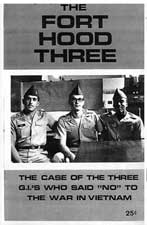
| The first GIs—known as the Fort Hood Three, U.S. Army Privates James Johnson, Dennis Mora and David Samas—refused to be sent to Vietnam. All were members of the 142nd Signal Battalion, 2nd Armored Division stationed at Fort Hood, Texas. The three were from working-class families, and had denounced the war as “immoral, illegal and unjust.” They were arrested, court-martialed and imprisoned. The Pentagon reported 503,926 “incidents of desertion” between 1966 and 1971. |
 |
| 1961-1973: GI resistance in the Vietnam War |
| View their pamphlet |
Ballad
of The Fort Hood Three Pete
Seeger |
|
The 26th Amendment to the U.S. Constitution, lowering the minimum voting age to 18 in all elections, was ratified after ¾ of the 50 state legislatures had agreed to it, a mere 100 days after its
passage by Congress. |
|
The Selective Service law, authorizing the draft, expired, marking the official end of conscription in the U.S. and the beginning of the
all-volunteer armed forces. |
|
| Spain legalized same-sex marriage by a vote of 187-147 in parliament. Such couples were also granted the right to adopt and receive inheritances. Prime Minister Jose Luis Rodriguez Zapatero spoke in support of the bill, “We are expanding the opportunities for happiness of our neighbors, our colleagues, our friends and our relatives. At the same time, we are building a more decent society. |
 |
Read more |
|
June
1 2 3 4 5 6 7 8 9 10 11 12 13 14 15 16 17 18 19 20 21 22 23 24 25 26 27 28 29 30
visit
another month
Jan
• Feb
• March • April
• May • June
• July
• Aug • Sept
• Oct • Nov
• Dec
|
We make custom buttons
your design or ours
email your idea and info |
|
If you are not already on our email list and would like to have our free calendar delivered to your inbox then please . . .
|
 |
Sign up for our
Peace and Social Justice history newsletter.
Just send me an email |
|
|
Please
support this newsletter visit
peacebuttons.info
|
| |
|


 a
young Gandhi
a
young Gandhi


