Four
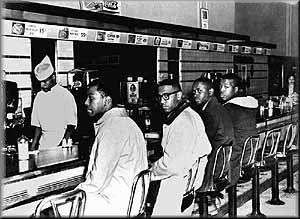
black college students sat in at Woolworth's lunch counter
in Greensboro, North Carolina, where they'd been refused
service, to protest segregation. Similar protests subsequently
took place all over the South and in some northern communities.
By September 1961, more than 70,000 students, whites
and blacks, had participated, and many were arrested,
during sit-ins.
February
1, 1961
On
the first anniversary of the Greensboro sit-in, there
were demonstrations all across the south, including a
Nashville movie theater desegregation campaign (which
sparked similar tactics in 10 other cities). Nine students
were arrested at a lunch counter in Rock Hill, South
Carolina, and chose to take 30 days hard labor on a road
gang. The next week, four other students repeated the
sit-in, also choose jail.
February
1, 1968
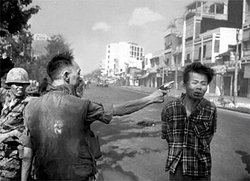
Saigon
police chief Nguyen Ngoc Loan summarily executed Nguyen
Van Lem, suspected leader of a Viet Cong assassination
platoon, with a pistol shot to the head on the street.
AP photojournalist Eddie Adams’s Pulitzer Prize-winning
photograph of the incident became one of the most famous,
ubiguitous and lasting images of the war in Vietnam,
affecting international and American public opinion
regarding the war.
General
Nguyen Ngoc Loan executes Nguyen Van Lem a NLF officer.
February
2, 1779
Anthony
Benezet refused to pay taxes to support the American
Revolutionary War.
read
more about Anthony Benezet
February
2, 1848
The
Treaty of Guadalupe Hidalgo was signed in the city of
the same name ending the Mexican War. In 1845 Congress
had voted to annex Texas, and sent troops to patrol the
border newly defined by the Rio Grande. General Winfield
Scott and troops eventually seized Mexico City.
The treaty’s provisions called for Mexico to cede 55% of its
territory (present-day Arizona, California, New Mexico, and parts of
Colorado, Nevada and Utah) in exchange for fifteen million dollars
in compensation for war-related damage to Mexican property.
February
2, 1931
The
first of well over 400,000 Mexican-Americans from across
the country, many U.S. citizens living here as long as
40 years, were "repatriated" as Los Angeles
Chicanos were deported to Mexico.
February
2, 1932
Conference
on the Reduction and Limitation of Arms, the world’s
first disarmament convention opened in Geneva, Switzerland.
Sponsored by the League of Nations, and attended by delegates
from 60 nations, no agreement was reached. The U.S. delegation
called for the abolition of all offensive weapons as
the basis for the negotiations but found little support.
February
2, 1966
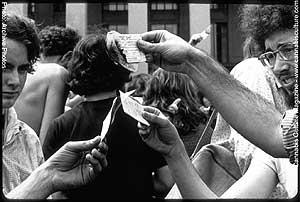
The
first burning of Australian military conscription papers
as a protest against the Vietnam War occurred in Sydney,
Australia.
February
2, 1970
Bertrand
Russell, philosopher of peace, died in Penryndeudreaeth,
Merioneth, at age 97.
February
2, 1980
Reports
surfaced that the FBI had conducted a sting operation
targeting members of Congress using phony Arab businessmen
in what became known as ''Abscam,'' a code name protested
by Arab-Americans.
February
2, 1989
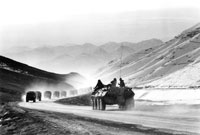
Soviet
participation in the war in Afghanistan ended as Red
Army troops withdrew from the capital city of Kabul.
They left behind many of their arms for use by Afghan
government forces.
February
2, 1990
South
African President F.W. De Klerk unbanned (lifted
the ban on) opposition parties: the African National
Congress (ANC), the Pan-Africanist Congress and the
South African Communist party were now legal. He
also announced the lifting of restrictions on the
UDF, COSATU and thirty-three other anti-apartheid
organizations, as well as the release of all political
prisoners and the suspension of the death penalty.
February
3, 1893
Abigail
Ashbrook of Willingboro, New Jersey refused to pay taxes
because she was denied the right to vote.
February
3, 1964
In
New York City, more than 450,000 students, mostly black
and Puerto Rican and nearly half the citywide enrollment,
boycotted the New York City schools to protest segregation.
February
3, 1988
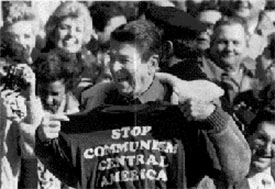
The
U.S. House of Representatives rejected President Ronald
Reagan's request for at least $36.25 million in aid
to the Nicaraguan Contras, a rebel group trying violently
to overthrow the elected Sandinista government.
February
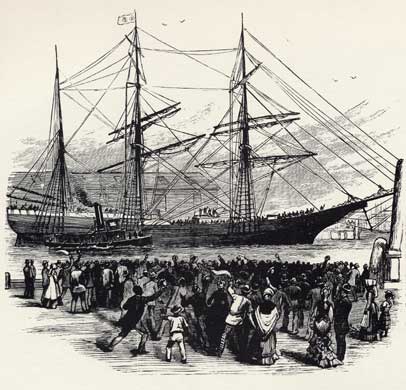
4, 1822
The
American Colonization Society founded the African
state of Liberia in West Africa as a home for freed
U.S. slaves.
read
more
American
Colonization Society ship leaving New York City bound
for Liberia.
February
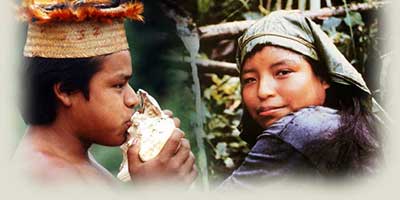
4, 1990
The
Colombian government recognized native rights to half
of its 69,000 square miles of forest in the Amazon River
basin, home to 55,000 indigenous tribal people.
read
more about indigenous U’wa people in Columbia
February
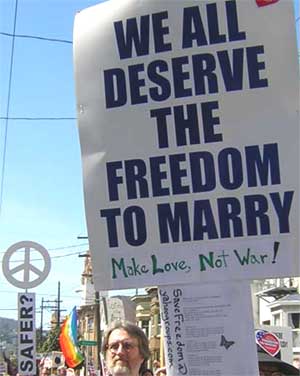
4, 2004
The
Massachusetts Supreme Court declared that gays were
entitled to nothing less than marriage, and that
Vermont-style civil unions would not suffice.
read
more
February
5, 1830
The
first daily labor newspaper, "New York Daily Sentinel," began
publication.
February
5, 1991
49
German troops conscientiously objected to serving in
Turkey during the Gulf War. The German peace movement
actively supported U.S. soldiers stationed there by helping
them file for conscientious objector status.
read
more
February
6, 1943
The
U.S. government required the 110,000 disposessed
Japanese-Americans forcibly held in concentration
(internment) camps to answer loyalty surveys.
February
6, 1956
Autherine
Lucy was excluded from attending classes just three
days after becoming the first black person to attend
the University of Alabama.
Her suspension "for her own safety" followed three days
of riots over her Supreme Court-ordered enrollment. Crows of sudents,
townspeople and members of the Ku Klux Klan shouted “Kill her!” among
other things. It is unclear why the University did not suspend the
students who were among the rioters.
read
more
Autherine
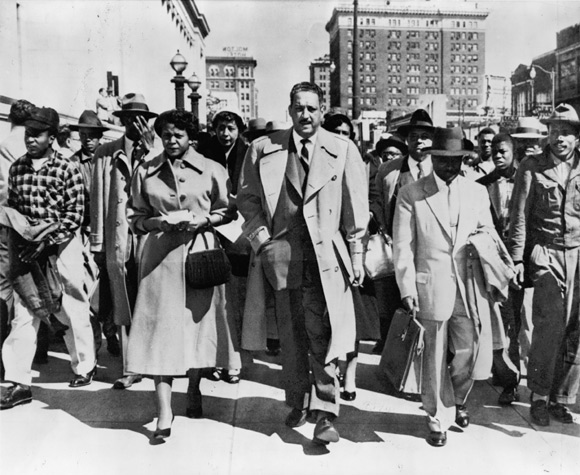
J. Lucy and her attorney Thurgood Marshall
Historical
note: Lucy had originally applied for graduate study in
library science in 1952, and had been accepted until the
University realized her race, and claimed state law prevented
her admission. A graduate of traditionally black Miles
College, she was only admitted with the help of the NAACP
and lawyers Thurgood Marshall (later a Supreme Court justice)
Constance Baker Motley (future federal judge) and Arthur
Shores (elected to Birmingham City Council).
February
6, 1959
The
United States successfully test-fired its first intercontinental
ballistic missile (ICBM), known as Titan, from Cape Canaveral.
It was a two-stage missile also capable of boosting payloads
into space.
February
6, 1961
The
civil rights jail-in movement began when students in
Rock Hill, South Carolina, were arrested and demanded
jail time rather than paying fines.
February
6, 1985
The
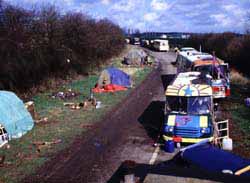
Molesworth Common Peace Camp, just outside the Royal
Air Force Base there, was evicted by the British Army.
The 300 inhabitants and their many supporters were nonviolently
protesting the siting of U.S. cruise missiles at the
base. Peace camps were established at several locations
in Europe in the early 1980s to protest the destabilizing
nuclear weapons buildup.
Molesworth
Common peace camp
February
7, 1926
"Negro
History Week" was observed for the first time, conceived
by Dr. Carter G. Woodson, an an opportunity to study
the history and accomplishments of African-Americans.
Dr. Woodson was the founder, in Chicago in 1915, of the Association
for the Study of Negro Life and History and first published the
Journal of Negro History — a publication still in existence.
Top
L-R: Frederick Douglass, former slave and abolitionist
leader; Muhammad Ali, poet, World Champion, the greatest;
Ruby Dee, actor, author, activist; Malcolm X, strong
and clear-eyed brother seeking freedom and honor and
dignity ; Harriet Tubman, liberator and conductor on
the Underground Railroad. Below: Jimi Hendrix, prolific
guitar genius, rock ‘n’ roll writer; Nat “King” Cole,
jazz composer, pianist and singer; Rev. Martin Luther
King, Jr., pastor, scholar and author, leader of a people,
inspiration to peacemakers.
Woodson
was a graduate of the University of Chicago, the Sorbonne
in France, and was the second black man to receive his
doctorate from Harvard.
He chose February because it is the birth month of both Abraham Lincoln
and Frederick Douglass; now it is considered Black History Month.
read
more about
Dr. Carter G. Woodson
February
7, 1971
Women
in Switzerland were given the right to vote in national
elections and to stand for parliament for the first
time in their nation's history.
February
7, 1986
Haitian
self-appointed President-for-Life Jean-Claude Duvalier
fled his country after being ousted by the military,
ending 28 years of authoritarian family rule.
Policies begun by his father, Francois “Papa Doc” Duvalier,
had forced many to flee Haiti (the western portion of the island of
Hispaniola), leaving it the poorest and most illiterate nation in the
hemisphere.
Jean-Claude
`Baby Doc' Duvalier with his father Francois `Papa
Doc' Duvalier.
February
7, 1991
The
Rev. Jean-Bertrand Aristide was sworn in as Haiti's president
after winning the country’s first-ever democratic
election. Haiti had achieved its independence from France
in 1804 but had a long succession on unstable governments,
as well as significant U.S. control in the first half
of the 20th century, including military occupation from
1915 to 1934.
February
8, 1962
More
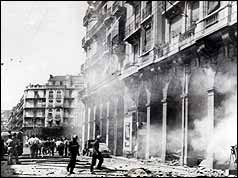
than 20,000 attended a demonstration in Paris against
the Secret Army Organization (Organisation de l'Armée
Secrète or OAS), a group of European Algerians
using terrorist methods to keep Algeria a French colony.
They
set off bombs in Metropolitan France and made multiple
attempts on President DeGaulle’s life. DeGaulle
had chosen a referendum among Algerians to decide their
independence where Europeans were outnumbered 9:1 by
the native Islamic population.
The demonstration was held in violation of a declared state of emergency
(because of OAS actions) and, in the subsequent rioting, at least
eight people were killed and 240 injured (half of them police officers).
February
8, 1968
The
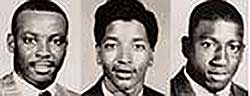
Orangeburg Masssacre
College
students conducted a civil rights protest against a whites-only
bowling alley in Orangeburg, South Carolina. Three black
students were killed and 50 wounded in a confrontation
with highway patrolmen.
read
more
February
8, 1980
President
Jimmy Carter unveiled a plan to re-introduce draft registration.
February
9, 1780
Capt.
Paul Cuffee and six other African-American residents
of Massachusetts petitioned the state legislature for
the right to vote.
A few years earlier Cuffee and his brother had refused to pay local
taxes, reasoning that there was a connection between an obligation
to pay taxes to a government and the right to vote for that government.
Captain Paul Cuffee
February
9, 1950
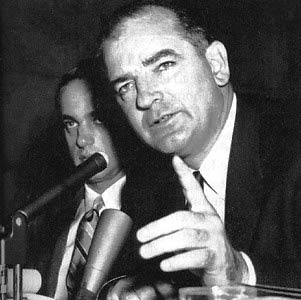
United
States Senator Joseph P. McCarthy (D-WI) accused more than
200 staff members in the State Department of being Communists,
launching his anti-red crusade.
He
made the allegation in a public speech in Wheeling, West
Virginia, saying that State was infested with communists,
and brandished a sheet of paper which purportedly contained
the alleged traitors' names. "I have here in my
hand," he said, "the names of 205 men that
were known to the Secretary of State [Dean Acheson] as
being members of the Communist party and who nevertheless
are still working and shaping the policy of the State
Department." Some years later, he confided the paper
was actually just a laundry list.
The
rebirth of McCarthyism
February
9, 1964
G.I.
JOE action figure made its debut as an 11.5 inch "doll" for
boys with 21 moving parts, named after the movie "The
Story of G.I. JOE."
Puts
you in the action!
February
9, 1965
President
Lyndon Johnson ordered a U.S. Marine Corps Hawk air
defense missile battalion deployed to Da Nang, South
Vietnam, to provide protection for the key U.S. air
base there. American military advisors had been in
country since the retreat of the French in 1954 but
this was the first commitment of combat troops to South
Vietnam.
There was considerable reaction around the world to this new level
of U.S. involvement. Both the People’s Republic of China and
the Soviet Union threatened to intervene if the United States continued
its military support of the South Vietnamese government. In Moscow,
some 2,000 demonstrators, led by Vietnamese and Chinese students
and clearly supported by the authorities, attacked the U.S. Embassy.
Britain and Australia supported the U.S. action, but France called
for negotiations.
February
9, 2002
Ten
thousand, organized by Gush Shalom (the peace bloc in
Hebrew), a coalition of Israeli peace groups, marched
in Tel Aviv against the Ariel Sharon government's increasingly
brutal attacks on Palestinian civilians during the continuing
occupation of territory beyond Israel’s recognized
1967 borders.
February
9, 2003
Six
weeks before the Iraq War began, Secretary of State Colin
Powell said on ABC's This Week dismissed the need for
U.N. weapons inspectors to continue searching Iraq for
weapons of mass destruction.
He
said the administration saw no further need for ''inspectors
to play detectives or Inspector Clouseau running all
over Iraq.'' Clouseau was the bumbling detective played
by Peter Sellers in the Pink Panther films.
U.N.
weapons inspectors, left, and Iraqi National Monitoring
Directorate members visit a Baghdad storage facility
in this photo taken Feb. 5, 2003, just hours before
U.S. Secretary of State Colin Powell appeared at the
U.N. Security Council to offer evidence of alleged
Iraqi attempts to hide banned weapons.
February
10, 1961
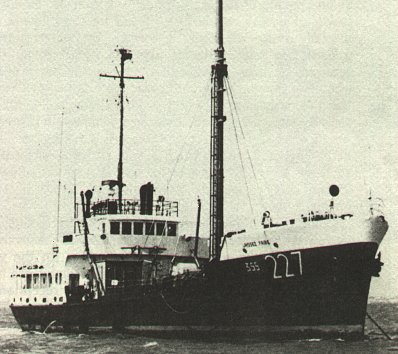
The
Voice of Nuclear Disarmament, a pirate radio station,
began operation offshore of Great Britain.
Pirate
radio ship
February
10, 1964
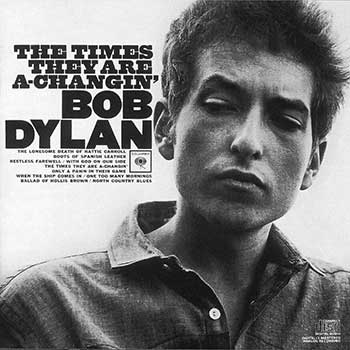
Bob
Dylan's album ''The Times They Are A-Changin’''
was released. The title song captured the emerging, principally
generational gap in American culture concerning war and
racism.
read
the lyrics
February
10, 2003
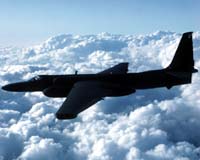
Iraq
acceded to U-2 surveillance flights over its territory,
meeting a key demand by U.N. inspectors searching for
banned weapons of mass destruction (WMD) there. The 60
weapons inspectors were under the U.N. Monitoring, Verification
and Inspection Commission (UNMOVIC), led by Hans Blix,
and the International Atomic Energy Agency.
The
U.N. had destroyed all of Iraq’s banned weapons
by 1994, as well as production and development facilities
later. The embargo during the inter-war period prevented
resumption of the weapons programs. CIA and other intelligence
estimates, however, insisted upon the existence of
WMDs in Iraq. None have ever been found.
U-2
spy plane
February
11, 1790
The
Pennsylvania Society for Promoting the Abolition of
Slavery composed of Quakers and Mennonites petitioned
Congress for the Emancipation of slaves. Benjamin Franklin
had become vocal as an abolitionist and in 1787 began
to serve as President of the Society which not only
advocated the abolition of slavery, but made efforts
to integrate freed slaves into American society.
The resolution was immediately denounced by pro-slavery congressmen
and sparked a heated debate in both the House and the Senate.
more
on early Abolitionist and Anti-Slavery Movements
February
11, 1777
Vermont
became the first state to abolish slavery.
February
11, 1911
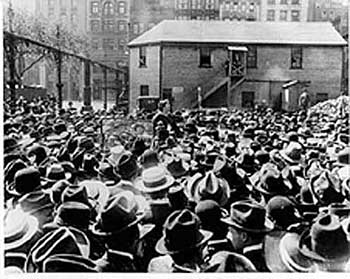
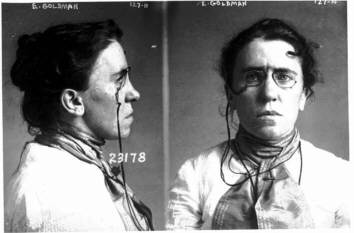
Emma
Goldman was arrested for lecturing on birth control which
violated the 1873 Comstock Law which prohibited the distribution
of literature on birth control.
Goldman
considered this essential to women's sexual and economic
freedom; she had worked as a nurse and midwife among
poor immigrant workers on the Lower East Side in the
1890s. She also organized for womens’ suffrage,
opposed U.S. involvement in World War I and was imprisoned
for obstructing military conscription.
Emma
Goldman speaking on Birth Control -Union
Square, New York City May 20, 1916
read
more
February
11, 1937
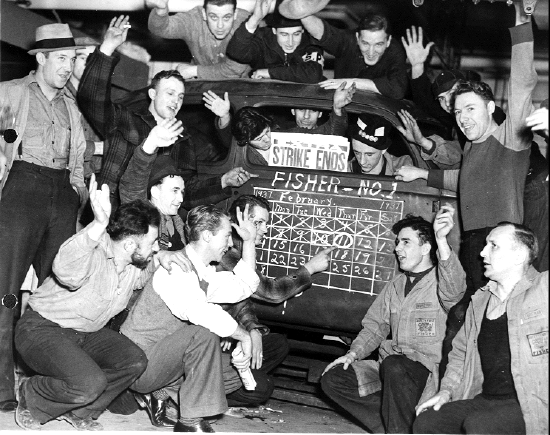
Forty-eight
thousand General Motors workers won a 44-day sit-down
strike in Flint, Michigan. On December 30 workers at
Fischer Plants 1 & 2 sat down andrefused
to leave, forcing workers around them to stop work
and preventing the next shift from starting.
The
sit-down strike ended when the company agreed to recognize
the United Automobile Workers union as the representative
bargaining agent for the hourly employees. Other automakers
gradually accepted the legitimacy of the union. The
success of the sit-down was an inspiration to workers
in other industries to organize their own unions.
read
more
February
11, 1978
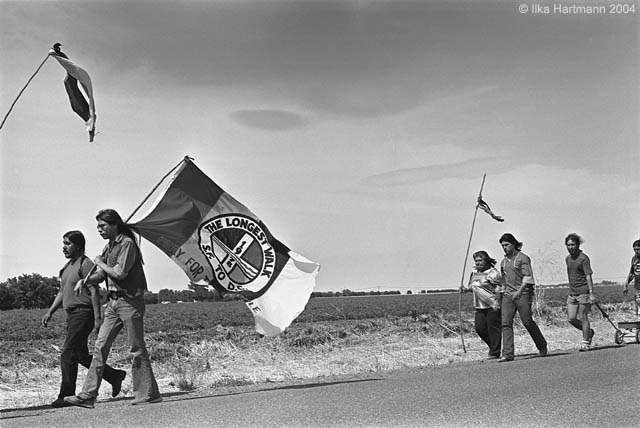
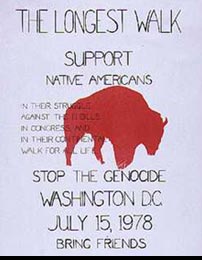
Native
Americans began The Longest Walk, a march from Alcatraz
Island in San Francisco to Washington, DC.
The
walk was a reminder of the forced removal of American
Indians from their homelands across the continent and
drew attention to the continuing problems plaguing the
Indian community.
February
11, 1979
Poet
John Trudell, a former national chairman of the American
Indian Movement (AIM), burned an upside-down flag on
the steps of the FBI building in Washington, D.C. during
a vigil for Leonard Peltier. Peltier, also a leader
of AIM, was in prison (and still today after 27 years),
and considered a political prisoner by Amnesty International.
Twelve hours later his wife Tine, her mother, and their three children
died in an arsonist's attack on their home on the Duck Valley Reservation
in Nevada. The FBI did not investigate even though the crime fell
under its jurisdiction.
Learn
about Leonard Peltier
February
11, 1990
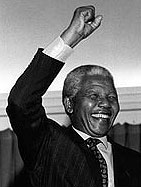
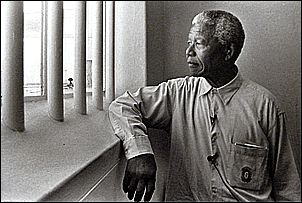
Nelson
Mandela was freed after 27 years in a South African
prison following months of secret negotiations with
South African President F.W. (Frederik Willem) de Klerk.In
1952, Mandela became deputy national president of the
African National Congress (ANC), the oldest black political
organization in South Africa, having joined as a young
lawyer in 1944.
He advocated nonviolent resistance to apartheid – South Africa's
institutionalized system of white supremacy, black disenfranchisement
and rigid racial segregation.
However,
after the massacre of peaceful black demonstrators at
Sharpeville in 1960, Mandela helped organize a paramilitary
branch of the ANC to engage in guerrilla warfare against
the white minority government.
He and deKlerk were jointly awarded the Nobel Peace prize in 1993 "for
their work for the peaceful termination of the apartheid regime, and
for laying the foundations for a new democratic South Africa.”
read
more
February
12, 1909
The
National Association for the Advancement of Colored People
(NAACP) was founded by sixty blacks and whites in a call
to safeguard civil, legal, economic, human, and political
rights of black Americans partly in reaction to a race
riot in 1908 in Springfield, Illinois, home of Abraham
Lincoln. The call was principally written by Oswald Garrison
Villard, president of the N. Y. Evening Post Company,
and published on Lincoln’s Birthday.
Read
the call to action and the signatories:
February
12, 1947
An
estimated 400-500 veterans and conscientious objectors
from World Wars I and II burned their draft cards during
two demonstrations, in front of the White House and
at New York City’s Labor Temple, in protest of
a proposed universal conscription law. This was the
first peacetime draft card-burning.
February
12, 1993
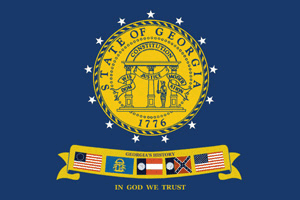
About
5,000 demonstrators marched on Atlanta's State Capitol
to protest the Georgia state flag because its principal
element was the Confederate battle flag(on left). That
flag was adopted in 1956 by the state legislature in
reaction to the Supreme Court decision of Brown v. Board
of Education ordering the racial integration of public
schools. Several newspaper editorials opposed the flag
as well as 18 local patriotic organizations, including
the United Daughters of the Confederacy, stating the
flag "would cause strife."
In
2001 the Georgia state flag was redesigned, shown on
bottom.
February
12, 1997
In "Prince
of Peace Plowshares," six activists poured blood
and symbolically disarmed the U.S.S. The Sullivans, a
nuclear-capable Arleigh Burke-class destroyer, at the
Bath Iron Works in Bath, Maine. All were eventually convicted
of destruction of government property and conspiracy.
read
more
February
13, 1960
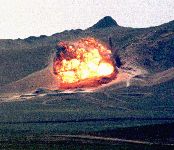
France
became the world’s fourth nuclear power, conducting
its first plutonium bomb at the Reggane base in the
Sahara Desert in what was then French Algeria. It was
detonated from a 330-foot tower and had a yield of
60-70 kilotons.
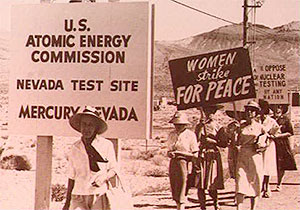
February
13, 1967
Carrying
huge photos of Vietnamese children who had been victims
of Napalm (a flammable defoliant), 2,500 members of the
group Women Strike for Peace stormed the Pentagon, demanding
to see "the generals who send our sons to Vietnam." When
Pentagon guards locked the main entrance doors, the women
took off their shoes and banged on the doors with their
heels. They were eventually allowed inside, but Defense
Secretary Robert McNamara would not meet with them.
They
were eventually allowed inside, but Defense Secretary
Robert McNamara would not meet with them.
Sen.
Jacob Javits (R-NY) agreed to meet a few hundred of
the women, but he was booed by the women when he denied
the U.S. was using toxic gas in Vietnam.
February
13, 1968
Five
soldiers were arrested at a pray-in for peace in Vietnam
at Fort Jackson, South Carolina.
February
13, 1971
Two
precision-guided missiles destroyed the Amirayah subterranean
bunker in Baghdad being used as an air-raid shelter by
408 Iraqi civilians during the first Gulf War.
The deaths of all made it the single most lethal incident for non-combatants
in modern air warfare. 3% of the the 250,00 bombs and missiles fired during
that conflict were considered such “smart bombs.”
The
U.S. had detected signals coming from the bunker and considered
it a military command and control center. There was an
antenna atop the bunker but it was connected by cable to
the actual command center 300 yards away, which was not
hit by the 2000 lb. bombs which landed precisely on their
intended target, penetrating ten feet of hardened concrete.
February
14, 1957
The
organization that would shortly be called the Southern
Christian Leadership Conference (SCLC) chose its leadership
at a meeting in New Orleans. Rev. Martin Luther King, Jr.
and Rev. Ralph David Abernathy led the group which sought
to coordinate civil rights protests throughout the South.
Organizers of bus boycotts inspired by Montgomery, Alabama’s, had
met in Atlanta a month earlier. During that meeting Dr. Abernathy’s
home and church were bombed.
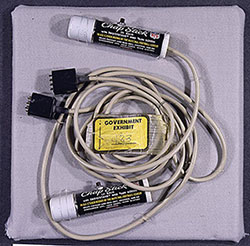
February
14, 1971
President
Richard Nixon ordered a secret taping system in his offices
in the White House.
read
more
Government
Exhibit 133: Chapstick Tubes
with
Hidden Microphones, ca. 1972
February
14, 1989
At
a meeting of the presidents of Nicaragua, Honduras, Guatemala,
Costa Rica, and El Salvador, the leftist Sandinista government
of Nicaragua agreed to release a number of political prisoners
and hold free elections within a year. In return, Honduras
promised to close bases being used by the anti-Sandinista
Contra rebels. Within a year, elections in Nicaragua resulted
in the defeat of the Sandinistas, removing what President
Ronald Reagan’s administration referred to as a "beachhead
of communism" in the Western Hemisphere.
February
15, 2002
President
George W. Bush approved Nevada's Yucca Mountain as
the site for long-term disposal of 77,000 tons of highly
radioactive nuclear power plant waste. 12 years and
$6.8 billion worth of study and construction had gone
into the site 90 miles from Las Vegas.
2000
additional tons of such waste are generated by U.S.
nuclear power plants each year.
February
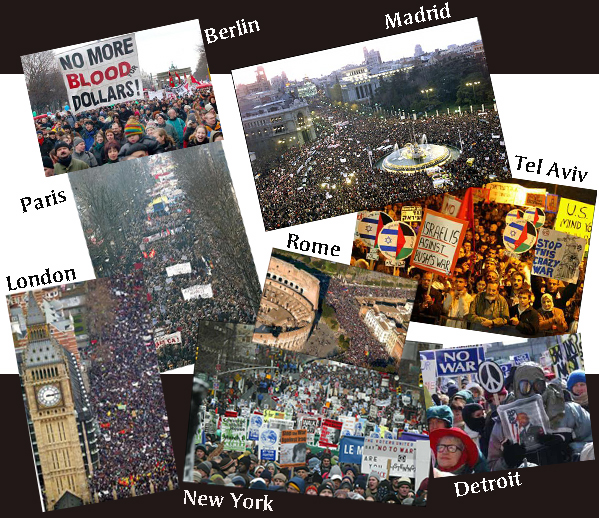
15, 2003
The
world said NO to war...
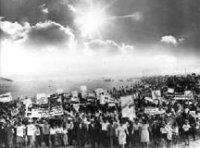
In
the single largest day of protest in world history, millions
on 6 continents demonstrated against the U.S./U.K. plans
to invade Iraq. Reported totals included 1 to 2 million
in London and Rome; 1.3 million in Barcelona, Spain (a
city of 1.5 million); 500,000 each in Berlin, Paris,
Madrid, and New York.
Smaller demonstrations were held in over 600 cities and towns across
the US, including tens of thousands in several cities,
and 150,000 the following day in San Francisco.
Totals estimated 25 million in more than 100 countries.
February
16, 1959
Fidel
Castro
Fidel
Castro was sworn in as Cuba’s youngest prime minister
after leading a years-long guerrilla campaign that forced
right-wing dictator Fulgencio Batista into exile. Castro,
who had become commander-in-chief of Cuba's armed forces
after Batista was ousted on January 1, replaced the more
moderate Jose Miro Cardona as head of the country's new
provisional government.
read
more
Fulgencio
Batista
February
16, 1962
First
of two days on which Boston SANE (Organization for a Sane
Nuclear Policy) and the newly formed Students for a Democratic
Society (SDS) held an anti-nuclear march on Washington;
4,000-8,000 participated.
February
16, 1996
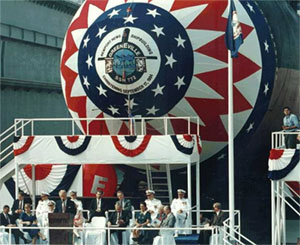
Seven
activists were arrested for blocking the road to the
ceremony commissioning the nuclear warship U.S.S. Greeneville
at the Norfolk (Virginia) Naval Base.
February
16, 2005
The
Kyoto Protocol went into effect after countries representing
55% of the world’s greenhouse gas (GHG) emissions
had ratified the treaty, after Russia signed on. The agreement’s
purpose is to reduce such gases to 12% below their levels
in 1990 by 2012 and, thus, slow global warming.
180
countries had agreed (except for the United States and
Australia) to rules for implementing the Kyoto Protocol
on July 29, 2001, in Bonn, Germany. Pres. G.W. Bush withdrew
the U.S. from the process shortly after he took office.
The U.S. is responsible for 25% of the earth’s
GHG, and has increased its emissions (13.4 percent higher
in 2004).
read
more
February
17, 1958
The
first meeting of Britain's Campaign for Nuclear Disarmament
(CND) was held.
the
CND today
original
CND logo
February
17, 1975
Several hundred residents of Wyhl, Germany, occupied the construction
site of a nuclear power plant with the intent of halting construction.
Police responded with water cannon and arrests. By the following
week, 28,000 had joined the occupation. This is believed to have
been the first such plant occupation in the world.
February
18, 1688
Pennsylvania
Quakers made first formal protest against slavery.
From their proclamation "...we shall doe [sic] to all men like as
we will be done ourselves; making no difference of what generation, descent
or colour they are."
read
more
February
18, 1961
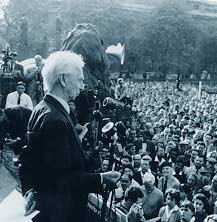
In
London, Bertrand Russell, 88, led a march of 20,000 and
sit-down of 5,000 in an anti-nuke rally outside U.K.
Defense Ministry and was jailed for seven days. It was
the first public demonstration organized by the Committee
of 100, the direct action wing of the Committee for Nuclear
Disarmament.
the
CND today
<Bertand
Russell addresses demonstration
early
CND demonstator>
February
18, 1970
Five
of the "Chicago Seven" (Rennie Davis, David Dellinger,
Tom Hayden, Abbie Hoffman, and Jerry Rubin) were found
guilty of crossing state lines to incite a riot at the
1968 Democratic convention.
John
Froines and Lee Weiner had both been charged withy
making incendiary devices (stink bombs) but were found
not guilty as well. None of the seven were found guilty
of conspiracy. Attorneys William Kunstler and Leonard
Weinglass were sentenced for contempt of court. All
appealed.
read
more
The
Chicago Seven
February
19, 1919
The
first Pan-African Congress was organized by W.E.B. DuBois
in Paris, France to coincide with the Versailles Peace
Conference after World War I.
The Congress’s aim was to bring to the attention of those laying
the plans for a League of Nations the grievances of oppressed minorities.
DuBois
was a moving spirit behind the growing struggle for self-determination
among Africans, both on the continent and in the diaspora,
and the Pan-African Congresses helped to bring the issues
of this struggle to world attention. The Pan-African
Congress was re-convened in 1921, 1923, 1927, and 1945.
read
more about W.E.B. DuBois
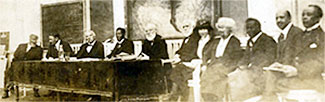
Speakers
at the Pan-African Congress
Brussels,
Belgium, in 1921.
Du
Bois is 2nd from right.
February
19, 1942
Executive
Order 9066 was signed by President Franklin D. Roosevelt
10 weeks after the Japanese attack on Pearl Harbor, ordering
all Japanese Americans (Nisei) evacuated from the West Coast
of the U.S. and forcing them to live in concentration camps.
The
document authorized the Secretary of War and military
commanders “to prescribe military areas...from
which any or all persons may be excluded.”
There was strong support from California Attorney General Earl Warren
(later U.S. Supreme Court Chief Justice), liberal journalist Walter Lippmann
and Time magazine—which referred to California as "Japan's
Sudetenland"
112,000 citizens of Japanese ancestry were relocated, losing their businesses,
homes, and belongings to whites.
read
more
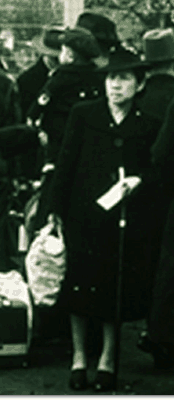
Japanese
American residents board the bus for Camp Harmony, 1942.
Note:
In the entire course of the war, 10 people were convicted
of spying for Japan, all
of whom were Caucasian.
This
day is referred to as the "Day of Remembrance.” It
has been commemorated every year, for 65 years to remind
us of that miscarriage of justice, and to ensure such things
do not happen again.
February
19, 1972
Paul
McCartney's song, "Give Ireland Back to the Irish," was
immediately banned from airplay by the BBC.
February
19, 2004
After
sanctioning more than 2,800 gay marriages, the city of
San Francisco sued the state of California, challenging
its ban on same-sex marriages.
read
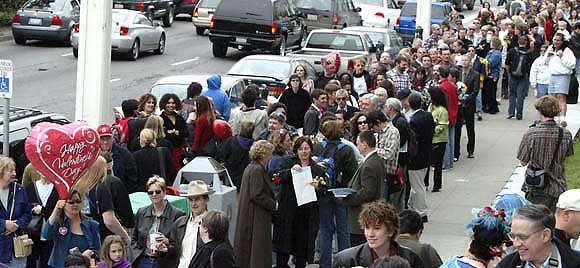
more
San
Francisco City Hall is almost encircled by wedding parties
on Valentine's Day.
February
20, 1942
The
vast majority of teachers in German-occupied Norway refused
to comply with the forced Nazification of the school system.
The government had ordered the portrait of Vidkun Quisling
hung in all classrooms, instruction and textbooks to reflect
Nazi ideology, and teaching of German to replace English
as their second language.
The
teachers organized and 12,000 of 14,000 nationwide wrote
the same letter on this day to the education department
refusing membership in the newly formed Nazi teachers’ association.
Two days later clergy throughout the country read a manifesto
against Nazi control of the schools.
read
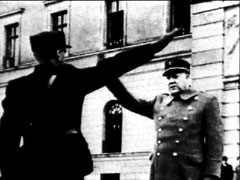
more
Vidkun
Quisling (on right), Germany’s puppet leader in
Norway,
allowed Germany to invade his country and declared himself Prime Minister.
In
Norway his name has become synonymous with traitor.
February
20, 1956
The
U.S. rejected a Soviet proposal to ban nuclear weapons
tests and deployment.
February
21, 1848
Friedrich
Engels Karl
Marx
“The
Communist Manifesto,” written by 29-year-old Karl
Marx with the assistance of Friedrich Engels, was published
in London (in German) by a group of German-born revolutionary
socialists known as the Communist League. The political
pamphlet—arguably the most influential in history—proclaimed
that "the history of all hitherto existing society
is the history of class struggles" and the inevitable
victory of the proletariat, or working class, would put
an end to class society forever.
February
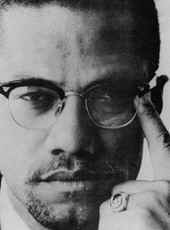
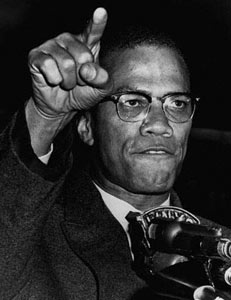
21, 1965
Malcolm
X, an African-American nationalist and religious leader,
was shot and killed by rival Black Muslims in New York
City, as he was about to address his Organization of
Afro-American Unity at the Audubon Ballroom in New York
City’s Washington Heights. He was 39.
more
on Malcolm X
Malcolm & Martin: “In
1964, after his break with Nation of Islam leader Elijah
Muhammad, and following his trips to Africa and
to Mecca, Malcolm was seriously questioning black nationalism.
He was also beginning to recognize that MLK’s non-violent
methods, far from being passive, were actually creating
more change than the separatism of the Nation of Islam.
In this same period MLK was beginning to recognize that Malcolm was advocating
self-defense, not violence.
In March Malcolm and Martin encountered one another by chance at a news
conference in Washington, D.C. Subsequently Malcolm spoke at several
rallies in support of the civil rights movement, and in February 1965,
two weeks before his assassination, he went to Selma to meet with King." –Grace
Lee Boggs
"You
can’t separate peace from freedom because no
one can be at peace unless he has his freedom."
--"Prospects
for Freedom in 1965," speech, January 7 1965.
February
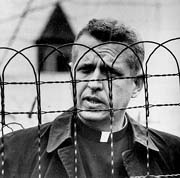
21, 1972
The
trial began for Father Philip Berrigan and six other
activists (the "Harrisburg Seven") in Pennsylvania.
They were charged with conspiring in an alleged plot
to kidnap Secretary of State Henry Kissinger. Proceedings
later ended in a mistrial.
more
about Fr. Philip Berrigan
February
21, 1975
Former
Attorney General John N. Mitchell and former White House
aides H.R. Haldeman and John D. Ehrlichman were sentenced
to 2 1⁄2 to 8 years in prison for their roles in
the Watergate cover-up.
February
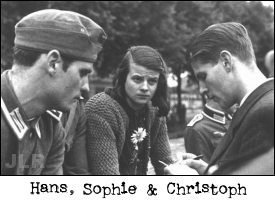
22, 1943
Sophie
Scholl, a 22-year-old "White Rose" activist
at Munich University, was executed after being convicted
of urging students to rise up and overthrow the Nazi
government.
There are many memorials in Bavaria
and Germany to Sophie and her group, the White
Rose, but little is known outside of Germany.
They were medical students who organized nonviolent
resistance to Hitler. They were arrested for
printing and distributing anti-Nazi flyers. Sophie,
her brother Hans, and Christof Probst, the three
young people in the photo, were executed. Few
White Rose members survived the war which is
why the story is not well known.
read
about the movie
In
2005 a newer film SOPHIE SCHOLL-THE FINAL DAYS was nominated
for an Academy Award for Best Foreign Language Film
read more watch
the trailer
February
22, 1967
Elected
Indonesian President Sukarno surrendered all executive
authority to military dictator General Suharto, remaining
president in title only.
Suharto
launched a purge of Indonesian communists that resulted
in thousands of deaths. In 1967 he assumed full power,
and in 1968 was elected president. He was also responsible
for Indonesia's 1975 invasion of East Timor, which left
an estimated 100,000 Timorese dead from famine, disease,
and warfare. General
Suharto
February
22, 1974
Sam
Lovejoy toppled the weather tower for a proposed nuclear
power plant in Montague, Massachusetts. This was the
first act of civil disobedience against nuclear power
in the U.S.
read
more
Sam
Lovejoy
February
22, 1997
Nearly
35,000 marched in Paris against a new anti-immigration
bill. Many of the demonstrators chanted "First, second
or third generation, we are all children of immigrants." Another
5,000 movie directors, writers, painters, actors, translators,
journalists and teachers signed petitions pledging civil
disobedience.
February
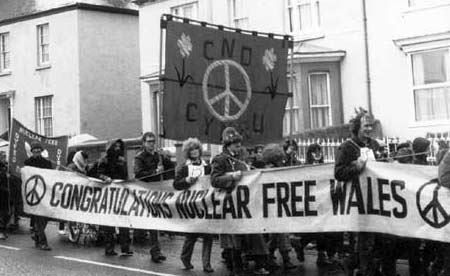
23, 1982
Wales
declared itself a nuclear-free zone.
read
more
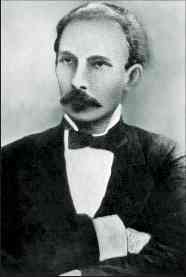
February
24, 1895
José Martí,
a Cuban revolutionary, poet, journalist and teacher began
the liberation struggle against Spanish control. He had
been forced out of Cuba repeatedly (to Spain) for his
opposition to colonial rule, and spent 15 years in the
U.S. organizing the revolution just before returning
home.
I
Cultivate a White Rose
By José Martí I cultivate a white rose
In July as in January
For the sincere friend
Who gives me his hand frankly.
And for the cruel person who tears out
the heart with which I live,
I cultivate neither nettles nor thorns:
I cultivate a white rose.
read
about Jose Marti
February
24, 1965
District
1199 of the health care workers’ union (Service
Employees International Union) in New York City became
the first U.S. labor union to officially oppose the war
in Vietnam.
February
24, 1972
Daniel
Berrigan (part of the "Catonsville 9") was released
after 18 months of a three-year term. He went to Harrisburg,
Pa., where his brother Phil Berrigan was on trial, also
for anti-Vietnam War activities.
February
24, 1983
A
congressional commission released a report condemning the
internment of Japanese-Americans during World War II, calling
it a "grave injustice."
February
25, 1941
A
general strike was called in Amsterdam to protest Nazi
persecution of Jews under the German Nazi occupation.
Truck
drivers, dock and metal workers, civil servants and factory
employees — Christians, Liberals, Social Democrats
and Communists — answered the call and brought the
city to a standstill. The work stoppages spread to Zaanstreek,
Kennemerland and Utrecht.
Two days later the strike was called off: nine people were dead, 50 injured
and another 200 arrested, some of whom were to die in the concentration
camps.
read
more (pdf)
February
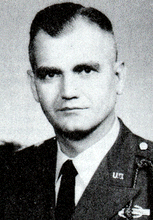
25, 1968
Discussing
the war capacity of North Vietnam, a country that had
been fighting for 23 years and had just staged the
massive, successful Tet Offensive, U.S. General William
C. Westmoreland stated, "I do not believe Hanoi
can hold up under a long war."
General
Westmoreland
February
25, 1971
Legislation
was introduced in both houses of Congress to forbid U.S.
military support of any South Vietnamese invasion of
North Vietnam without congressional approval. This bill
was a result of the controversy that arose following
the invasion of Laos by South Vietnamese forces. On February
8, South Vietnamese forces had launched a major cross-border
operation into Laos to interdict the Ho Chi Minh Trail
and destroy the North Vietnamese supply dumps in the
area.
February
25, 1972
Paul
McCartney
Paul
McCartney's song, "Give Ireland Back to the Irish," was
released and immediately banned from airplay by the BBC.
read the lyrics
February
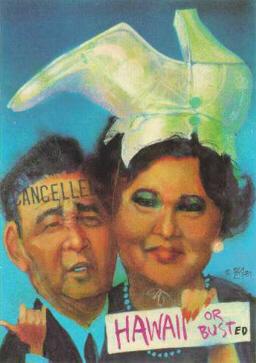
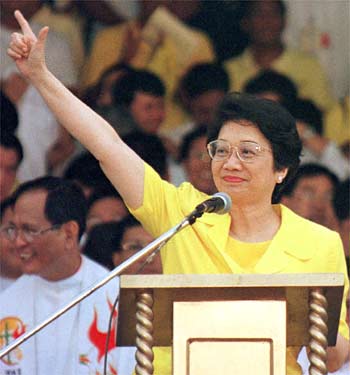
25, 1986
The
new Philippines president Corazon Aquino was sworn in,
bringing to an end years of dictatorship under Ferdinand
Marcos. In the face of massive demonstrations against his
rule, Philippines President Ferdinand Marcos and his entourage
were airlifted from the presidential palace in Manila by
U.S. helicopters.
Elected
in 1966, Marcos had declared martial law in 1972 in
response to leftist violence. In the next year, he
assumed dictatorial powers. Backed by the United States,
his regime was marked by misuse of foreign financial
support, repression, and political murders. In 1986,
Marcos defrauded the electorate in a presidential election,
declaring himself the victor over Corazon Aquino, the
wife of an assassinated rival. Aquino also declared
herself the rightful winner, and the public rallied
behind her.
read
more
Corazon
Aquino
Ferdinand & Imelda
Marcos
February
26, 1966
Julian
Bond
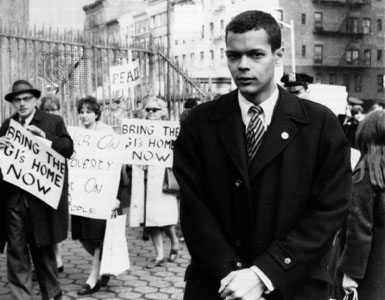
Four
thousand picketed outside New York's Waldorf-Astoria
Hotel as President Lyndon Johnson received the National
Freedom Award. As Johnson began his speech in defense
of his Vietnam policies, James Peck of the War Resisters
League jumped to his feet and shouted, "Mr. President,
peace in Vietnam!" On the streets, meanwhile, activist
A.J. Muste presented the crowd's own "Freedom Award" to
Julian Bond, who had been denied his seat in the Georgia
legislature for refusing to disavow his opposition to
the war, and for his support of the Student Non-Violent
Coordinating Committee.
February
26, 1984
The
last of the peacekeeping troops President Ronald Reagan
had sent to the Lebanese capital of Beirut were evacuated.
The president withdrew almost all American troops following
the deaths of 241 Marines and others in a suicide truck
bombing carried out four months earlier by forces supported
by Islamic Revolutionary Guards.
read
more
February
26, 1998
An
international weapons inspection team, including Canadian
Member of Parliament Libby Davies, was not allowed entry
to determine the presence or absence of weapons of mass
destruction at the Bangor, Washington, nuclear submarine
base.
read
more
Libby
Davies
February
27, 1939
Flint
sit-down strikers, 1937
The
Supreme Court outlawed sit-down strikes in its decision,
NLRB v. Fansteel Metallurgical Corp. Such strikes had become
a very effective strategy employed by workers to organize
unions. The 1937 Flint sit-down strike of autoworkers at
General Motors forced GM to recognize and negotiate with
the United Auto Workers as the union representing its hourly
employees.
More
about the decision:
February
27, 1973
Hundreds
of Oglala Sioux and members of the American Indian Movement
(AIM) occupied the village of Wounded Knee, South Dakota.
Angered over a long history of violated treaties, mistreatment
and discrimination, and in response to a recent campaign
of harassment and violence by tribal and FBI officials,
they chose the site of the 1890 massacre of Sioux men,
women and children. The occupation lasted until May.
AIM
leader Russell Means on Wounded Knee
February
28, 1919
Mohandas
Gandhi launched his campaign of non-cooperation with
Imperial British control of India. He called his overall
method of non-violent action Satyagraha, formed from
satya (truth) and Agraha, used to describe an effort
or endeavor. This translates roughly as "Truth-force." A
fuller rendering, though, would be "the force that
is generated through adherence to Truth."
Gandhi, 1919
February
28, 1946
Ho
Chi Minh, the leader of the newly formed Democratic Republic
of Vietnam, facing reimposition of French colonial rule
over his country, sent a telegram to Pres. Harry Truman: “...I
most earnestly appeal to you personally and to the American
people to interfere urgently in support of our independence
and help making the negotiations more in keeping with the
principles of the Atlantic and San Francisco charters [founding
documents of the League of Nations and United Nations].”
February
28, 1958
The
Campaign for Nuclear Disarmament (CND) was founded in
London by philosopher Bertrand Russell,
then 86 years old, and the Rev. Canon (Lewis)
John Collins.
The
peace symbol was originally developed for CND.
history
of the CND
the
CND today
February
28, 1989
The
Nevada-Semipalatinsk Movement to Stop All Nuclear Testing
was founded in the USSR. Oleg Suleimenov, a popular Kazakh
poet, was chosen to lead this first anti-nuclear non-governmental
organization on the territory of the former USSR. Nevada-Semipalatinsk
ended nuclear arms tests at the Semipalatinsk Polygon.
Organizers had been inspired by the large Nevada Test
Site anti-nuclear demonstrations and encampments outside
Las Vegas in the mid-to-late 1980s.
read
more
a
Semipalatinsk test
demo
at Semipalatinsk, 1990
February
29, 1968
The
National Advisory Commission on Civil Disorders (Kerner
Commission) warned that racism was causing America to move "toward
two societies, one black, one white – separate but
unequal."
This
Week In History compiled by peacebuttons.info from various
sources
which are available upon request.
Submissions are always welcome. Please furnish sources. cb@peacebuttons.info
Reproduction
of this calendar for non-profit purposes
is permitted and encouraged. Please credit/link to www.peacebuttons.info








 Top
L-R: Frederick Douglass, former slave and abolitionist
leader; Muhammad Ali, poet, World Champion, the greatest;
Ruby Dee, actor, author, activist; Malcolm X, strong
and clear-eyed brother seeking freedom and honor and
dignity ; Harriet Tubman, liberator and conductor on
the Underground Railroad. Below: Jimi Hendrix, prolific
guitar genius, rock ‘n’ roll writer; Nat “King” Cole,
jazz composer, pianist and singer; Rev. Martin Luther
King, Jr., pastor, scholar and author, leader of a people,
inspiration to peacemakers.
Top
L-R: Frederick Douglass, former slave and abolitionist
leader; Muhammad Ali, poet, World Champion, the greatest;
Ruby Dee, actor, author, activist; Malcolm X, strong
and clear-eyed brother seeking freedom and honor and
dignity ; Harriet Tubman, liberator and conductor on
the Underground Railroad. Below: Jimi Hendrix, prolific
guitar genius, rock ‘n’ roll writer; Nat “King” Cole,
jazz composer, pianist and singer; Rev. Martin Luther
King, Jr., pastor, scholar and author, leader of a people,
inspiration to peacemakers.















 Fidel
Castro
Fidel
Castro