May Day also became known as International Workers’
Day in 1886 when 340,000 went on strike for the 8-hour work
day.
May
1, 1890 May Day labor demonstrations spread to thirteen other
countries; 30,000 marched in Chicago as the newly prominent
American Federation of Labor threw its weight behind the 8-hour
day campaign.
May
1, 1933
The
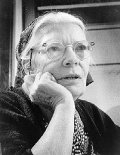
Catholic Worker newspaper was founded by Dorothy Day and Peter
Maurin.
"God meant things to be much easier than we have made
them." -Dorothy Day
Peter
Maurin wanted to build a society "where it is easier
for people to be good."
read
more about the Catholic Worker
May
1, 1967
Soviet
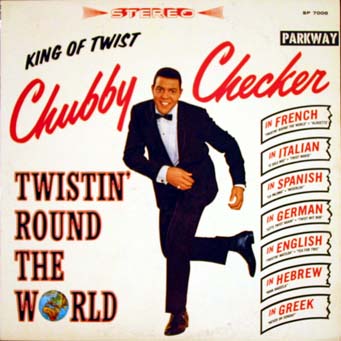
youths openly defied police & danced the twist
in Moscow's Red Square during May Day celebrations.
read
more
In
the early 60s the Twist had been banned in Buffalo, NY and
Tampa, FL
The religious right claimed the Twist was actually a pagan
fertility dance.
Are
you old enough to remember Chubby Checker?
May
1, 1977
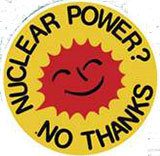
Following
a 24-hour occupation at the site of two proposed nuclear power
plants in Seabrook, New Hampshire, 1,414 people were arrested.
The non-violent civil disobedience, organized by the Clamshell
Alliance, became a model for anti-nuclear direct actions across
the country. National and international news coverage brought
the issue of nuclear power into public focus and no nuclear
reactors were ordered after that time.
The
ones in the pipeline eventually went online, including Seabrook
Unit I, but Unit 2 was never built.
There is still no permanent method for long-term safe storage
of highly radioactive waste generated by these plants. Most
of the radioactive isotopes in high-level waste emit large
amounts of radiation and have extremely long half-lives (some
longer than 100,000 years). Currently, it is stored on-site
at nuclear plants around the country.
read more
May
1, 1986
One
million South Africans demonstrated their opposition to apartheid
in a strike organized by the Congress of South African Trade
Unions (COSATU).
read
more about COSATU
May
1, 2003
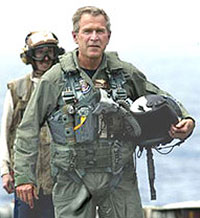
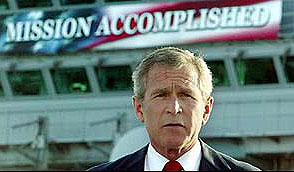
President
George W. Bush landed in a jet on the aircraft carrier USS
Abraham Lincoln off the California coast and, in a speech
to the nation, declared major combat in Iraq over. The banner
his staff posted on the ship read “Mission Accomplished.”
Since
that presidential declaration more than 2000 Americans and more
than 30,000 Iraqis have lost their lives, in addition to the
tens of thousand of others injured in the hostilities.
<Iraq
body count read more
Cost of War>
May
2, 1968
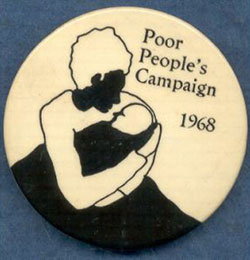
The Poor People's Campaign began with groups from several
locations around the U.S. setting out for Washington, DC,
to draw attention to the conditions of poor people in the
United States. Conceived and organized by Rev. Martin Luther
King, Jr., and despite his murder the previous month, it was
led by his successor at the head of the Southern Christian
Leadership Conference (SCLC), Rev. Ralph David Abernathy.
read
more
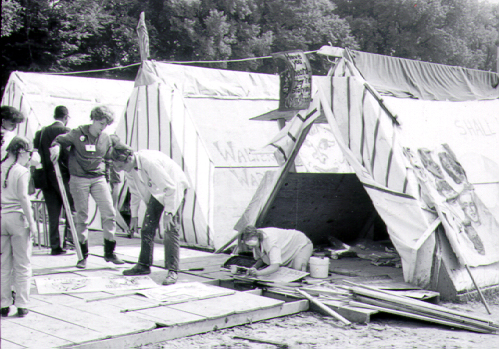
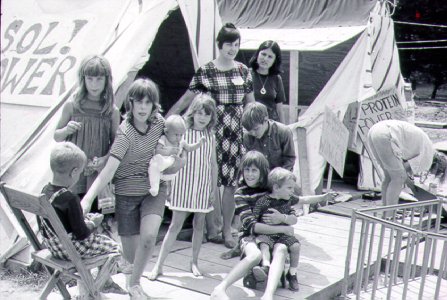
The
first wave of demonstrators arrived in Washington on May 12.
One
week later, Resurrection City was built on the Washington
Mall, a settlement of tents and shacks to house the protesters.
watch
a video about poverty in our country today
Resurrection
City
May
3, 1971
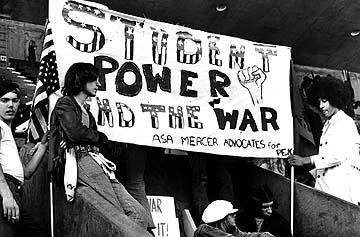
The Nixon administration ordered the arrest of nearly 13,000
anti-war protesters calling themselves the Mayday Tribe who
began four days of demonstrations in Washington, DC, on the
first. They aimed at shutting down the nation's capital by
disrupting morning rush-hour traffic and other forms of non-violent
direct action, skirmishing with metropolitan police and Federal
troops throughout large areas of the capital. The slogan of
the Mayday tribe: "If the government won't stop the war,
we'll stop the government."
May
3, 1971
The
first broadcast of National Public Radio’s evening news
and public affairs program, "All Things Considered,"
was aired on NPR affiliates around the country.
May
3, 1980
Sixty-thousand marched on the Pentagon to urge the end to U.S.
military involvement in El Salvador.
May
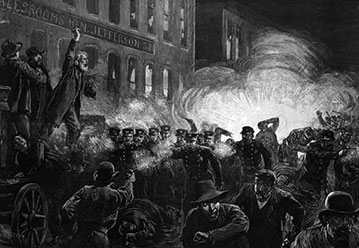
4, 1886
At Haymarket Square in Chicago, a labor demonstration for
an eight-hour workday turned into a riot when a bomb exploded.
A mass meeting had been called for that night when a large
force of 176 police officers arrived with a demand that the
meeting disperse. Someone, unknown to this day, then threw
a bomb at the police. In their confusion, the police began
firing their weapons in the dark, killing at least four in
the crowd and wounding many more. Several police died (only
one by the bomb), the rest probably by police fire.
read
more
May
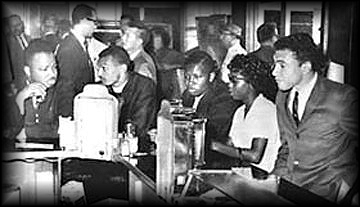
4, 1961
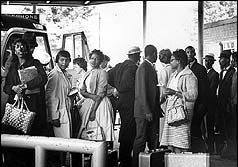
A group of Freedom Riders left Washington, DC for New Orleans
in a first challenge to racial segregation on interstate buses
and in bus terminals; it was organized by the Congress of
Racial Equality (CORE).
read more about the freedom riders
The
Freedom Riders dining at a lunch counter in Montgomery before
traveling to Jackson, Mississippi and New Orleans, Louisiana.
May
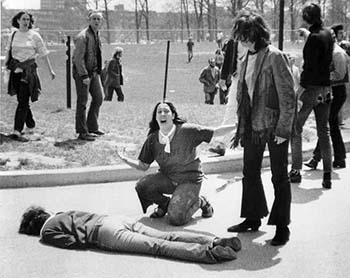
4, 1970
Ohio National Guard troops opened fire on anti-war protesters
at Kent State University, killing four students and wounding
nine others. The previous day, President Nixon had announced
a widening of the Vietnam War with bombing in neighboring
Cambodia. There were major campus protests around the country
with students occupying university buildings to organize and
discuss the war and other issues.
read
more
May
5, 1969
Draft resisters publicly burned 231 military induction orders
in Los Angeles.
May
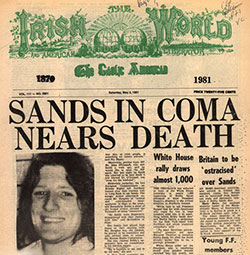
5, 1981
Irish
Republican Army hunger-striker Bobby Sands died at the Maze
Prison in Northern Ireland on his 66th day without food. He
had just been elected to a seat in Parliament while still
serving the last of a 14-year sentence for possession of firearms.
read
more and some poetry by Bobby Sands
“Our
revenge will be our children’s smiles.”-
Bobby Sands
May
5, 2000
Reformers swept Iran's run-off elections, winning control
of the legislature from conservatives for the first time since
the 1979 Islamic revolution.
May
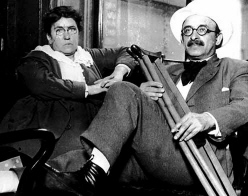
6, 1916
Emma Goldman and Alexander Berkman started the No Conscription
League in the U.S. This was prior to American troops’
being sent to Europe in what is known as World War I.
read
the No-Conscription League Manifesto
Emma
Goldman and Alexander Berkman
May
6, 1973
14 cities across France saw demonstrations against their country’s
nuclear weapons tests in the Pacific Ocean.
May
7, 1954
The
Battle at Dien Bien Phu in Vietnam ended after 55 days with
Viet Minh insurgents overrunning French forces. An agreement
for complete French withdrawal was negotiated within two months
in Geneva.
The battle began in March, when a force of 40,000 Vietnamese
troops armed with heavy artillery surrounded 15,000 French
soldiers holding the French position under siege. The Viet
Minh guerrillas had been fighting a long and bloody war against
French colonial control of Vietnam since 1946.
May
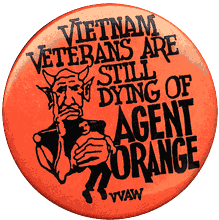
7, 1984
American
veterans of the Vietnam War reached a $180-million out-of-court
settlement with seven chemical companies in their class-action
suit relating to the use of herbicide Agent Orange in Vietnam.
The veterans charged they had suffered injury and illness
from exposure to the defoliant used widely in the war to eliminate
cover for Vietnamese forces opposing the U.S.
Agent
Orange: An Ongoing Atrocity
May
8, 1882
The
American Peace Society was established when the peace societies
of Maine, New Hampshire, Massachusetts, New York, and Pennsylvania
merged to become a national organization. Based in Boston,
the merger was a result of a suggestion by William Ladd.
read
more
May
8, 1933
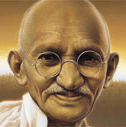
Mohandas
Gandhi began a 31-day fast to support political rights for
the Dalit (or untouchables) whom he called Harijans, the children
of God. He had been jailed by the British to interfere with
his movement to end their colonial control of India.
May
8, 1962
An
estimated 9,000,000 people in Belgium participated in a
ten-minute work stoppage to protest nuclear weapons.
May
9, 1967
In
April, Muhammad Ali refused induction into the U.S. Army
due to his religious convictions. He angered many Americans
after claiming, "I ain't got no quarrel with those
Vietcong." He was stripped of his heavyweight boxing
title and his license to fight.
In June, a court found him guilty of draft evasion, fined
him $10,000, and sentenced him to five years in prison.
He remained free, pending numerous appeals, but was still
barred from fighting.
May
9, 1969
The
New York Times revealed the United States had been secretly
bombing Cambodia--officially a noncombatant, neutral country
during the Vietnam War.
May
9, 1970
Five
days after the Kent State killings, 100,000 marched in Washington,
DC against the Vietnam War. About 600 Canadian protesters
defaced the Peace Arch at the U.S.-Canadian border in Blaine,
Washington.
May
9, 1979
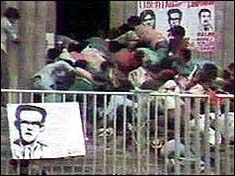
At
least 18 demonstrators were killed and many wounded after
police opened fire on anti-government protesters outside
the Metropolitan Cathedral in San Salvador, the capital
of El Salvador.
read
more
CBS
reporter: "The police continued to fire as bodies piled
up on the cathedral steps"
May
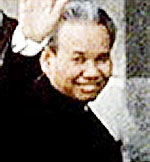
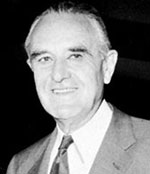
10, 1968
Peace talks began between the US and North Vietnam with W.
Averell Harriman representing the United States, and former
Foreign Minister Xuan Thuy heading the North Vietnamese delegation.
The
Paris Peace treaty was finally signed on
January
27, 1973.
May
10, 1980
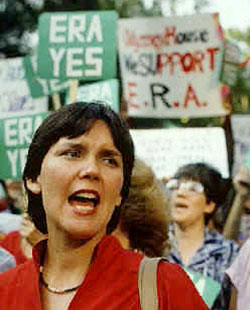
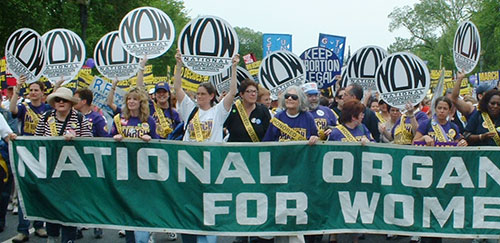
The
National Organization for Women (NOW) organized 85,000 people
to march in Chicago in support of Illinois ratification of
the Equal Rights Amendment to the U.S. Constitution.
a
chronology of the Equal Rights Amendment, 1923-1996
May
10, 1980
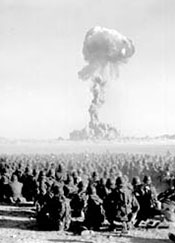
A
federal judge in Salt Lake City, Utah, found the U.S. government
negligent for its above-ground testing of nuclear weapons
in Nevada from 1951 to 1962.
.
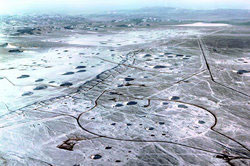
The
land of the Nevada Test Site is scarred with craters from
nuclear testing
May
10, 1994
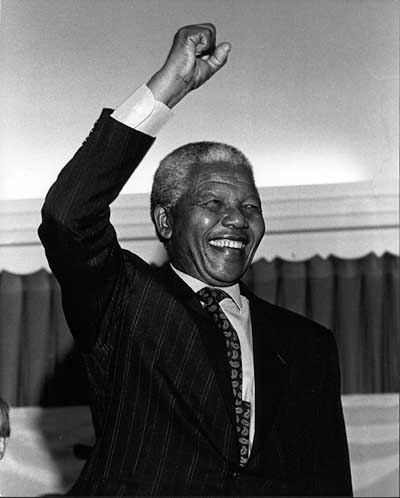
Nelson
Mandela was inaugurated following his election as South Africa’s
first black president after more than three centuries of exclusively
white rule, and nearly three decades of his imprisonment for
the struggle to attain political and civil rights for all
South Africans.
read
more
May
11, 1973
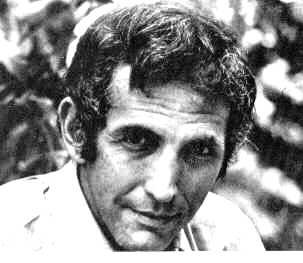
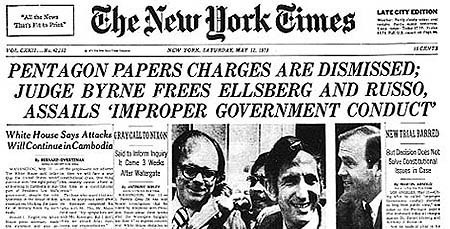
Charges
against former Pentagon analyst Daniel Ellsberg for his role
in the release of the Pentagon Papers (a comprehensive classified
study of the origins and conduct of the Vietnam War) were
dismissed by Judge William M. Byrne, citing government misconduct.
read
chapters from the Pentagon Papers history of the war
Secrets: A Memoir of Vietnam and the Pentagon Papers
May
11, 1975
80,000
turned out in New York City's Central Park to celebrate the
end of the Vietnam War.
May
12, 1968
The
Poor People's Campaign, organized by the Southern Christian
Leadership Conference (SCLC) began when contingents of the
poor, mainly from the south, began pitching tents in a "Resurrection
City" near the Lincoln Memorial. It was dismantled by
police on June 24.
May
13, 1888
Brazil, which imported more African slaves than any other
Western Hemisphere country (including the U.S.), abolished
slavery.
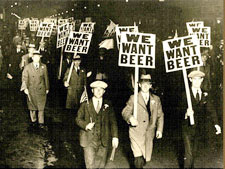
May
13, 1932
"We
Want Beer" marches were held in cities all over America,
with 15,000 unionized workers demonstrating in Detroit. Prohibition
(the 18th amendment to the U.S. Constitution barring “the
manufacture, sale or transportation of intoxicating liquors”)
was repealed the following year.
May
13, 1954
Natives
of the Marshall Islands pleaded for an end to atmospheric
H-Bomb testing in the south Pacific.
read
more
May
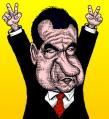
13, 1958
During a goodwill trip through Latin America, Vice President
Richard Nixon's limousine was attacked with rocks and bottles
by an angry crowd and nearly overturned while traveling through
Caracas, Venezuela. The crowd was angered by U.S. Cold War policies
and their effect on Latin America. Five days before, the Vice
President was shoved, stoned, booed, and spat upon by protesters
in Peru.
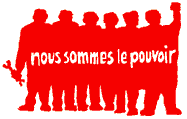
May
13, 1968
Workers
joined Paris students’ protest in a one-day general
strike calling for the fall of the government and protesting
police brutality. The protest by French students included
occupation of The Sorbonne; by the end of the month over 10,000,000
had been involved in school and workplace occupations.
view
and read about the great poster art from Paris ‘68
May
14, 1941
The
first groups of WWII conscientious objectors (COs) were ordered
to report to camp at Patapsco, Maryland.
World
War II COs
May
14, 1970
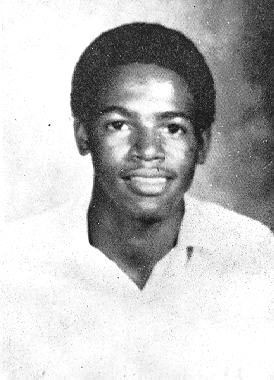
Phillip
Lafayette Gibbs
Two
African-American students were shot to death and 30 others
wounded by government troops at primarily black Jackson State
University in Mississippi. The two were watching demonstrators
protesting the invasion of Cambodia and racial discrimination
from a nearby dormitory tower. Two days of riots ensued in
Jackson resulting in curfews and sealing off of the city.
read
more
James
Earl
Green
May
15, 1870
Julia
Ward Howe, suffragist, abolitionist and author of the “Battle
Hymn of the Republic,” proposed Mother's Day as a peace
holiday.
She had seen firsthand some of the worst effects of war --
the death and disease which killed and maimed, and the widows
and orphans left behind on both sides of the Civil War --
and realized that the effects of the war go beyond the killing
of soldiers in battle. Mother’s Day did not become a
national holiday until declared by President Woodrow Wilson
in 1914.
"Disarm!
Disarm!
The sword of murder is not the balance of justice."
Blood does not wipe our dishonor,
Nor violence indicate possession.
As men have often forsaken the plough and the anvil
At the summons of war,
Let women now leave all that may be left of home
For a great and earnest day of counsel.”
read
her Mother’s Day Proclamation
May
15, 1935
The
National Labor Relations Act was passed, recognizing workers'
rights to organize and bargain collectively with their employer.
read
more
May
15, 1957
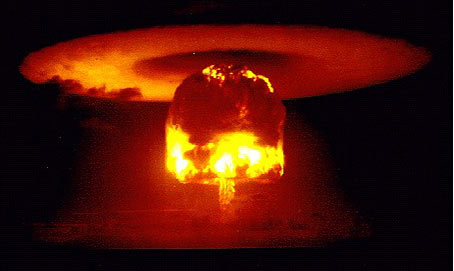
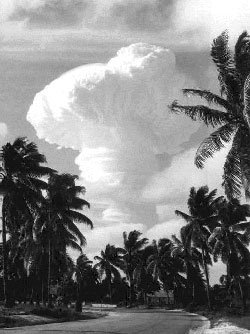
Britain tested its first H-bomb over Christmas Island in
the south Pacific, after just two years of development.
Mushroom
cloud over Christmas Island.
May
15, 1966
The
American Friends Service Committee, SANE (The Committee for
a SANE Nuclear Policy), and Women March for Peace, with four
other organizations, sponsored a 10,000+ person anti-war picket
at White House and a 63,000+ rally at the Washington Monument
to oppose the Vietnam War.
May
15, 1970
In
response to the U.S. invasion of Cambodia (an expansion
of the Vietnam War) and the killings at Kent State and Jackson
State Universities, several million U.S. students held campus
strikes opposing the Vietnam War.
May
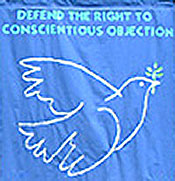
15 (since the 1980's)
International
Conscientious Objectors Day, established to honor those who
leave or refuse to enter their country’s armed forces
for reasons of principle.
Are
you a CO? For more info visit PEACE-OUT
Read
the stories of 4 Conscientious Objectors
May
16, 1918
The
U.S. Congress passed the Sedition Act, legislation designed
to protect America’s participation in World War I. Aimed
at socialists, pacifists and other anti-war activists, the
Sedition Act imposed harsh penalties on anyone found guilty
of making false statements that interfered with the prosecution
of the war; insulting or abusing the U.S. government, conscription,
the flag, the Constitution or the military; agitating against
the production of necessary war materials; or advocating,
teaching or defending any of these acts.
read
more
May
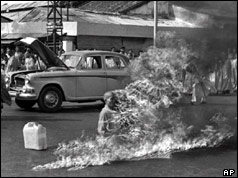
16, 1967
Nhat
Chi Mai immolates herself in Saigon, the capital of South
Vietnam, to protest the war.
"I
offer my body as a torch / to dissipate the dark / to waken
love among men / to give peace to Vietnam."
read
more
May
17, 1954
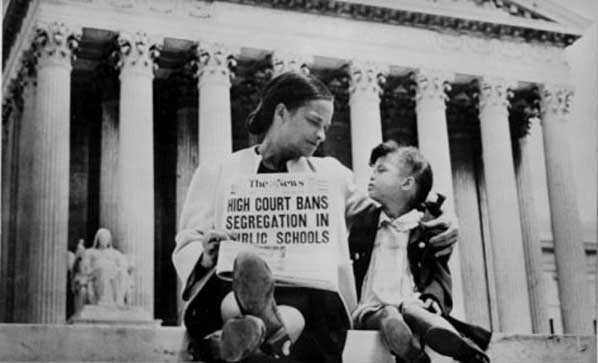
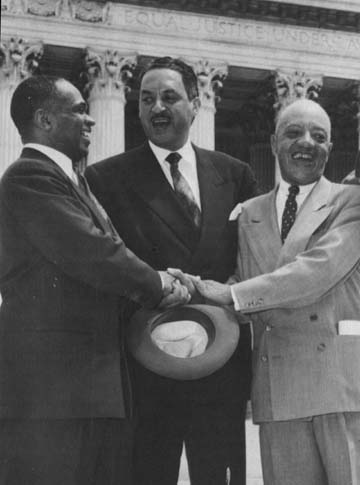
In
a major civil rights victory, the U.S. Supreme Court handed
down a unanimous decision in Brown v. Board of Education,
ruling "separate but equal" public education to
be unconstitutional under the 14th Amendment which guaranteed
equal treatment under the law. The historic decision, bringing
an end to federal tolerance of racial segregation, specifically
dealt with Linda Brown, a young African American girl denied
admission to her local elementary school in Topeka, Kansas,
because of the color of her skin.
read
more
Above:
Nettie Hunt and her daughter Nickie on the
steps
of the U.S. Supreme Court, 1954.
George
E. C. Hayes, Thurgood Marshall and James M. Nabrit (left to
right), the successful legal team, celebrate the Brown decision
May
17, 1968
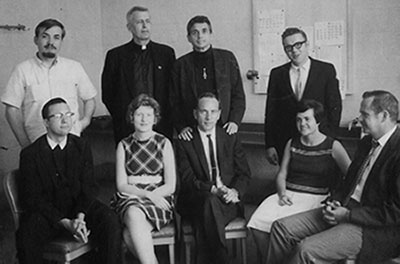
A group of anti-war activists who came to be known as the
"Catonsville Nine," including Philip and Daniel
Berrigan, broke into the Catonsville, Maryland, draft board
center and burned over 600 draft files.
The
Catonsville Nine in a picture taken in the police station
minutes after the action.
From
left to right (standing) George Mische, Philip Berrigan, Daniel
Berrigan, Tom Lewis. From left to right (seated) David Darst,
Mary Moylan, John Hogan, Marjorie Melville, Tom Melville.
photo Jean Walsh
read
more about the Catonsville Nine
May
17, 1970
100
protesters staged a silent "die-in" at Fifth Avenue
and Pine Street in downtown Seattle to protest shipment through
their city of Army nerve gas being transported from Okinawa,
Japan, to the Umatilla Army Depot in eastern Oregon.
read
more
May
18, 1872
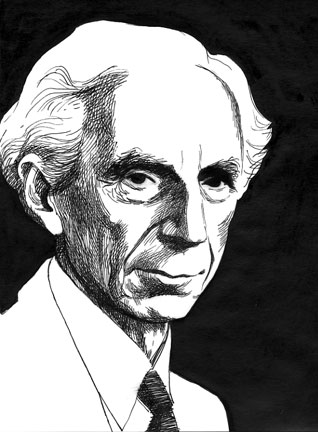
Bertrand
Russell
Birthday
of Sir Bertrand Russell, British philosopher, logician, essayist,
and social critic, a leading figure in his country’s
anti-nuclear movement. In 1954 he delivered his famous "Man's
Peril" broadcast on the BBC, condemning the Bikini H-bomb
tests, and warning of the threat to humanity from the development
of nuclear weapons. A year later, together with Albert Einstein,
he released the Russell-Einstein Manifesto calling for the
curtailment of nuclear weapons.
He became the founding president of the Campaign for Nuclear
Disarmament in 1958 resigning, however, in 1960 to form the
more militant Committee of 100 with the overt aim of inciting
mass civil disobedience. He, along with Lady Russell led mass
sit-ins in 1961 that brought them a two-month prison sentence.
May
18, 1972
Maggie
Kuhn
Margaret
(Maggie) Kuhn founded the Gray Panthers (originally called
the Consultation of Older and Younger Adults for Social Change)
to consider the common problems faced by retirees —
loss of income, loss of contact with associates and loss of
one of our society's most distinguishing social roles, one's
job. They also discovered a new kind of freedom in their retirement
— the freedom to speak personally and passionately about
what they believed in, such as their collective opposition
to the Vietnam War.
Gray
Panther history
May
18, 1974
In the Rajasthan Desert in the state of Pokhran, India successfully
detonated its first nuclear weapon, a fission bomb similar in
explosive power to the U.S. atomic bomb dropped on Hiroshima,
Japan.
The test fell on the traditional anniversary of the Buddha's
enlightenment, and Indian Prime Minister Indira Gandhi received
the message "Buddha has smiled" from the exuberant
test-site scientists after the detonation. The test, which made
India the world's sixth nuclear power, broke the nuclear monopoly
of the five members of the U.N. Security Council--the United
States, the Soviet Union, Great Britain, China, and France.
May
18, 1979
The
Silkwood v. Kerr-McGee decision established that corporations
are responsible for the people they irradiate. Karen
Silkwood worked for the Kerr-McGee Nuclear Corporation at
their Cimmaron, Texas, plant that manufactured plutonium.
She became the first female member of the Oil, Chemical and
Atomic Workers bargaining committee, focusing on worker safety
issues, and suffered radiation exposure in a series of unexplained
incidents.
read
more about Karen Silkwood
Karen
Silkwood
May
19, 1952
Author
and activist Lillian Hellman advised the House Committee on
Un-American Activities (HUAC) that she refuses to testify
against friends and associates, saying: "I cannot
and will not cut my conscience to fit this year's fashions."
read
more about Lillian Hellman
May
20, 1961
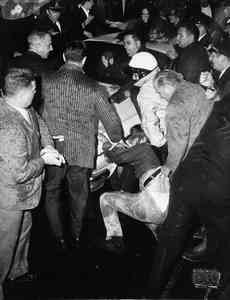
A
white mob attacked "Freedom Riders" in Montgomery,
Alabama, prompting the federal government to declare martial
law and send in United States Marshals to restore order.
read
more
Freedom
Riders challenged racial segregation at Montgomery bus depot.
May
20, 1968
Arlington
Street Unitarian-Universalist Church in Boston offered sanctuary
to Robert Talmanson and William Chase, both wanted for acts
of disobedience to military duty.
Draft
resister Robert Talmanson dragged by authorities from Arlington
Street Church.
May
20, 1971
A
delegation of U.S. pacifists traveled to Cuba to exchange children's
art.
May
21, 1956
The
United States conducted the first airborne test of an improved
hydrogen bomb, dropping it from a B-52 bomber over the tiny
island of Namu, part of the Bikini Atoll in the Pacific Ocean.
The United States first detonated a hydrogen bomb in 1952
in the Marshall Islands, also in the Pacific. This bomb was
far more powerful than those previously tested and was estimated
at 15 megatons or larger (one megaton is roughly equivalent
to 1 million tons of TNT). Observers said that the fireball
caused by the explosion measured at least four miles in diameter
and was brighter than the light from 500 suns.
May
21, 1981
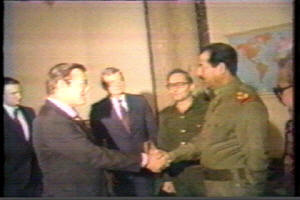
Donald
Rumsfeld and Saddam Hussein
The U.S. Senate approved a $20 billion program to return U.S.
to full-scale production of chemical and nerve-gas weapons.
Though the U.S. maintained a public policy opposing chemical
weapons, it extended financial and military assistance to
Iraq in its war against Iran, despite its almost daily use
of such weapons. Iraq had developed its “CW production
capability, primarily from Western firms, including possible
a U.S. foreign subsidiary.” (from a memorandum to Secretary
of State Alexander Haig)
Watch
a video on the U.S./Saddam Hussein partnership
May
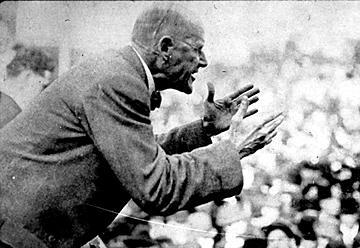
22, 1895
Eugene
V. Debs was imprisoned for his role in the Pullman railway
strike in Woodstock, Illinois.
read
more about the Pullman strike and the origin of Labor Day
May
22, 1978
Four
thousand protesters occupied the Trident nuclear submarine
base site in Bangor, Washington.
read
more
May
22, 1984
Declaration of the Six-Nation Five Continent Peace Initiative.
“...the
pursuit of peace must be uncoupled from strategies of nuclear
deterrence,
and
such strategies must be universally repudiated....”
-Rajiv Ghandi, prime minister of India
read
more
May
23, 1838
U.S. General Winfield Scott ordered the forced removal of
the Cherokee Indians from the east to the "Indian Nation"
(what is now Oklahoma).
Approximately one quarter of the 10,000 died on this march
called "The Trail of Tears."
May
23, 1982
10,000
marched in London in protest of British Prime Minister Margaret
Thatcher’s Falklands War. The Falklands were islands
off the coast of Argentina and Great Britain was fighting
to maintain colonial control over them; they are known as
the Malvinas Islands in Argentina.
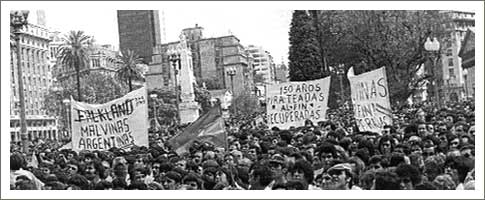
an
anti-war demonstration in Argentina
May
23, 1982
Four
hundred thousand demonstrated for peace and disarmament,
Tokyo.
May
23, 1997
Iranians elected a new president, Mohammad Khatami, a relative
moderate, over hard-liners in the ruling Muslim clergy. Khatami
won largely due to the female and youth vote, who voted for
him because he promised to improve the status of women and
respond to the demands of the younger generation in Iran.
read
more
May
24, 1964
Senator
Barry Goldwater (R-Arizona), running for the Republican Party
nomination for president, gave an interview in which he said
he would consider the use of low-yield atomic bombs in North
Vietnam.
May
24, 1968
Four
protesters, including Phil Berrigan and Tom Lewis, were sentenced
in Baltimore, Maryland, to six years each in prison for pouring
blood on draft cards.
May
24, 1971
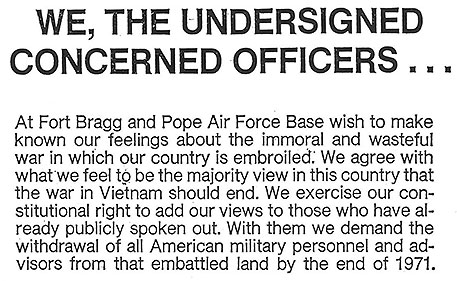
At
Fort Bragg, North Carolina, an anti-war newspaper advertisement
signed by 29 US soldiers supporting the Concerned Officers Movement
results in controversy. The group had been formed in 1970 in
Washington, D.C., by a small group of junior naval officers
opposed to the war. The newspaper advertisement at Fort Bragg
was in support of group's members, who had joined with antiwar
activist David Harris and others in San Diego to mobilize opposition
to the departure of the carrier USS Constellation for Vietnam.
No official action was taken against the military disside
May
24, 1981 (since 1981)
International Women's Day for Disarmament was declared.
read
more
May
25, 1925
John
T. Scopes was indicted for teaching Darwin's theory of evolution.
Scopes, a football coach and substitute biology teacher in
Dayton, Tennessee, agreed to be arrested and put on trial
to challenge a new state law against teaching evolution that
had become law just four days prior.
May
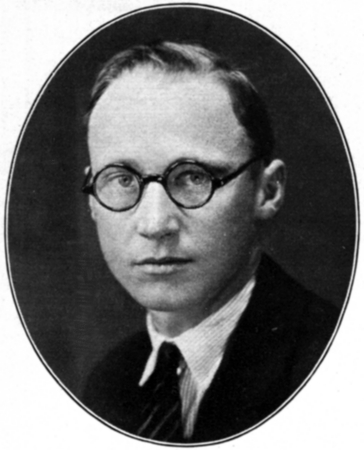
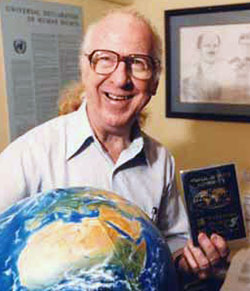
25, 1948
Garry
Davis, formerly a member of the U.S. military, renounced his
American citizenship to become a Citizen of the World. Davis
continued to promote "world citizenship" for over
50 years; 400,000 have, at one time or another, joined the
movement.
read
more about a World Government of World Citizens
May
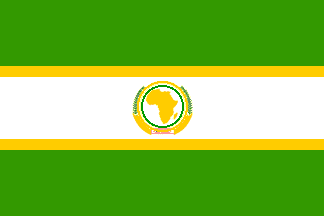
25, 1963
Leaders
of 32 African nations met in Addis Ababa, Ethiopia, to set
up the Organization of African Unity (OAU), giving them a
united voice for the first time in the continent’s history.
The primary aim of the OAU was to end European colonial control
in the countries where it still existed: Southern Rhodesia,
South Africa, Mozambique and Angola.
read
more
OAU
flag
May
25, 1986
An estimated 7 million Americans participated in Hands Across
America, forming a line across the country from Los Angeles
to New York to raise public awareness of the issues of hunger
and homelessness in the U.S. Participants paid ten dollars
to reserve their place in line; the proceeds were donated
to local charities to fight hunger and help the homeless.
May
25, 2003
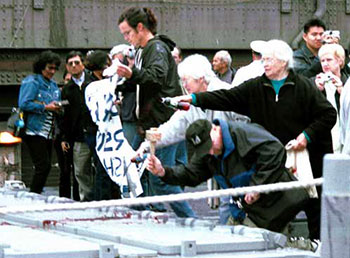
Four activists, members of the Catholic Worker movement and
known as "Riverside Ploughshares,” were arrested
for pouring their blood and hammering on the USS Philippine's
Tomahawk cruise missile hatches. The ship was visiting New
York City for its annual "Fleet Week."
read
more
“With
hammers we have initiated the process of disarming this battle
ship, of transforming this carrier of mass destruction into
a vessel for peace...”
pouring
blood and hammering..
May
26, 1647
The
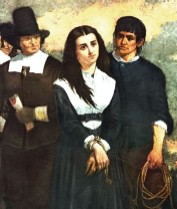
first recorded American execution of a "witch" took
place in Windsor, Connecticut. Many more were soon to follow
in Salem, Massachusetts. May 26, 1647 The first person in
America was executed for the crime of witchcraft. Alse Young
was arrested, tried for this capital offense in Windsor, Connecticut,
and hanged at Meeting House Square in Hartford, the site of
what is now the Old State House.
There is no further record of Young's trial or the specifics
of the charge -- only that she was a woman, as 80% of those
executed for witchcraft were. The Salem witch trials would
not begin for another 45 years.
read
more
Some
300 years later the U.S. experienced another “witch
hunt” as Senator Joe McCarthy and the House Un-American
Activities Committee pursued communists. Arthur Miller makes
this comparison in his famous play “The Crucible.”
read
more about the play “The Crucible”
May
26, 1937
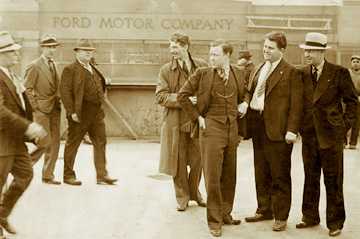
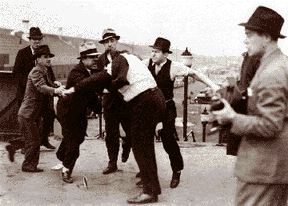
United
Auto Workers organizers and Ford Service Department men clashed
in a violent confrontation on the Miller Road Overpass outside
Gate 4 of the Ford River Rouge Plant in Dearborn, Michigan.
It became known as "The Battle of the Overpass."
Henry Ford announced: "We'll never recognize the United
Automobile Workers Union or any other union." Though
General Motors and Chrysler signed collective bargaining agreements
with the UAW in 1937, Ford held out until 1942.
read
more
The
Ford Servicemen (goons) approach Walter Reuther and Richard
Frankensteen, third and second from right, and the other unionists.
UAW
official Richard Frankensteen being beaten
by
Ford goons
May
26, 1946
A patent was filed in the U.S. for the H-Bomb.
May
26, 1972
The
Anti-Ballistic Missile (ABM) Treaty was signed by U.S. and
U.S.S.R. The two countries agreed not to build defensive missile
systems and thus to limit escalation of the nuclear arms race.
If either side deployed defensive missiles, the other would
be forced to respond by increasing the number, explosive yield
or effectiveness of their offensive nuclear capabilities to
maintain the balance of nuclear deterrence.
This treaty was abrogated by President George W. Bush in the
first months of his presidency.
May
26, 1991
20,000
participated in an Arab-Jewish peace rally in Tel Aviv, Israel.
May
27, 1963
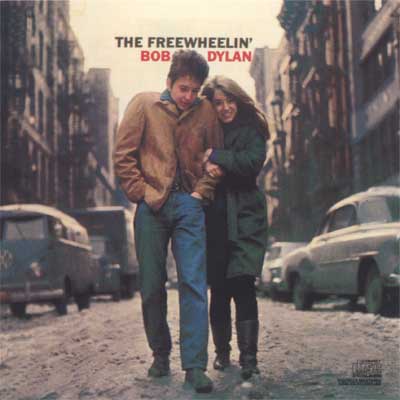
The
album, ''The Freewheelin' Bob Dylan,'' which featured the
song ''Blowin' in the Wind,'' was released. The song warns
of the perils of nuclear fallout.
“...how
many times must the cannon balls fly
Before they're forever banned?”
read
the lyrics, hear the song, more Bob Dylan..
May
28, 1892
The
Sierra Club, America's oldest, largest and most influential
grassroots environmental organization, was organized in San
Francisco.
The
Sierra Club today
May
28, 1961
Amnesty
International (AI) was founded on this date in Great Britain.
It is a worldwide movement of people who campaign for internationally
recognized human rights.
visit
Amnesty International
May
28, 1998
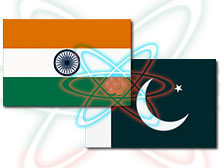
Pakistan
exploded five underground nuclear devices in response to India's
recent nuclear tests. Since the partition of the subcontinent
in 1947 there have been three wars between the two countries
and numerous border clashes over the disputed Kashmir province.
read
more
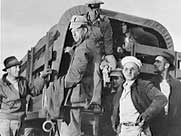
May
29, 1932
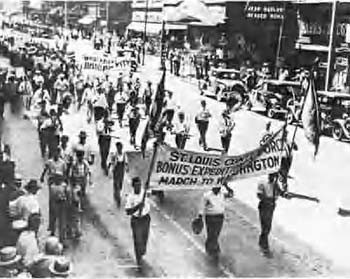
At
the height of the Great Depression, the "Bonus Expeditionary
Force," a group of 1,000 World War I veterans seeking
cash payments for their veterans' bonus certificates, arrived
in Washington, D.C. By mid-June, they had set up a massive
“Hooverville,” a contemporary term for an encampment
of the homeless. One month later, other veteran groups made
their way to the nation's capital, swelling the Bonus Marchers
to nearly 20,000 strong, most of them unemployed veterans
in difficult financial straits. In direct violation of the
Posse Comitatus Act, they were violently disbanded by the
Army in July.
read
more
The
St. Louis contingent of the Bonus Expeditionary Force is pictured
here as it starts for Washington, D.C., in May 1932.
May
29, 1986
The
Christic Institute filed a lawsuit charging U.S. government
complicity in a Contra assassination bombing at La Penca,
Nicaragua, and the CIA role in smuggling cocaine into the
U.S. to fund the Contras.
find
out more about the Christic Institute
May
30, 1868
Memorial Day, originally known as Decoration Day, was first
observed when two women in Columbus, Mississippi, placed flowers
on both Confederate and Union graves of Civil War soldiers.
May
30, 1937
1000 striking steel workers (and members of their families),
on their way to picket at the Republic Steel plant in south
Chicago where they were organizing a union, were stopped by
the Chicago Police. In what became known as the "Memorial
Day Massacre" police shot and killed 10 fleeing workers,
wounded 30 more, and beat 55 so badly they required hospitalization.
read
more
May
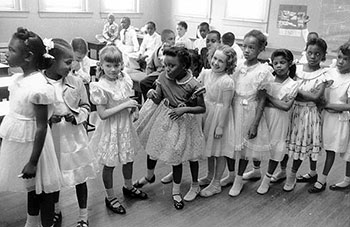
31, 1955
The U.S. Supreme Court ordered (in a decision known as "Brown
II") that school integration be done "with all
deliberate speed," ordering the lower federal courts
to require desegregation. Between 1955 and 1960, federal
judges held more than 200 school desegregation hearings.
a
timeline of school integration
May
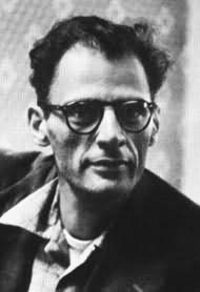
31, 1957
U.S.
playwright Arthur Miller was convicted of contempt of Congress
after refusing to reveal the names of alleged Communist writers.
May
31, 1966
Nguyen
Thi Can, a 17-year-old Buddhist girl, committed suicide by
setting herself afire (self-immolation) on a street in the
city of Hue. She was protesting against the South Vietnamese
regime; it was the fifth such death in three days.
May
31, 1973
A
bipartisan majority (69-19) of the U.S. Senate voted to cut
off funds for the bombing of Cambodia despite pleas from Secretary
of State Henry Kissinger.
This
Week In History compiled by peacebuttons.info from various
sources
which are available upon request.
Submissions are always welcome. Please furnish sources. cb@peacebuttons.info
Reproduction
of this calendar for non-profit purposes
is permitted and encouraged. Please credit/link to www.peacebuttons.info




 Are
you old enough to remember Chubby Checker?
Are
you old enough to remember Chubby Checker? 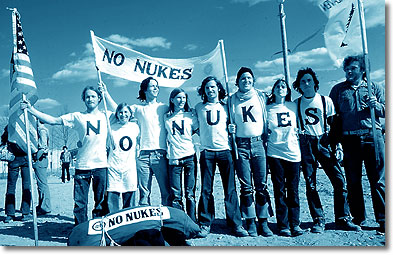
 Resurrection
City
Resurrection
City 



 Phillip
Lafayette Gibbs
Phillip
Lafayette Gibbs 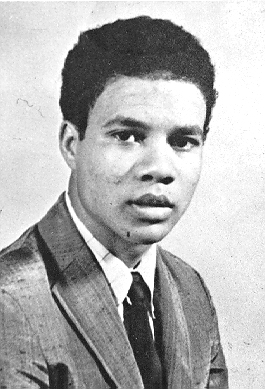 James
Earl
James
Earl 

 read
more about the Catonsville Nine
read
more about the Catonsville Nine 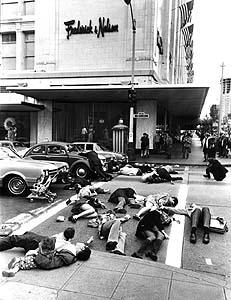

 Karen
Silkwood
Karen
Silkwood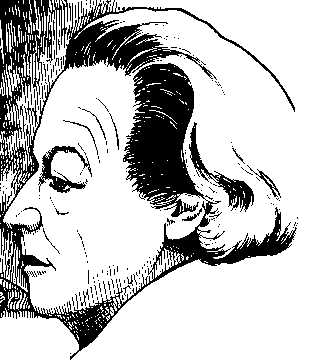
 Donald
Rumsfeld and Saddam Hussein
Donald
Rumsfeld and Saddam Hussein


 OAU
flag
OAU
flag