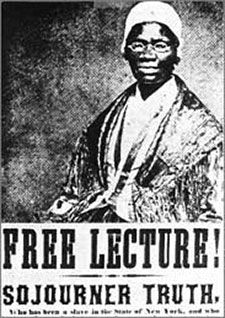
Sojourner Truth (a name she believed God had given her as
a symbolic representation of her mission in life) set out
from New York on a historic journey across America, preaching
about the evils of slavery and promoting women's rights.
read
more about Sojourner Truth
June
1, 1932
Gay rights organizer Henry Gerber published an article in
Modern Thinker magazine attacking the view that homosexuality
is a neurosis.
In
1924, Henry Gerber, a postal worker in Chicago, started the
Society for Human Rights, America's first known gay rights
organization. "The Society for Human Rights is formed
to promote and protect the interests of people who are abused
and hindered in the legal pursuit of happiness which is guaranteed
them by the Declaration of Independence, and to combat the
public prejudices against them."
After having created and distributed a newsletter called "Friends
and Freedom,” Gerber was arrested and held for 3 days
without a warrant or being charged with any infractions. Upon
release he lost his job for "conduct unbecoming a postal
worker.”
June
1, 1942
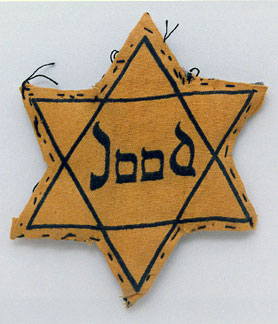
On this day in 1942, on the advice of Nazi propaganda minister
Joseph Goebbels, Adolf Hitler ordered all Jews in occupied
Paris to wear an identifying yellow star on the left side
of their coats.
read
more
June
1, 1950
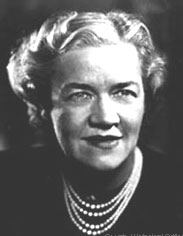
Senator
Margaret Chase Smith (R-Maine), the only woman in the Senate,
and only the second in history, denounced Sen. Joseph McCarthy
(R-Wisconsin) and his "red-baiting" tactics on
the floor of the U.S. Senate, in a speech called "A
Declaration of Conscience.”
read
the declaration
June
1, 1963
The U.S. Supreme Court banned formal prayers and religious
exercises from public schools.
[School
Dist. Of Abington Township v. Schempp, 374 U.S. 203 (1963);
Engel v. Vitale, 370 U.S. 421 (1962)]
June
1, 1967
The Vietnam Veterans Against War (VVAW) was formed.
the
VVAW today
June
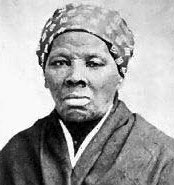
2, 1863
Abolitionist
and former slave James Montgomery led 300 African-American
troops of the Union's 2nd South Carolina Volunteers on a raid
of plantations along the Combahee River. Meanwhile, backed
by three gunboats, Harriet Tubman's forces set fire to the
plantations and freed 750 slaves.
read
more
Harriet
Tubman
June
2, 1936
General
Anastasio Somoza took over as dictator of Nicaragua.
read
more
June
2, 1952
The U.S. Supreme court ruled illegal President Truman's order
two months earlier for the Army to seize the nation's steel
mills in order to avert a strike.
June
3, 1900
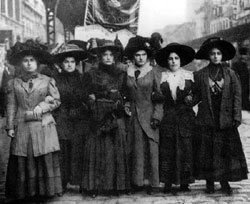
The International Ladies Garment Workers Union (ILGWU) was
founded.
read
more
June
3, 1957
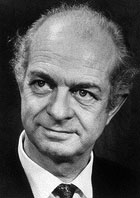
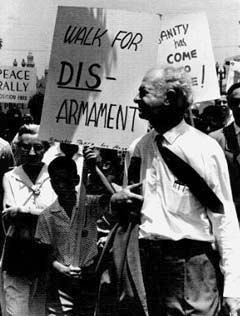
Linus Pauling and thousands of other scientists joined in
a call for banning nuclear weapons testing. President Eisenhower
rejected their plea.
“...Then on May 15, 1957, with the help
of some of the scientists in Washington University, St. Louis,
I wrote the Scientists' Bomb Test Appeal, which within two
weeks was signed by over two thousand American scientists
and within a few months by 11,021 scientists, of forty-nine
countries....”
read
more
Linus
Pauling's Nobel Peace Prize speech 1962
Linus
Paulng at a disarmament demonstration
June
3, 1964
Conscientious objection became legally recognized in Belgium.
a
history of European conscientious objection
June
4, 1972
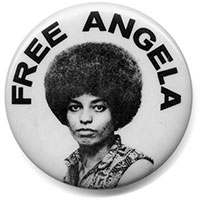
Angela Y. Davis, a former philosophy professor at the University
of California, militant black leader and self-proclaimed communist,
was acquitted on charges of conspiracy, murder, and kidnapping
by an all-white jury in San Jose, California.
read
more
June
4, 1987
New Zealand passed legislation declaring itself nuclear-free.
In 1986, New Zealand had banned the entry of U.S. Navy ships
from their ports in the belief that they were carrying nuclear
weapons or were nuclear-powered. U.S. government protests
of the policy led to breakup of the ANZUS (Australia-New Zealand-United
States) defense alliance.
The
New Zealand Nuclear Free Zone, Disarmament and Arms Control
Act 1987 (which implemented the Nuclear Non-Proliferation
Treaty) prohibits the:
- manufacture, acquisition, possession, control
of any nuclear explosive device,
- aiding, abetting or procuring any person to
manufacture, acquire, possess, or have control over any nuclear
explosive device, and
- transport ,stockpiling, storage, installation,
or deployment of any nuclear explosive device.
June
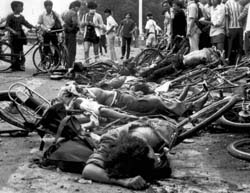
4, 1989
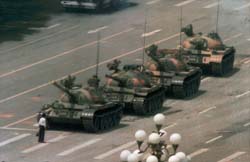
Hundreds
of civilians were shot dead by China’s People’s
Liberation Army during a bloody military operation in Beijing’s
Tiananmen Square. Students and workers had became part of
a growing pro-democracy movement, gathering there continuously
for weeks. The Chinese government still officially denies
any deaths occurred; thousands arrested "disappeared"
and remain unaccounted for.
"deaths
from the military assault on Tiananmen Square range from 180
to 500; thousands more have been injured . . . thousands of
civilians stood their ground or swarmed around military vehicles.
APCs [armored personnel carriers] were set on fire, and demonstrators
besieged troops with rocks, bottles, and Molotov cocktails."*
watch
*From
a comprehensive overview prepared by the National Security
Archive based on formerly classified U.S. Government documents
June
5, [since] 1972
World
Environment Day was established by the U.N. General Assembly
to commemorate the opening of the Stockholm Conference on
the Human Environment in Sweden. The United Nations Environment
Programme (UNEP) was established as a result of the conference.
UNEP
Mission: To provide leadership and encourage partnership in
caring for the environment by inspiring, informing, and enabling
nations and peoples to improve their quality of life without
compromising that of future generations.
read
more
past
milestones of World Environment Day
Each
year World Environment Day adopts a theme.
For
2006 the theme of World Environment
Day
is Deserts and Desertification Don't Desert Drylands!
June
6, 1936
First issue of Peace News published in England.
read
more
June
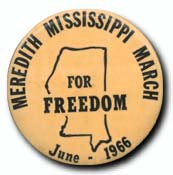
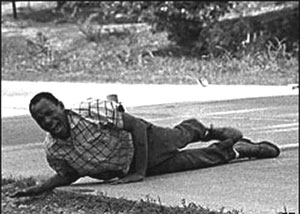
6, 1966
James
H. Meredith, the first African American ever to attend the University
of Mississippi, was shot by a sniper in the back and legs while
on a lone "March Against Fear."
He was walking the 220 miles from Memphis, Tennessee, to Jackson,
Mississippi, to encourage others to stand up for their rights
and respect, and to register to vote. Law enforcement officers
and reporters following him witnessed the attack, and the
shooter was arrested.
read
more
June
6, 1968
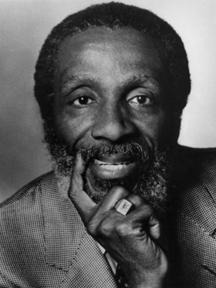
Comedian Dick Gregory began a hunger strike in Olympia, Washington
jail after his arrest with others at a fish-in, an act of
civil disobedience in support of the fishing rights of the
Nisqually Indian Tribe.
visit
Dick Greogy.com
read
more about Dick Gregory
June
7, 1892
Homer
Plessy was arrested when he refused to move from a seat reserved
for whites on a train in New Orleans. The case led to the
U.S. Supreme Court's landmark ''separate but equal'' decision
in Plessy v. Ferguson in 1896.
more about Homer Plessy
Read his petition
to the Court
June
7, 1893
a
young Ghandi
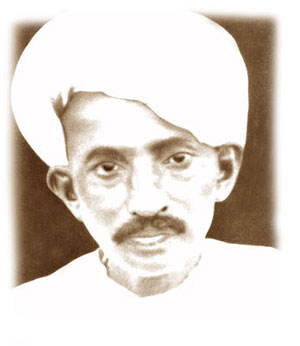
In
his first act of civil disobedience, Mohandas Gandhi refused
to comply with racial segregation rules on a South African
train and was forcibly ejected at Pietermaritzburg.
read
"Pietermaritzburg: The Beginning of Gandhi's Odyssey"
June
7, 1997
Seven
activists are arrested for distributing copies of the Bill
of Rights outside the Bradbury Science Museum, part of Los
Alamos National Laboratory in New Mexico, the primary nuclear
research facility in the U.S.
June
8, 1966
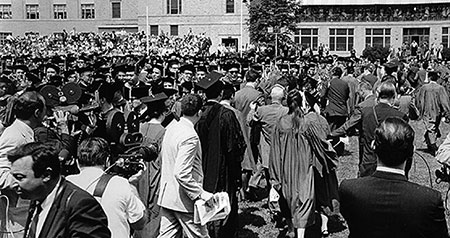
270 walked out of graduation ceremonies at New York University
(NYU) to protest the presentation of an honorary degree to
Robert McNamara, then the Secretary of Defense and responsible
for U.S. forces waging war in Vietnam.
June
8, 1969
Two-thirds
of the graduating class of Brown University (Providence, Rhode
Island) turned their backs on Secretary of State Henry Kissinger
as he gave the commencement address, silently expressing their
opposition to U.S. foreign policy and the war in Vietnam.
June
9, 1954
Counsel
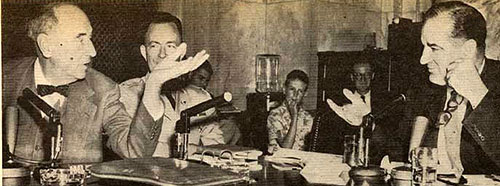
for the U.S. Army Joseph N. Welch confronted Sen. Joseph R.
McCarthy (R-Wisconsin) during hearings into alleged communist
infiltration of the Army Signal Corps. McCarthy attacked a
member of Welch's law firm, Frederick G. Fisher, as a communist
for his prior membership in the
National
Lawyers Guild.
Army
counsel Joseph N. Welch (left) confronts Sen Joseph McCarthy
(right)
Said Welch: "Have you no sense of decency, sir? At long
last, have you left no sense of decency?" The entire
hearings and this encounter were broadcast live on television,
a first, and was the beginning of the end for McCarthy’s
power to spread fear.
read
more
June
9, 1984
150,000
marched in London, England, for nuclear disarmament, protesting
the presence of U.S. Cruise missiles on British soil.
June
9, 1993
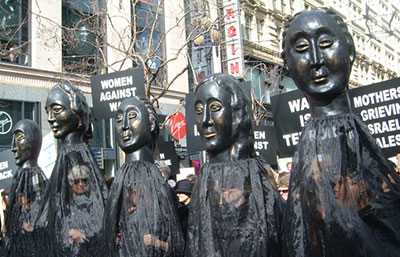
Police banned a vigil by Women in Black in Belgrade, Serbia.
read
about Women in Black
Women
in Black demonstrations combine art & politics
June
10, 1917
The
Women's Peace Crusade in Scotland launched a three-week campaign
of street meetings and demonstrations in dozens of towns to
build support for peace in the midst of World War I.
read
more
June
10, 1980
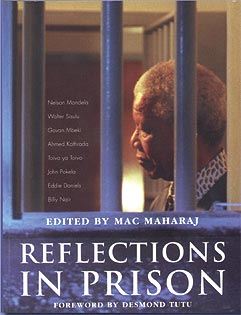
Nelson
Mandela's first writings while imprisoned on South Africa’s
Robben Island were smuggled out and made public.
read
more about Nelson Mandela
Reflections
in Prison
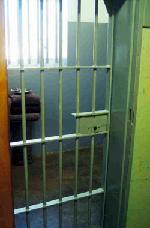
Nelson
Mandela's cell on Robben Island
where
he spent 17 years
June
11, 1962
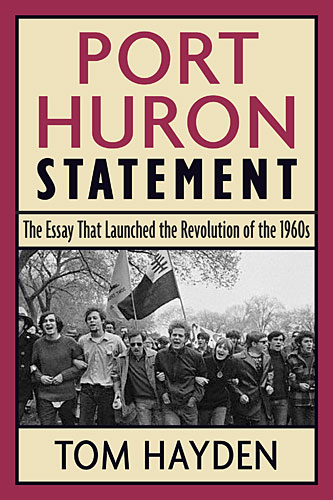
Students
for a Democratic Society (SDS) held its founding convention
in Michigan and issued The Port Huron Statement, laying out
its principles and program.
“Making values explicit--an initial task in establishing
alternatives--is an activity that has been devalued and corrupted.
The conventional moral terms of the age, the politician moralities--"free
world," "people's democracies"--reflect realities
poorly, if at all, and seem to function more as ruling myths
than as descriptive principles.”
read
The Port Huron Statement
June
11, 1963
Thich Quang Duc, a Buddhist monk from the Linh-Mu Pagoda in
Hue, Vietnam, burned himself to death (self-immolation) in
front of U.S. embassy in downtown Saigon to protest the the
South Vietnamese regime and the war.
June
11, 1968
Daniel
Cohn-Bendit arrived in Britain, stirring up fears of campus
unrest. The 23-year-old Paris law student had been given permission
to remain in the UK just 24 hours, but immediately threatened
to defy the authorities and out-stay his welcome. Mr Cohn-Bendit
-- a German citizen -- had been expelled from France in May
for being an organizer of the French student and worker demonstrations
which almost brought the country to a standstill the previous
month.
read
more
"I
don't know how long I will stay. I think it's a free country"
June
11, 1988
100,000
marched from United Nations headquarters to Central Park during
the 3rd U.N. Special Session on Disarmament.
June
12, 1963
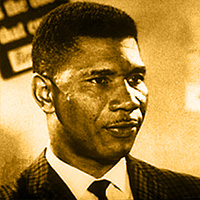
In
the driveway outside his home in Jackson, Mississippi, civil
rights leader Medgar Evers was shot to death by a white supremacist.
His murderer was not convicted until 1994.In the driveway
outside his home in Jackson, Mississippi, civil rights leader
Medgar Evers was shot to death by a white supremacist. His
murderer was not convicted until 1994.
read more
June
12, 1964
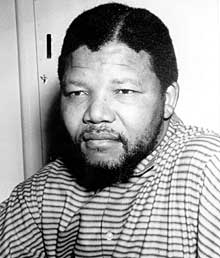
Nelson
Mandela, a 46-year-old lawyer and a leader of the opposition
to South Africa’s racially separatist apartheid system,
was convicted of sabotage in the Rivonia Trial and sentenced
to life imprisonment.
“I
have fought against white domination, and I have fought against
black domination. I have cherished the ideal of a democratic
and free society in which all persons live together in harmony
and with equal opportunities. It is an ideal which I hope
to live for and to achieve. But if needs be, it is an ideal
for which I am prepared to die.”
Nelson
Mandela, 1963
June
12, 1967
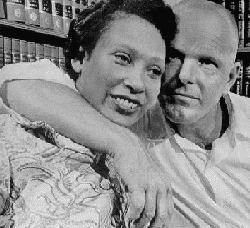
Mildred
and Richard Loving
The
Supreme Court struck down state miscegenation laws prohibiting
interracial marriages as violations of the 14th amendment
which guarantees equal protection under the law. In June of
1958, Richard Loving and Mildred Jeter had married in Washington
D.C. Upon return to their home state of Virginia, the couple
was arrested, convicted of a felony, and sentenced to a year
in jail. Their appeal led to the decision.
read more about it
“The
freedom to marry has long been recognized as one of the vital
personal rights
essential to the orderly pursuit of happiness by free men.”
From Chief Justice Earl Warren’s majority opinion in
Loving v. Virginia
June
12, 1982
In
the largest U.S. peace demonstration to date, one million
rallied in Central Park to support the newly formed Nuclear
Freeze Campaign which called for a halt to all nuclear weapons
testing.
read about the origin of the Nuclear Freeze Campaign
June
13, 1967
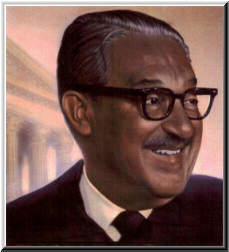
Thurgood
Marshall was nominated for justice of the Supreme Court by
President Lyndon Johnson. Marshall was the Solicitor General
of the United States and had been the lead attorney in the
Brown v. Board of Education case that ended legal segregation.
He would be the first African American on the Court.
more
about Justice Thurgood Marshall
June
13, 1971
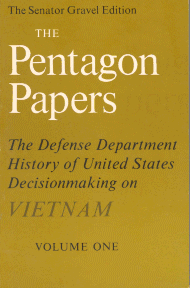
The
New York Times began publishing the “Pentagon Papers,”
a series of excerpts from the government’s classified
history of the Vietnam War, giving details of U.S. involvement
in Vietnam from the end of World War II to 1968. Publication
was interrupted after the Nixon administration went to court
to block it, asserting its power to exercise prior restraint.
The Washington Post then began publishing the papers. On June
30 the Supreme Court, 6-3, allowed publication to resume.
more
on the Pentagon Papers
“But
out of the gobbledygook, comes a very clear thing: [unclear]
you can’t trust the government; you can’t believe
what they say; and you can’t rely on their judgment;
and the – the implicit infallibility of presidents,
which has been an accepted thing in America, is badly hurt
by this, because it shows that people do things the President
wants to do even though it’s wrong, and
the President can be wrong.”
-- H.R. Haldeman to President Nixon, Monday,
14 June 1971, 3:09 p.m.
June
13, 1985
1,765
are arrested in 150 cities protesting U.S. aid to Nicaraguan
Contras.
June
13, 1991
Jeffrey
Collins is awarded $5.3 million settlement from Shell Oil which
had fired him for being gay. Collins had offered to settle out
of court for $50,000, but Shell refused.
June
14, 1816
The
Society for the Promotion of Universal and Permanent Peace,
often known as the London Peace Society, was founded. Nearly
all of the members of the Society came from Protestant denominations,
and Quaker influence was strong.
read
more
June
14, 1943
The
U.S. Supreme Court decided a West Virginia case, Barnette
v. Board of Education, upholding the constitutional right
of children in public schools to refuse to salute the American
flag.
A
group of Jehovah’s Witnesses had objected to the mandatory
salute as a violation of the third commandment (Exodus 20:4)
which prohibits worshipping a graven image.
read
more
School
children, in this undated Library of Congress photo, are saluting
the flag during the recitation of the Pledge of Allegiance.
This type of salute was changed to the “hand over the
heart” salute in the Flag Code of 1942. This change came
about because of the similarity of this salute with the Nazi
salute.
June
14, 1964
Members
of Women Against the Bomb called for complete nuclear disarmament
during a visit to Moscow, U.S.S.R. (Union of Soviet Socialist
Republics)
June
14, 1968
Dr. Spock, the pediatrician, author and peace activist, was
found guilty of aiding draft resisters during the Vietnam
War. A Federal District Court jury in Boston convicted Dr.
Benjamin Spock and three others, including Yale University
Chaplain William Sloane Coffin, Jr., of conspiring to “aid,
abet, and counsel draft registrants to violate the Selective
Service Act.”
read A Call to Resist Illegitimate Authority
co-authored by Dr. Spock (1967)
June
14, 1986
60,000
marched to Central Park demanding economic sanctions against
South Africa for their apartheid regime.
June
15, 1943
CORE (Congress on Racial Equality) was founded in Chicago.
view
a history of CORE
June
15, 1970
The
U.S. Supreme Court ruled (U. S. v. Sisson) that conscientious
objectors need not base their moral beliefs on an organized
religion.
visit
the Central Committee for Conscientious Objectors
June
16, 1961
Following
a meeting between South Vietnam envoy Nguyen Dinh Thuan and
President John F. Kennedy, the United States agreed to increase
the number of American military advisors in Vietnam from 340
to 805, and to provide direct training and combat supervision
to South Vietnamese troops. U.S. personnel rose to 3,200 by
the end of 1962.
President
Ngo Dinh Diem and President Eisenhower in DC, five years earlier
June
16, 1976
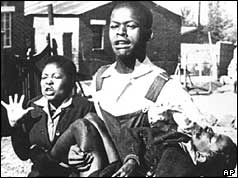
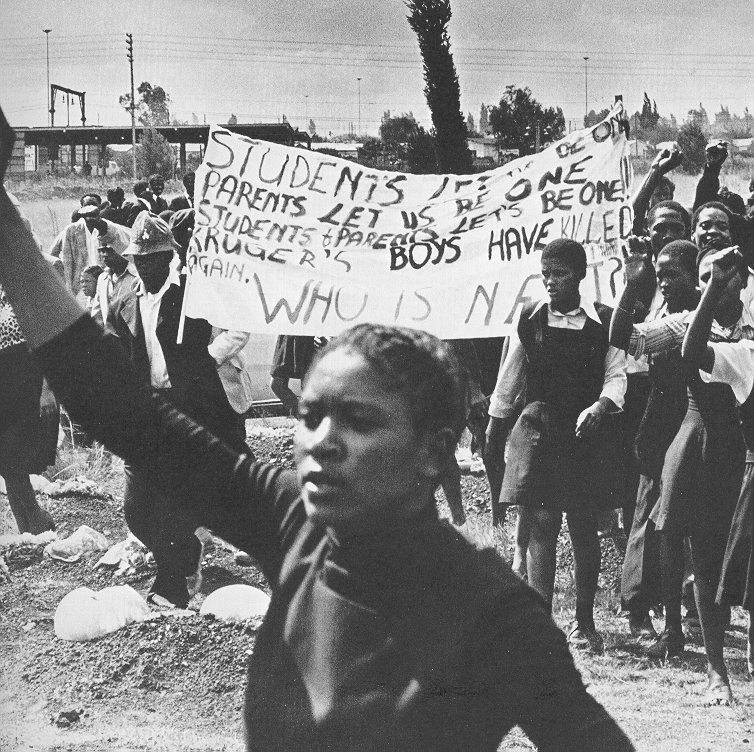
South
African police opened fire on black students peacefully protesting
the requirement to learn Afrikaans, the language of the small
white majority that enforced apartheid regime.
Over
150 South African children were killed and hundreds more injured
in the shooting -- what became known as the Soweto Massacre.
read
more on Soweto
fact:
Soweto stands for
SOuth
WEst TOwnships
June
16, 1992
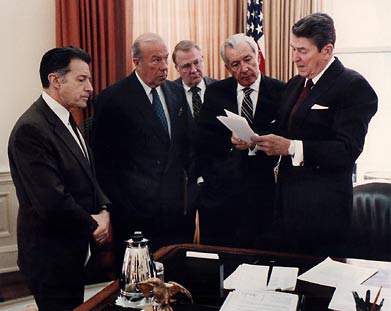
President
Ronald Reagan with Caspar Weinberger, George Shultz, Ed Meese,
and Don Regan discussing the President's remarks on the Iran-Contra
affair.
Former
Defense Secretary Caspar Weinberger was indicted on felony
charges in the Iran-Contra affair, charged with four counts
of lying to Congress and prosecutors. He concealed the secret
arrangement to provide funds to the Nicaraguan contra rebels
with profits from selling arms to Iran. The Reagan administration
was circumventing the legal ban on material support for the
terrorist activities of the contras. Iran had needed the weapons
for its war with Iraq, and it was hoped that Iran would respond
by encouraging the release of hostages being held by Islamist
groups in Lebanon.
Weinberger
and five others charged were pardoned by President George
H. W. Bush six months later, days before the trial was to
start.
more
on Iran-Contra pardons
June
17, 1838
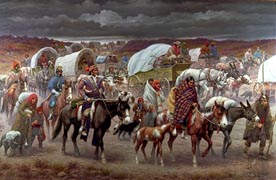
The
Cherokee Nation began the 1,200-mile forced march known as
the Trail of Tears. Their removal from their ancestral land
had been ordered by Pres. Andrew Jackson as the result of
a treaty signed by a small minority of the tribe, and approved
in the Senate by a one-vote margin. Ordered to move on the
Cherokee, General John Wool resigned his command in protest;
Gen. Winfield Scott and 7000 troops moved in to enforce the
treaty.
"The
Trail Where They Cried" ("Nunna daul Tsuny"
in the Cherokee language) led from northern Georgia to Oklahoma
during which an estimated 4,000 died from hunger, exposure
and disease.
a Brief History of The Trail of Tears
June
17, 1972
In the early morning five men were arrested for breaking into
the Democratic National Committee headquarters at the Watergate
complex in Washington, D.C. to install bugging devices. They
had been hired and financed by President Richard Nixon’s
re-election committee. The abuse of power involved in the
cover-up of this crime eventually led to the resignation of
the President.
left
to right: James McCord, Jr., Roman Gonzalez, Frank Sturgis,
Eugenio Martinez, and Bernard Baker.
The
Historical and Political Context of Watergate
a
Watergate chronology
June
18, 1970
The U.S. voting age would be lowered to 18 as a result of
the passage by Congress of the 26th amendment to the constitution.
June
18, 1979
SALT
II (Strategic Arms Limitation Treaty),
an
agreement to put limits on both America’s and the Soviet
Union’s long-range missiles and bombers, was signed
by Presidents Jimmy Carter and Leonid Brezhnev. This was the
first arms-reduction treaty between the two superpowers.
June
19, 1964
Two
hundred college students left Western College for Women in
Oxford, Ohio, to join hundreds of other civil rights volunteers
in Mississippi as part of "Freedom Summer."
Under the umbrella organization of COFO (Council of Federated
Organizations) they worked on projects across the state. Led
by SNCC (Student Non-Violent Coordinating Committee) and CORE
(Congress of Racial Equality) field secretaries, they helped
Negroes try to register to vote, they taught in Freedom Schools,
participated in community organizing, and endured the hostility
toward civil rights work in the deep South. “If we can
crack Mississippi,” the students said, “we can
crack segregation anywhere."
read
more about "Freedom Summer"
<Student
protestors are photographed by a policeman on Freedom Day
in Greenwood, Mississippi in 1964.
>ROBERT
MOSES, director of the 1964 Mississippi Summer Project and
leader of the training program in Oxford, is shown here
during a break in a session which he conducted in Jackson,
Mississippi, to prepare African-Americans for politically
effective action.
more
photos
June
19, 1964
The
Civil Rights Act of 1964 was approved after surviving an 83-day
filibuster in the United States Senate. The new law, initiated
and passed through the determination of Pres. Lyndon Johnson,
guaranteed for the first time equal access to public accommodations
“without discrimination or segregation on the ground
of race, color, religion, or national origin.”
read
about the Civil Rights (1964) and Voting Rights Acts (1965)
Massive
demonstrations a year earlier insured passage of the Acts
June
19, 1982
One thousand landowners occupied key islands in protest
against French nuclear tests at Kwajalein Atoll. Kwajalein
Atoll is located in the western Pacific Ocean, about 2,100
miles southwest of Hawaii and 1,400 miles east of Guam.
The island is now home to USAKA (United States Army Kwajalein
Atoll), the Ronald Reagan Ballistic Missile Defense Test
Site, and about 2,000 support personnel and family members
on Kwajalein and Roi-Namur islands.
read
more about nuclear testing in the Pacific
June
20, 1960
Nobel
laureate for Chemistry Linus Pauling defied Congress by refusing
to name circulators of petitions calling for total halt of
nuclear weapons testing. Pauling later won a second Nobel,
a Peace Prize for his work championing nuclear disarmament.
an
interview with Linus Pauling on the peace movement, 1983
Linus
Pauling
June
20, 1982
2,500
were arrested during a two-day blockade of Lawrence Livermore
Laboratories in California, the principal American nuclear
weapons research site.
June
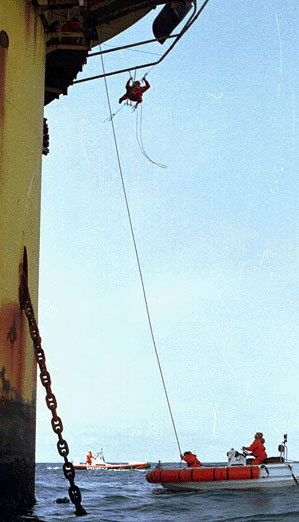
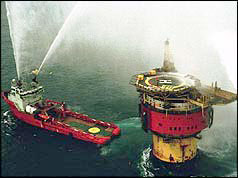
20, 1995
Shell
Oil gave in to international pressure and abandoned its plans
to dump the Brent Spar oil-drilling platform in the North Atlantic.
The environmental group Greenpeace spearheaded the effort to
prevent Shell from sinking the rig, its members boarding and
occupying it as a tactic to stop the deep sea disposal.
Shell’s plan would have dumped toxic and radioactive sludge
into the ocean just west of the British Isles. A month later,
at the Oslo and Paris Commission (OSPARCOM) meeting, 11 out
of 13 countries agreed on a moratorium on the dumping of offshore
installations, pending agreement on a outright ban.
Greenpeace
climbers on Brent Spar platform
read
more about Greenpeace and Brent
Spar
Shell
ships use water cannons against Greenpeace activists on
board the rig.
June
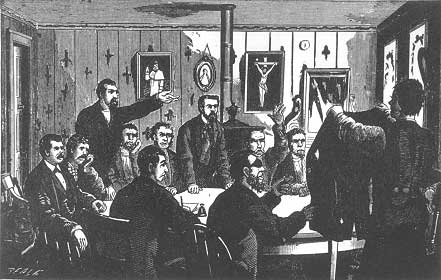
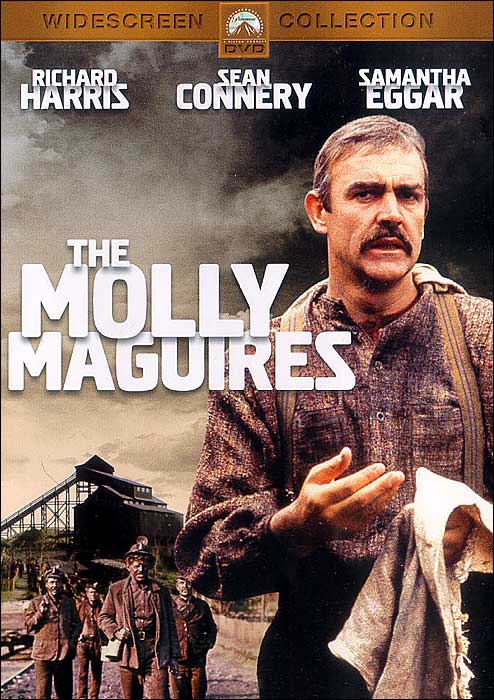
21, 1877
The
Molly Maguires
Four
members of the "Molly Maguires" were hung in what
was then Mauch Chunk, and in Pottsville, Pennsylvania, charged
with murder. The Molly Maguires were a secret and violent
Irish-Catholic organization of coal miners formed to combat
the oppressive working and living conditions in the anthracite
region of the state.
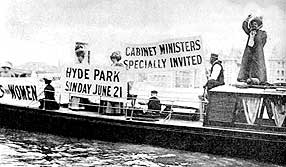
A
Women's Sunday Suffrage rally, supporting the right of women
to vote, drew several hundred thousand to London’s Hyde
Park from all over the country.
Women
were encouraged to wear "the colours" – white
(for purity), green (hope) and purple (dignity) – and
in "as fetching, charming and ladylike a manner as possible."
As the Yorkshire Daily Post put it: "At least one half
of the crowd was composed of the sort of people you would expect
to see at a suburban garden party."
the
women's suffrage movement
June
21, 1964
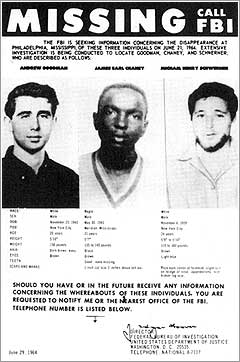
James
Chaney, Andrew Goodman and Michael Schwerner, three young Freedom
Summer workers, disappeared in Philadelphia, Mississippi, while
registering Blacks to vote. Their bodies were found six weeks
later, having been shot and buried in an earthen dam.
Eight
members of the Ku Klux Klan eventually went to prison on federal
conspiracy charges related to the disappearance; none served
more than six years.
Schwerner and Goodman, both white New Yorkers, had traveled
to heavily segregated Mississippi to help organize civil rights
efforts on behalf of the Congress of Racial Equality (CORE).
Chaney was a local African American man who had joined CORE
in 1963.
James
Chaney, Andrew Goodman and Michael Schwerner
June
21, 1997
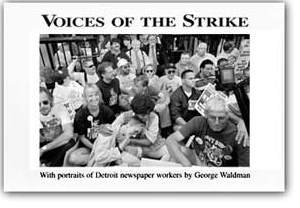
100,000
marched in solidarity with striking newspaper workers in Detroit
after nearly two years on the picket line.
support
rally march 1, 1997
photo:
Paul Felton
The
Detroit Newspaper Agency had refused to bargain in good faith,
even after the union members had worked for months without
a contract, and the DNA, which ran both the Detroit Free Press
and the Detroit News had begun to impose the changes they
were insisting on at the bargaining table.
The First General Peace Convention opened in London, England
of "persons from different nations ... to deliberate
upon the best means, under the Divine blessing, to show the
world the evil and inexpediency of the spirit and to promote
permanent and universal peace."
June
22, 1987
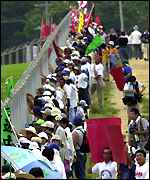
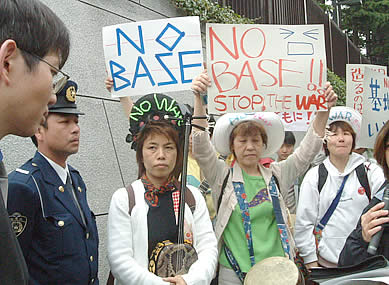
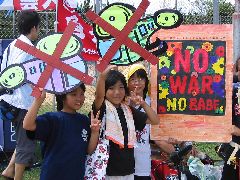
At
least 8,000 peace protesters formed a 10-mile human chain
around the U.S. air base on Okinawa, Japan.
2002
No Base chain at Okinawa.
People
in Okinawa demostrate against a new U.S. base every day.
June
23, 1972
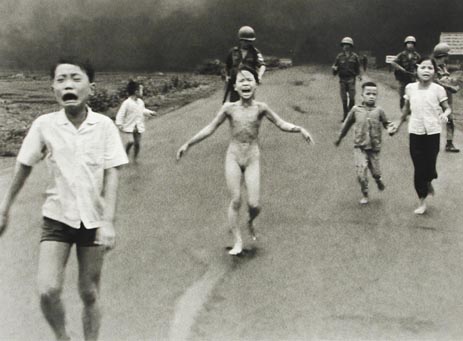
Life
magazine published photos of South Vietnamese children running
from Napalm, an incendiary weapon used widely by U.S. forces
to burn down the jungle and eliminate cover for North Vietnamese
and Viet Cong troops. Napalm, a sticky mixture of gasoline,
polystyrene and benzene that burns at very high temperature,
had been used in WWII and Korea.
read
about the photograph
June
23, 1973
The
International Court of Justice granted an injunction, requested
by Australia and New Zealand governments, against French nuclear
weapons testing in the South Pacific.
June
24, 1948
President
Truman signed the Selective Service Act, creating a system
for registering all men ages 18-25, and drafting them into
the armed forces as the nation’s military needs required.
June
24, 1970
U.S. Senate voted overwhelmingly to repeal the Gulf of Tonkin
Resolution, passed in August, 1964 following a provocation
by the U.S. destroyer Maddox, but portrayed as aggressive
military action by North Vietnamese PT boats. The resolution,
authorizing the president “to take all necessary measures
to repel any armed attack against the forces of the United
States” was used by President Lyndon Johnson, absent
a formal congressional, and constitutional, declaration of
war, to justify open-ended pursuit of war in Vietnam.
June
24, 1980
A
general strike was held in El Salvador against the Death Squads.
These Death Squads were “private” groups supported
by the government, its various “security” forces
as a way to control civilian society.
a
Salvadoran death squad at work
June
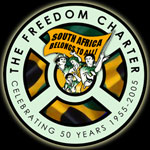
25, 1955
The South African Freedom Charter was adopted at the Congress
of the People in Johannesburg.
“We, the People of South Africa, declare for all our
country and the world to know that South Africa belongs to
all who live in it, black and white, and that no government
can justly claim authority unless it is based on the will
of all the people....”
read
the whole Charter
June
25, 1978
In
response to passage of an anti-gay ordinance in Miami, 240,000
people marched in San Francisco, the first large-scale version
of that city's annual Gay Freedom Day Parade.
read
more about the Gay Parades of the Seventies
(pictures
and stories)
June
25, 1987
Conscientious objector Michaelis Maraggakis jailed four years
for refusing compulsory military service, Thessaloniki, Greece.
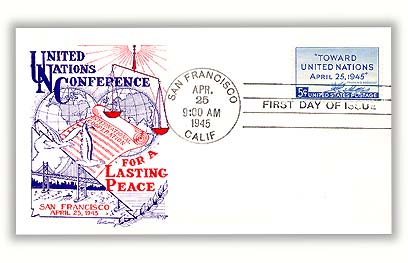
June
26, 1945
In the Herbst Theater auditorium in San Francisco, delegates
from 50 nations sign the United Nations Charter, establishing
the world body as a means of saving "succeeding generations
from the scourge of war."
The
U.S. Post Office issues a commemorative envelope.
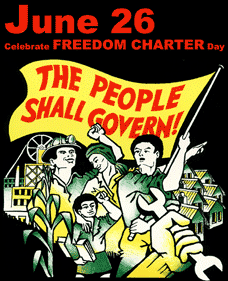
June
26, 1955
The
South African Freedom Charter is adopted at the Congress of
the People in Johannesburg.
read
more
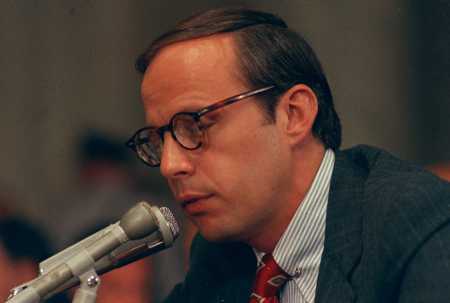
June
27, 1973
Former White House counsel John W. Dean tells the Senate Watergate
Committee about an ''enemies list'' kept by the Nixon White
House.
read more
June
27, 1980
President
Carter signs a measure that requires approximately 4 million
U.S. men age 19 to 20 to register for the draft.
June
27, 1986
International
Court of Justice ("World Court") decides 12-3 that
United States violated international law as well of its Treaty
of Friendship, Commerce and Amity by its use of force
against Nicaragua including the mining of harbors, bombing
nearby airfields as well as furnishing financial, military
and logistical support to the so-called Contra insurgents.
The Contra's goal was to overthrow Nicaragua's popular left-wing
government.
read more about the decision
more
on The World Court by Howard N. Meyer in THE WORLD COURT IN
ACTION
June
28, 1916
One-day
strike by 50,000 German workers to free Socialist anti-war
leader Karl Liebknecht.
Karl
Liebknecht biography
June
28, 1969
Patrons
at the Stonewall Inn, a gay bar in New York City's Greenwich
Village, clash with police in an incident considered to be
the birth of the gay rights movement.
The riot was followed by several days of demonstrations and
was the impetus for the formation of the Gay Liberation Front
as well as other gay, lesbian, and bisexual civil rights organizations.
The first major protest on behalf of equal rights for homosexuals.
links
June
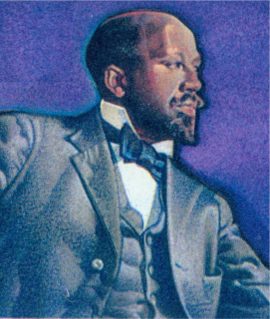
29, 1916
W.E.B.
DuBois and other leaders organize silent parade against lynching
of Blacks, New York City.
read
about W.E.B. DuBois
June
30, 1966
The
first GIs, known as The Fort Hood Three-a trio of U.S. Army
privates--James Johnson, Dennis Mora, and David Samas, refuse
to be sent to Vietnam. All are members of the 2nd Armored
Division stationed at Fort Hood, Texas. The three were from
working-class families, and they denounced the war as "immoral,
illegal and unjust." They were arrested, court-martialed
and imprisoned.
This
Week In History compiled by peacebuttons.info from various
sources
which are available upon request.
Submissions are always welcome. Please furnish sources. cb@peacebuttons.info
Reproduction
of this calendar for non-profit purposes
is permitted and encouraged. Please credit/link to www.peacebuttons.info









 Mildred
and Richard Loving
Mildred
and Richard Loving