In
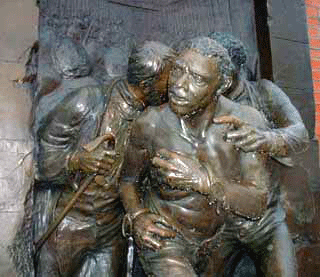
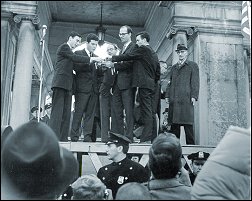
the "Jerry Rescue," citizens of Syracuse, New York
broke into the city’s police station and freed William
Henry (called Jerry), a runaway slave captured under the Fugitive
Slave Law. The federal law required "good citizens"
to assist in the return of runaway slaves. A group of black
and white men created a chaotic diversion and managed to free
Jerry but he was later re-arrested. At his second hearing,
a group of men, their skin color disguised with burnt cork,
forcibly overpowered the guards with clubs and axes and freed
Jerry a second time; he was secretly taken to Canada.
read
more
Jerry
Rescue monument
Syracuse,
New York
October
1, 1964
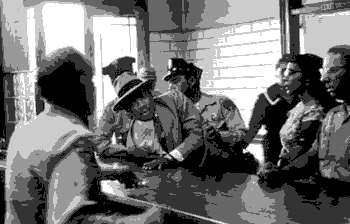
The
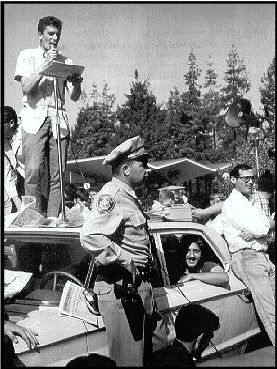
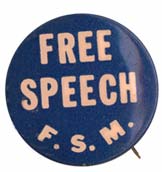
Free Speech Movement was launched at the University of California
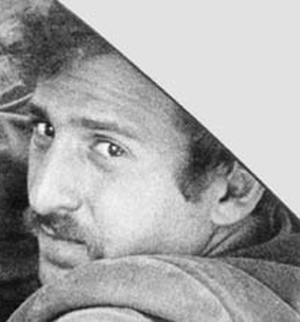
at Berkeley when mathematics grad student Jack Weinberg was
arrested for setting up a CORE (Congress of Racial Equality)
information table in front of Sproul Hall, the administration
building.
Hundreds of students surrounded the police car holding Weinberg
for 32 hours, making speeches from atop the car, and ultimately
negotiating Weinberg’s release.
University Chancellor Clark Kerr had been under pressure from
the Board of Regents to ban expression of views considered
communist, but the students, inspired by the Civil Rights
movement, questioned the restrictions.
read more
Jack
Weinberg
October
1, 1984
Five
activists, in what became known as the Trident II Plowshares,
hammered and poured blood on six missile tubes and unfurled
a banner which said: "Harvest of Hope - Swords into Plowshares"
at Electric Boat’s Quonset Point facility in North Kingston,
Rhode Island.
General Dynamics built the fourteen Ohio-class nuclear-powered
submarines there, each of which are armed with 24 Trident
II nuclear-tipped missiles (3.8 megatons each) launched from
underwater with a range of 4000 nautical miles (4600 miles;
7400 kilometers).
Plowshares participants, individually or in groups, actually
or symbolically damage parts of the United States first-strike
nuclear arsenal or conventional weaponry, and take public
responsibility for their actions.
read
more about this action
a
chronology of Plowshares actions
October
2, 1869
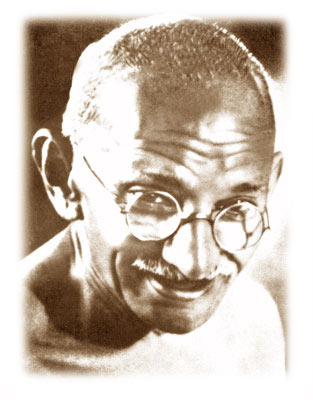
Mohandas
Karamchand Gandhi, the Indian nationalist leader whose philosophy
of nonviolence would influence movements around the world,
was born. He came to prominence as the leader of nonviolent
resistance to British colonial rule in India.
learn
more about Gandhi
October
2, 1961
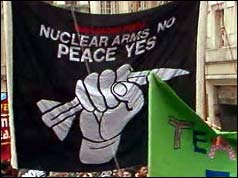
Ten
months after its start in San Francisco, an antinuclear peace
march sponsored by the Committee for Nonviolent Action arrived
in Moscow’s Red Square where they successfully distributed
leaflets calling for disarmament.
October
2, 1967
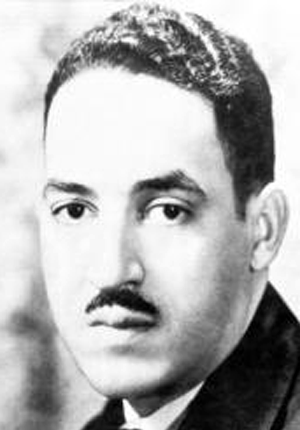
Thurgood
Marshall was sworn in as an associate justice of the United
States Supreme Court, the first African-American on the nation's
highest court. He was appointed by President Lyndon Johnson
who had previously chosen him as Solicitor General. Marshall
had been the lead attorney in the Brown v. Board of Education
decision which led to the end of legal segregation in the
nation’s schools.
read
more about Thurgood Marshall
October
3, 1932
With
the admission of Iraq into the League of Nations, Great Britain
terminated its control over the Arab nation, making Iraq independent
after 17 years of British rule and centuries of Sunni Ottoman
rule. It had taken 11 years from a plebiscite creating a constitutional
monarchy (King Feisel) until the new country achieved complete
independence. Iraq had been created in the wake of World War
I by combining three provinces, Mosul, Baghdad and Basra,
into one political entity under British mandate.
Excellent
history of Iraq
October
3, 1952
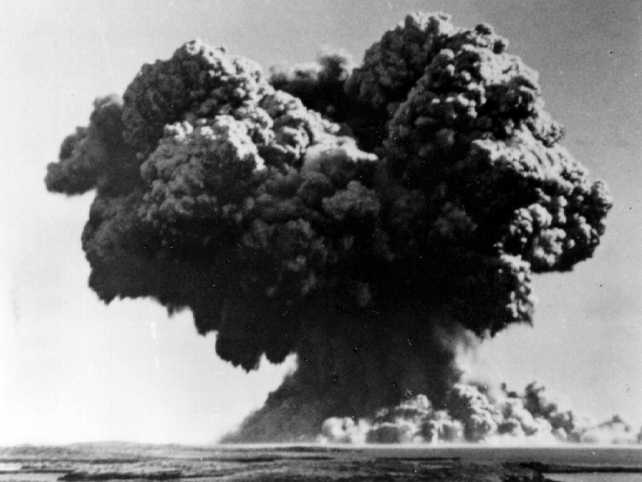
Britain successfully tested its first atomic bomb, dubbed
Hurricane, at the Monte Bello Islands, off the northwest coast
of Australia.
read
more
"Hurricane"
October
3, 1967
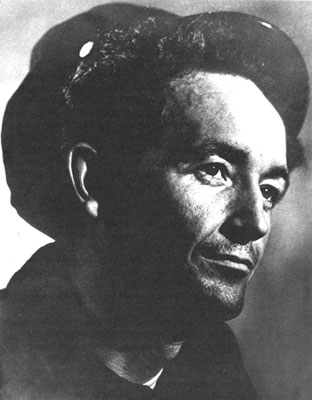
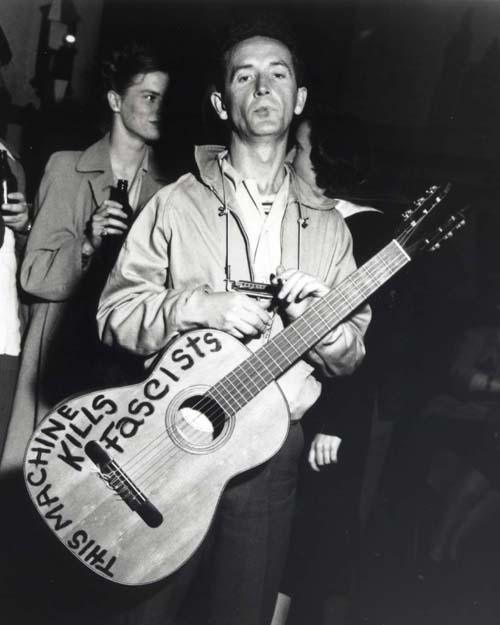
Woody
Guthrie
1912-1967
Folksinger/songwriter
Woody Guthrie died in New York City at the age of 55. He had
spent the last decade of his life in the hospital, suffering
from Huntington's chorea. Woody called his songs "people's
songs," filled with stinging honesty, humor and wit,
exhibiting Woody's fervent belief in social, political, and
spiritual justice.
read
more about Woody
October
3, 1981
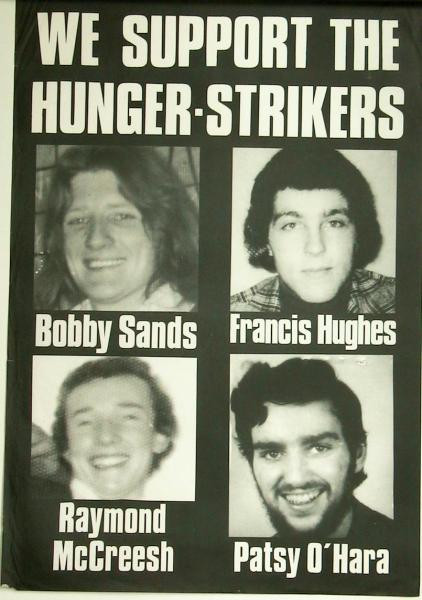
Irish nationalists at the Maze Prison near Belfast, Northern
Ireland, ended seven months of hunger strikes that had claimed
10 lives. The first to die was Bobby Sands, the imprisoned
Irish Republican Army (IRA) leader who initiated the protest
on March 1--the fifth anniversary of the British policy of
"criminalisation" of Irish political prisoners.
Prior to 1976, Irish political prisoners were
incarcerated under "Special Category Status," which
granted them a number of privileges that other inmates did
not enjoy. Despite Sands' election (while an inmate) as MP
from Fermanagh and South Tyrone after the first month of his
hunger strike, and his death from starvation a month later,
the government of British Prime Minister Margaret Thatcher
would not give in, and nine more Irish republicans perished
before the strike was called off. The dead included Kieran
Doherty, who had been elected to parliament in the Irish Republic
during the strike. In the aftermath, the British government
quietly conceded to some of the strikers' demands, such as
the rights to wear civilian clothing, to associate with each
other, to receive mail and visits, and not to be penalized
for refusing prison work.
October
4, 1887
Louisiana sugarcane workers, working with the racially integrated
Knights of Labor, went on strike. The Louisiana Militia, aided
by bands of "prominent citizens," shot and killed
35 unarmed black sugar workers striking to gain a dollar-per-day
wage, and lynched two strike leaders.
read more
October
4, 1997
Demonstrations
across the country protested the scheduled launch of the space
probe Cassini with its Three plutonium-fueled Radioisotope Thermoelectric
Generators which provide power for the mission.
The
probe carried 72.3 pounds of plutonium, the most ever put on
a space device. The concern was for an accidental release in
the event of a launch mishap.
Plutonium
is the most toxic substance known. "It is so toxic,"
says Helen Caldicott, president emeritus of Physicians for Social
Responsibility, "that less than one-millionth of a gram
is a carcinogenic dose. One pound, if uniformly distributed,
could hypothetically induce lung cancer in every person on Earth."
read
more
October
5th
Raoul
Wallenberg Day, honoring the Swedish diplomat who saved as
many as 100,000 Hungarian Jews from deportation and probable
death in concentration camps during WWII.
He
did this through bargaining with Nazi officials, establishing
safehouses, distributing false passports, disguising Jews
in Nazi uniforms and setting up checkpoints to avert deportations.
He had attended the University of Michigan.
read
more about Raoul Walenberg
October
5, 1966
A
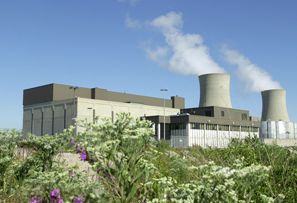
sodium cooling system malfunction caused a partial core meltdown
at the Enrico Fermi I fast-breeder reactor near Detroit, Michigan.
While conducting a power test, two fuel assemblies overheated
and two others partially melted, but there was no release
of radiation. The public did not find out until one of the
engineers who witnessed it wrote the book, “We Almost
Lost Detroit.” The event inspired the Gil Scott-Heron
song of the same name.
read
the lyrics
the
Fermi plant
October
5, 1979
2,000
activists demonstrated against development of uranium mines
in the Black Hills of South Dakota. This followed the Department
of the Interior releasing its final environmental impact statement,
endorsing the North Central Power Study's plans to turn the
Black Hills into a "national sacrifice area." The
plan was to devote nearly 200,000 acres to mineral extraction
and energy production with up to 25 nuclear power plants.
Uranium
Mining in the Black Hills
October
5, 1986
A
captured Eugene Hasenfus
The
cover-up of the Iran-Contra scandal began to unravel when
Eugene Hasenfus was captured by government troops in Nicaragua
after the plane in which he was flying was shot down; three
others on the plane died in the crash. Under questioning,
Hasenfus confessed that he had been shipping military supplies
into Nicaragua for use by the Contras, an anti-Sandinista
force that had been created and supported by the United States,
in violation of congressional action stopping the funding,
and run by the U.S. Central Intelligence Agency (CIA).
Iran-Contra
background
October
6, 1683
Thirteen Mennonite families from the Geman town of Krefeld
arrived in Philadelphia on the ship Concord. Having endured
religious warfare in Europe, the Mennonites were pacifists
who opposed all forms of violence.
modern
Mennonite peace activism:
October
6, 1979
Over
1,000 were arrested at Seabrook, New Hampshire, the construction
site of a nuclear power plant, for an occupation organized
by the Clamshell Alliance.
Seabrook
Nuclear Power Plant protest - late 1970s
October
7, 1955
Poet
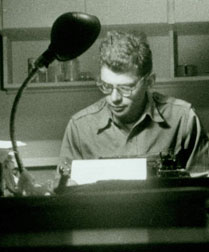
Allen Ginsberg read his poem "Howl" for the first
time at Six Gallery in San Francisco. The poem was an immediate
success that rocked the Beat literary world and set the tone
for confessional poetry of the 1960s and later.
Working
on Howl in San Francisco, circa June, 1956.
"Howl
and Other Poems" was printed in England, but its second
edition was seized by Customs officials as it entered the
country. City Lights, a San Francisco bookstore, published
the book itself to avoid customs problems, and storeowner
(and poet) Lawrence Ferlinghetti was arrested and tried for
obscenity, but defended by the ACLU. Following testimony from
nine literary experts on the merits of the book, Ferlinghetti
was found not guilty.
read
more about Allen Ginsberg
Autographed
City Lights Edition
read
Howl
October
7, 1998
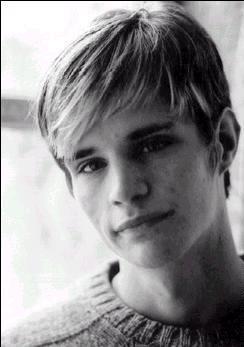
Matthew
Shepard, a gay student at the University of Wyoming, was beaten,
robbed and left tied to a wooden fence post outside Laramie,
Wyoming; he died five days later. The death of Matthew Shepard
awakened the world to the persecution that homosexuals have
endured for centuries.
read
more
Matthew
Shepard
October
8, 1945
President
Harry S Truman announced that the secret of the atomic bomb
would be shared only with Britain and Canada.
October
8, 1982
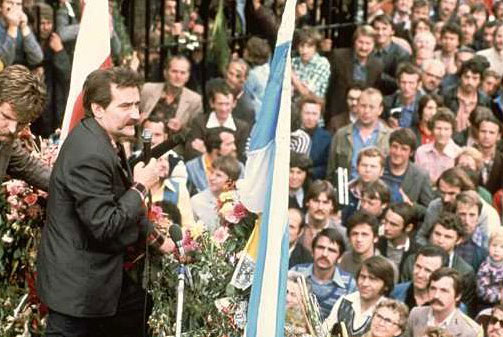
Solidarnosc
leader Lech Walesa, 1982
The
Polish Parliament overwhelmingly approved a law banning Solidarnos´c´
(Solidarity), the independent trade union that had captured
the imagination and allegiance of nearly 10 million Poles.
The
law abolished all existing labor organizations, including
Solidarity, whose 15 months of existence brought hope to people
in Poland and around the world but drew the anger of the Soviet
and other Eastern-bloc (Warsaw Pact) governments. The parliament
created a new set of unions with severely restricted rights.
October
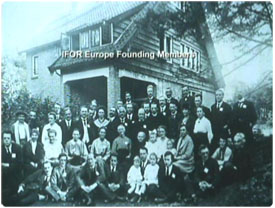
9, 1919
The
International Fellowship of Reconciliation was founded in
Bilthoven, the Netherlands.
Its
members have since been active in promoting programs and activities
for reconciliation, peace-building, active nonviolence, and
conflict resolution.
more
about FOR
October
9, 1990
The
U.S. began making reparations payments to survivors and families
of Japanese-Americans taken from their homes put into internment
(or concentration) camps during World War II.
The payments were a result of Civil Liberties Act of 1988
signed by President Reagan. Popularly known as the Japanese
American Redress Bill, this act acknowledged that "a
grave injustice was done" and mandated Congress to pay
each victim of internment $20,000 in reparations. The first
nine redress payments were made at a Washington, D.C. ceremony.
One-hundred-seven-year-old Rev. Mamoru Eto of Los Angeles
was the first to receive his check.
A
chronology of internment during WWII:
Some
of the housing in the concentration camps was in former horse
stalls.
Note:
In the entire course of the war, 10 people were convicted
of spying for Japan, all of whom were Caucasian.
October
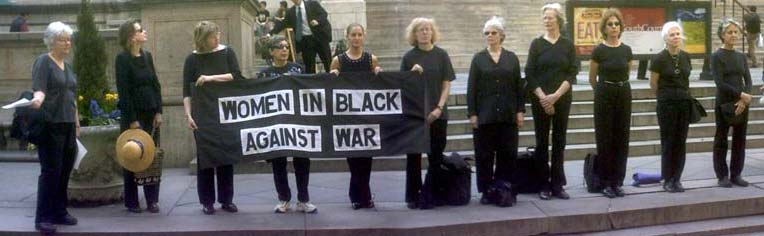
9, 1991
Women
In Black in Belgrade (Zene u Crnom) began regular weekly
silent vigils in Republic Square. They stood to protest
the nationalist violence that had erupted in the disintegration
of Yugoslavia. They encouraged men who refused to serve
in the military and engaged in many educational efforts.
They were initially encouraged by “Women Visiting
Difficult Places,” a group of Italian women who encouraged
women on both “sides” in conflict-ridden countries
to communicate. They in turn were inspired by Israeli Jewish
women who organized in 1988 during the first intifada to
protest their country’s occupation of Palestinian
territories, and held vigils in as many as forty locations,
later joined by Israeli Palestinians.
A
Short History Of Women In Black
Women
In Black • New York City
October
10, 1967
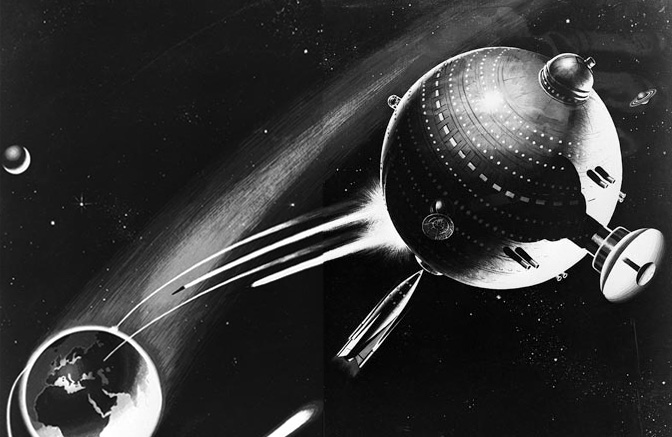
The
Outer Space Treaty (Treaty on Principles Governing the Activities
of States in the Exploration and Use of Outer Space, Including
the Moon and Other Celestial Bodies) demilitarizing outer space
went into force.
It sought to avoid "a new form of colonial competition"
as in the Antarctic Treaty, and the possible damage that self-seeking
exploitation might cause.
Discussions on banning weapons of mass destruction in orbit
had begun among the major powers ten years earlier.
read
more
1949
painting by Frank Tinsley of the infamous "Military
Space Platform"
proposed
by then Secretary of Defense James Forrestal in the December
1948 military budget.
October
10, 1963
Linus
Pauling
The
Limited Nuclear Test Ban Treaty took effect between The U.S.
and the Soviet Union. In 1957, Nobel Prize-winner (Chemistry)
Linus Pauling drafted the Scientists' Bomb-Test Appeal with
two colleagues, Barry Commoner and Ted Condon, eventually
gaining the support of 11,000 scientists from 49 countries
for an end to the testing of nuclear weapons. These included
Bertrand Russell, Albert Einstein, and Albert Schweitzer.
Pauling then took the resolution to Dag Hammarskjöld,
then Secretary-General of the United Nations, and sent copies
to both President John F. Kennedy and Soviet Premier Nikita
Kruschev. The final treaty had many similarities to Pauling’s
draft. It went into effect the same day as the announcement
of Pauling’s second Nobel Prize, this time for Peace.
October
10, 1986
Elliott
Abrams, then assistant secretary of state for inter-American
affairs, testified before the Senate Foreign Relations Committee
(in closed executive session) that he did not know Marine Lt.
Col. Oliver North, a White House employee in the Reagan administration,
was directing illegal arms sales to Iran and diverting the proceeds
to assist the Nicaraguan contras.
Abrams, who pleaded guilty in 1991 to withholding information
during that testimony from Congress in the Iran-contra affair,
but was pardoned by President George H.W. Bush. He has been
hired as deputy national security adviser to President George
W. Bush.
Elliott
Abrams
Presidents
George W. Bush &
George
H.W. Bush
Oliver
North
read
more about the pardons
October
10, 2002
The
House voted 296-133 to pass the “Joint Resolution to
Authorize the Use of United States Armed Forces Against Iraq,”
giving President George W. Bush broad authority to use military
force against Iraqi leader Saddam Hussein, with or without
U.N. support.
October
11, 1987
Nearly one million people flooded Washington, D.C., demanding
civil rights for gay and lesbian Americans, now celebrated
each year as National Coming Out Day.
October
12, 1492
Natives
of islands off the Atlantic shore of North America came upon
Italian explorer Christopher Columbus, who was searching for
a water route to India for Spanish Queen Isabella.
October
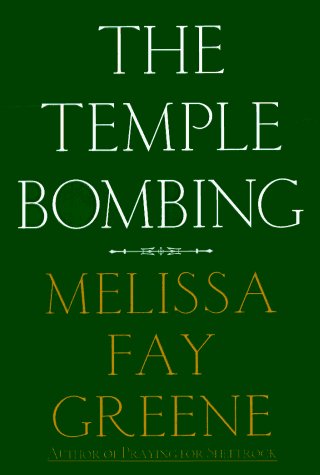
12, 1958
A
Reform Jewish Temple in Atlanta (the city’s oldest)
was firebombed with fifty sticks of dynamite in retaliation
for Jewish support of local black civil rights activists.
The Temple’s Rabbi Jacob Rothschild was outspoken in
his support of civil rights and integration, and was a friend
of Martin Luther King Jr. before it was fashionable or even
noteworthy.
read
more
October
12, 1967
British
zoologist Desmond Morris stunned the world with his book,
“The Naked Ape,” a frank study of human behavior
from a zoologist's perspective. Morris had earlier studied
the artistic abilities of apes and was appointed Curator of
Mammals at the London Zoo.
read
more
October
12, 1967
"A
Call to Resist Illegitimate Authority" appeared in The
Nation and the New York Review of Books. 20,000 signed it,
including academics, clergymen, writers.
It
urged “that every free man has a legal right and a moral
duty to exert every effort to end this war [Vietnam], to avoid
collusion with it, and to encourage others to do the same.”
This document became the main basis for the federal government's
criminal prosecution (encouraging draft evasion) of five of
the signers: Dr. Benjamin Spock, Marcus Raskin, Mitchell Goodman,
Michael Ferber, and the Reverend William Sloane Coffin.
read
the Call
October
12, 1970
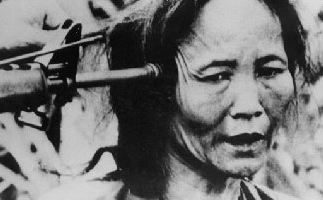
Lt.
William Calley was court-martialled for the massacre of 102
civilians in My Lai during Vietnam War; far more actually died
during the incident.
read more about My Lai
Lt.
Calley
(general)
(link/viewer
caution advised:)
October
12, 1977
Regents
of the University of California v. Bakke" was argued
in front of the U.S. Supreme Court. The question: Did the
University of California violate the Fourteenth Amendment's
equal protection clause, and the Civil Rights Act of 1964,
by practicing an affirmative action policy that resulted in
the repeated rejection of Bakke's application for admission
to its medical school?
Listen
to the oral argument:
October
13, 1934
The
American Federation of Labor (AFL) voted to boycott all German-made
products as a protest against Nazi antagonism to organized
labor within Germany.
October
14, 1967
Folksinger
Joan Baez was arrested during the blockade of a military induction
center in Oakland, California.
October
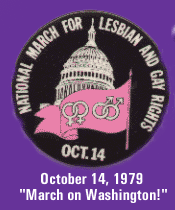
14, 1979
The first national gay and lesbian march for civil rights
in Washington, D.C., drew over 100,000 demanding an end to
all social, economic, judicial, and legal oppression of lesbian
and gay people.
a
photo gallery of the march:
October
14, 1981
Dock workers in Darwin, Australia, began a seven-day strike,
refusing to load uranium on board "Pacific Sky"
for eventual use by the U.S. military. After a week, the ship
was forced to leave without its cargo.
October
15, 1965
In
demonstrations organized by the student-run National Coordinating
Committee to End the War in Vietnam, the first public burning
of a draft card in the United States took place.
These
demonstrations drew 100,000 people in 40 cities across the
country. In New York City, David Miller, a young Catholic
pacifist, became the first U.S. war
protester to burn his draft card in direct violation of a
recently passed federal law forbidding such acts. Agents from
the Federal Bureau of Investigation later arrested him; he
was tried, found guilty, and sentenced to two years imprisonment.
Two years later, on October 16, 1967, 1158 young men turned
in their draft cards in eighteen U.S. cities.
Memoirs
of a Draft-Card Burner
Draft
card burning in support of Vietnam War resisters, 1965.
October
15, 1966
Huey
Newton and Bobby Seale formed the Black Panther Party for Self-Defense
in Oakland, California. Its revolutionary agenda and the fact
that it was armed prompted FBI chief J. Edgar Hoover to refer
to it as as "the greatest threat to the internal security
of the United States."
Read
the Panthers’ Ten Point Platform and Program:
<First
6 members - Top Left to Right: Elbert "Big Man"
Howard; Huey P. Newton, Sherman Forte, Chairman, Bobby Seale.
Bottom: Reggie Forte and Little Bobby Hutton.
Bobby
Seale(L) and Huey Newton(R)>
October
15, 1969
2
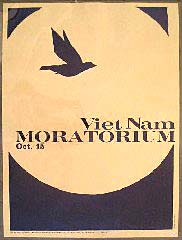
million took part in protest against the continuing war in
Vietnam. The National Moratorium was an effort by David
Hawk and Sam Brown, two anti-war activists, to forge a broad-based
movement against the war.
The organization initially focused its effort on 300 college
campuses, but the idea soon grew and spread beyond the colleges
and universities. Hawk and Brown were assisted by the New
Mobilization Committee to End the War in Vietnam, which was
instrumental in organizing the nationally coordinated antiwar
demonstration.
One
of the largest demonstrations occurred when 100,000 people
converged on the Boston Common, but demonstrations nationwide
also included smaller rallies, marches, and prayer vigils.
The demonstrations involved a broad spectrum of the population,
including those who had already participated in antiwar
demonstrations and many who had never before raised their
voices against the war. This was considered unprecedented:
Walter Cronkite (then CBS news anchor) called it "historic
in its scope. Never before had so many demonstrated their
hope for peace."
Later, a declassified Kissinger (then Nixon’s National
Security Advisor) file revealed that these protests discouraged
a plan by Nixon to use nuclear weapons in Vietnam.
read
more
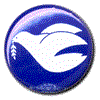
Reissued
The
original Vietnam Moratoium Peace Dove button
October
16, 1859
Abolitionist
John Brown led a group of 21 other men, five black and sixteen
white, in a raid on the U.S. arsenal at Harper's Ferry, Virginia.
John
Brown
They
had hoped to set off a slave revolt, throughout the south,
with the weapons they planned to seize. Virtually all his
compatriots were killed or captured by Gen. Robert E. Lee’s
troops; he was wounded and arrested, and hanged for treason
within two months.
read
more
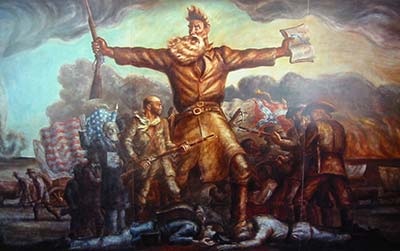
The
Tragic Prelude (John Brown)
mural
by John Steuart Curry (1937-1942)
October
16, 1934
Dick
Sheppard, who volunteered and joined the Army as a chaplain
in World War I, started the Peace Pledge Union in England.
In a letter published in The Guardian, Sheppard, a popular
priest in the Church of England, invited those who would be
willing to join a public demonstration against war to send
him a postcard.
read
more
In
a few weeks there were 30,000 replies. Members of the Peace
Pledge Union vowed to “renounce war and never again
to support another.”
“Up
to now the peace movement has received its main support from
women, but it seems high time now that men should throw their
weight into the scales against war.” -Dick
Sheppard
October
16, 1964
China
detonated its first atomic bomb.
Deng
Jiaxian. The father of the chinese bomb.
October
16, 1967
Folksinger
Joan Baez was arrested in a peace demonstration as rallies
took place across America during “Stop the Draft Week.”
1,158 young men returned their draft cards in eighteen U.S.
cities. Baez was among 122 anti-draft protesters arrested
at the Armed Forces Induction Center in Oakland; she was sentenced
to 10 days in prison.
read
more
Joan
Baez the day after the arrest
October
16, 1968
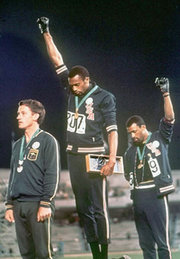
During
medal presentations at the 1968 Summer Olympic Games in Mexico
City, winning sprinters Tommie Smith and John Carlos raised
their black-gloved fists while the Star Spangled Banner was
played. They were suspended by the U.S. Olympic Committee
from the team two days later. Smith later told the media that
he raised his right fist in the air to represent black power
in America while Carlos's left fist represented unity in black
America.
read
more
October
16, 1973
U.S.
Secretary of State Henry Kissinger, though accused of war
crimes by some for the massive bombing of Laos and Cambodia,
was awarded the Nobel Peace Prize jointly with North Vietnam’s
Le Duc Tho (who refused the honor) for the cease-fire agreement
they had negotiated. This occurred just a month after the
bloody military coup, fully supported by the Nixon administration
and aided by the CIA, that overturned the democratically elected
government of Chile, and installed Gen. Augusto Pinochet as
military dictator for the next 17 years.
read
more
Henry
Kissinger
October
16, 1998
In a human rights and international law breakthrough, British
authorities, after receiving an extradition request from Spanish
Judge Baltasar Garzon, placed former Chilean dictator, and
senator-for-life, Augusto Pinochet under arrest for "crimes
of genocide and terrorism that include murder."
Kissinger(left)
and Pinochet(center)
October
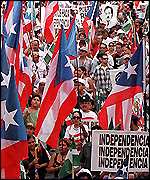
17, 1898
U.S.
took control of Puerto Rico. One year after Spain granted
Puerto Rican self-rule following their rout in the Spanish-American
War, troops raised the U.S. flag over the Caribbean island
nation, formalizing American authority over the island's one
million inhabitants.
a
history of the struggle for Puerto Rican Independence
October
17, 1986
U.S.
President Ronald Reagan signed into law an act of Congress
approving $100 million of military and "humanitarian"
aid for the Contras, a paramilitary group fighting to undermine
the elected Sandanista government in Nicaragua.
read
more
October
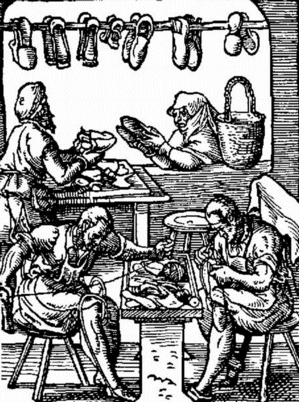
18, 1648
I.
Marc Carlson
The
Shoemakers Guild of Boston became the first labor union in
the American colonies.
October
19, 1923
The
War Resisters League was founded in New York City.
WRL
history
Above:
One of the founders, Jessie Wallace Hughan (r), 1942
photo:
WRL/Swarthmore Peace Collection
October
19, 1960
Martin
Luther King, Jr., and 35 students were jailed after being
arrested during a sit-in at the snack bar of Atlanta's Rich's
department store where they requested service.
October
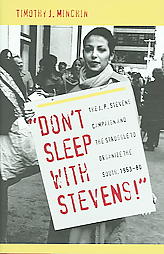
19, 1980
J.P.
Stevens & Co. was forced to sign its first contract with
a union after a 17-year struggle in North Carolina and other
southern states. The workers at J.P. Stevens were supported
by a widespread boycott by labor, progressive and religious
organizations.
read
more
October
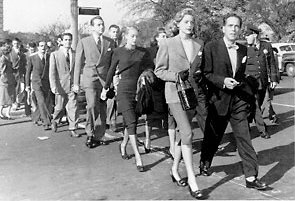
20, 1947
The House Un-American Activities Committee (HUAC) opened public
hearings into alleged Communist influence in Hollywood. To
counter what they claimed were reckless attacks by HUAC, a
group of motion picture industry luminaries, led by actor
Humphrey Bogart, his wife, Lauren Bacall, John Huston, William
Wyler, Gene Kelly and others, established the “Committee
for the First Amendment” (CFA).
read
more
October
20, 1962
A
folk music album, "Peter, Paul and Mary," hit No.
1 on U.S. record sales charts. The group’s music addressed
real issues – war, civil rights, poverty – and
became popular across the Unites States. The trio's version
of "If I Had A Hammer" was not only a popular single,
but also embraced as an anthem of the civil rights movement.
About
Peter, Paul and Mary
October
20, 1967
The biggest demonstration yet in Oakland, California, against
American involvement in the Vietnamese War took place. An
estimated 5000-10,000 people poured onto the streets to demonstrate
in a fifth day of massive protests against the conscription
of soldiers to serve in the war. [see
October 16, 1967 above]
read
more
October
21, 1837
The
U.S. Army, enforcing Pres. Andrew Jackson’s Indian Removal
Act, captured Seminole Indian leader Osceola (meaning "Black
Drink") by inviting him to a peace conference and then
seizing him and nineteen others, though they had come under
a flag of truce. The Seminole had moved to Florida (then under
the control of Spain) from South Carolina and Georgia as they
were forced from their ancestral lands, and were force farther
south into the Everglades. Under the law Jackson urged on
Congress, they and the others of the “Five Civilized
Tribes” (Choctaws, Chickasaws, Creeks and Cherokees)
were to be moved, by force if necessary, west of the Mississippi
(Arkansas and Oklahoma).
read
more
Osceola
painted by George Catlin, 1838
October
21, 1967
In
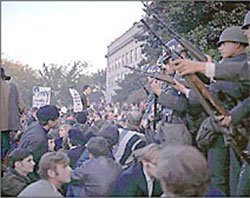
Washington, D.C., more than 100,000 demonstrators from all
over the country surrounded the reflecting pool between the
Washington and Lincoln monuments in a largely peaceful protest
to end the Vietnam War.
It was organized by "the Mobe," the National Mobilization
Committee to End the War in Vietnam. Some then marched on,
encircled and attempted to storm the Pentagon; 682 were arrested
and dozens injured. This protest was paralleled by demonstrations
in Japan and Western Europe, the most violent of which occurred
outside the U.S. Embassy in London where 3,000 demonstrators
attempted to storm the building.
Read
two different accounts of the day with photographs:
at
the Pentagon
October
21, 1983
In the first public action of the new Seattle Nonviolent Action
Group (SNAG), 12 people blockaded the Boeing Cruise Missile
plant in Kent, Washington; none were arrested.
October
22, 1968
More than 300,000 protesters marked International Antiwar Day
in Japan.
October
22, 1979
The deposed Shah of Iran, Mohammed Reza Pahlavi, arrived in
New York for medical treatment. He received permission to
do so from the U.S. government (which had installed him as
shah in a 1954 coup) despite warning from the newly established
Islamic republic in Iran which demanded that the Shah be turned
over to them for trial.
more
on the Shah
October
22, 1983
Capping a week of protests, more than two million people
in six European cities marched against U.S. deployment of
Cruise and Pershing nuclear missiles: 1.2 million Germans,
including 180,000 at Bonn; a 64-mile human chain between
Stuttgart and New Ulm (and Hamburg, W. Berlin); 350,000
Rome; 100,000 Vienna; 25,000 Paris; 20,000 Stockholm; 4000
Dublin; and 140 sites in U.S.
In London, the Campaign for Nuclear Disarmament (CND) held
its biggest protest ever against nuclear missiles with an
estimated one million people taking part.
read
more
October
23, 1915
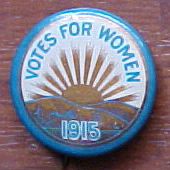
33,000
women marched in New York City demanding the right to vote.
Known as the "banner parade" because of the multitude
of flags and banners carried, it began at 2 o'clock in the afternoon
and continued until long after dark, attracting a record-breaking
crowd of spectators. Motor cars brought up the rear decorated
with Chinese lanterns; once darkness fell, Fifth Avenue was
a mass of moving colored lights.
October
23, 1945
Jackie Robinson and pitcher John Wright were signed by Branch
Rickey, president of the Brooklyn Dodgers Baseball Club, to
play on a Dodger farm team, the Montreal Royals of the International
League.
Robinson
became the first black baseball player to play on a major
league team.
Jackie
Robinson
October
23, 1947
The
NAACP filed formal charges with the United Nations accusing
the United States of racial discrimination. "An Appeal
to the World," edited by W.E.B. DuBois, was a factual
study of the denial of the right to vote, and grievances against
educational discrimination and lack of other social rights.
This
appeal spurred President Truman to create a civil rights commission.
W.E.B.
DuBois
October
23, 1956
The
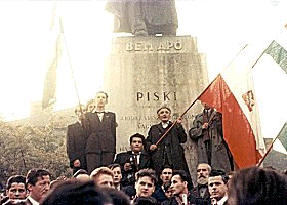
Hungarian revolution began with tens of thousands of people
taking to the streets to demand an end to Soviet rule.More
than 250,000 people, including students, workers, and soldiers,
demonstrated in Budapest in support of the insurrection in
Poland, demanding reforms in Hungary.
Hungarian
students,1956
On 22 October, the students had produced a list of sixteen
demands, including the removal of Soviet troops, the organization
of multi-party democratic elections and the restoration of
freedom of speech. On the evening of the 23rd a large crowd
pulled down the statue of Josef Stalin in Felvonulási
Square.
read
more
Hungarian
revolution monument
October
24, 1935
Langston
Hughes's play "Mulatto" opened on Broadway.
It
was the longest-running play there by an African-American
until Lorraine Hansberry's "A Raisin in the Sun"
premiered in 1959.
about
Langston Hughes
read
or listen to the poem "Mulatto"
Langston
Hughes
October
24, 1940
The
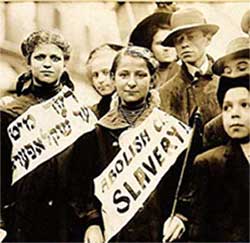
40-hour work week went into effect under the Fair Labor Standards
Act of 1938, requiring employers to pay overtime and restricting
the use of child labor.
Decades
of labor agitation and a considerable number of lives made
this change possible.
Background
on opposition to child labor:
October
24, 1945
The
United Nations World Security Organization came into being
when the Soviet Government in mid-afternoon deposited its
instrument of ratification, the twenty-ninth necessary to
bring this about, and James F. Byrnes, Secretary of State,
then signed the protocol formally attesting that the Charter
of the United Nations had come into force.
read
more
October
24, 1970
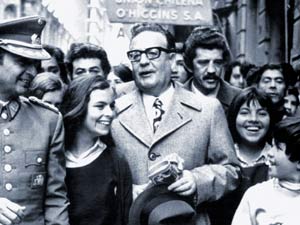
Salvador
Allende, an avowed Marxist and head of the Unidad Popular Party,
became the president of Chile after being elected and confirmed
by the Chilean Congress.
For the next three years, the United States would exert tremendous
pressure to try to destabilize and unseat the Allende government.
In 1958, and again in 1964, Allende had run on a socialist/communist
platform. In both elections, the United States government
(as well as U.S. businesses such as International Telephone
and Telegraph (ITT), which had significant investments in
Chile) worked to defeat Allende by sending millions of dollars
of assistance to his political opponents.
more
on Salvador Allende
Allende
and supporters
October
24, 1981
More
than 250,000 people, organized by the Committee for Nuclear
Disarmament, marched through London to protest the siting
of American nuclear missiles in the U.K.
watch
the march
October
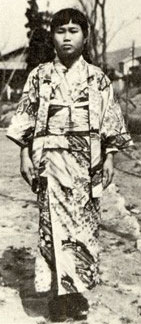
25, 1955
Sadako
Sasaki, following the Japanese custom of folding paper cranes
– senbazuru, symbols of good fortune and longevity –
persisted daily in folding cranes, hoping to reach 1000 when
a person's dream is believed to come true, died of leukemia.
the
Sadako story
Sadako
Sasaki
Sadako
was two years old when the atom bomb was dropped on Hiroshima
and at 12 was diagnosed with Leukemia, "the atom bomb"
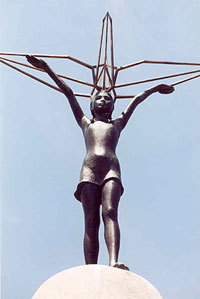
disease.
Children’s Peace Monument in Hiroshima showing Sadako
holding a golden crane
Photo:
Mark Bledstein
October
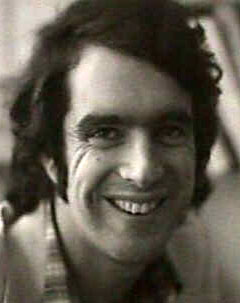
26, 1970
Garry
Trudeau,1976
"Doonesbury",
a cartoon series addressing political and social issues written
by Garry Trudeau, and initially published in a collegiate
daily, debuted in 28 newspapers.
read
Doonesbury
October
26, 1994
Israeli
Prime Minister Yitzak Rabin and Jordanian Prime Minister Abdelsalam
al-Majali, with President Clinton in attendance, formally
signed a peace treaty ending 46 years of war at a ceremony
in the desert area of Wadi Araba on the Israeli-Jordanian
border. President of Israel Ezer Weizman shook hands with
Jordan’s King Hussein.
read
more
October
27, 1659
William
Robinson and Marmaduke Stevenson, two Quakers who came from
England in 1656 to escape religious persecution, were executed
in the Massachusetts Bay Colony for their religious beliefs.
The two had violated a law, passed by the Massachusetts General
Court the year before, banning Quakers from the colony under
penalty of death.
Quakers opposed central church authority, preferring to seek
spiritual insight and consensus through egalitarian Quaker
meetings. They advocated sexual equality and became some of
the most outspoken opponents of slavery in early America.
October
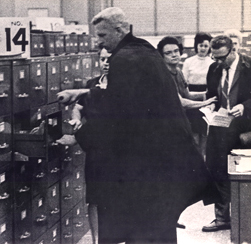
27, 1967
Phillip
Berrigan, artist Tom Lewis, poet David Eberhardt, and United
Church of Christ minister James Mengel, members of the Baltimore
Interfaith Peace Mission, entered the draft board at the United
States Customs House and poured duck’s blood on several
hundred draft records. Known as Plowshare Action Remembrance
Day: Phillip Berrigan, artist Tom Lewis, poet David Eberhardt,
and United Church of Christ minister James Mengel, members of
the Baltimore Interfaith Peace Mission, enter the draft board
at the United States Customs House and pour duck’s blood
on several hundred draft records.
Phillip
Berrigan pouring blood on draft files
The Baltimore Four, as they became known, were arrested and
later tried and convicted for the action which they saw as
a symbolic act of civil disobedience — a non-violent
attack on the machinery of war. This day later became known
as Plowshare Action Remembrance Day.
read
more
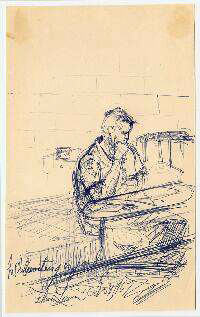
Berrigan
in his jail cell
drawning
by Tom Lewis
October
27, 1968
120,000
marched against the Vietnam War in London. Violence erupted
when a 6,000-strong Maoist splinter group broke away and charged
the police outside the United States Embassy in Grosvenor
Square.
October
27, 1969
Ralph
Nader set up a consumer organization with young lawyers and
researchers (often called "Nader's Raiders") who
produced systematic exposés of industrial hazards,
pollution, unsafe products, and governmental neglect of consumer
safety laws. Nader is widely recognized as the founder of
the consumers' rights movement. He played a key role in the
creation of the Environmental Protection Agency, the Occupational
Safety and Health Administration, the Freedom of Information
Act and the Consumer Product Safety Commission.
read
more
Ralph
Nader (center)
October
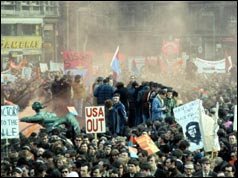
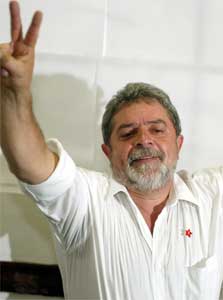
27, 2002
Luiz
Inacio Lula da Silva was elected president of Brazil in a
runoff, becoming the country's first elected leftist leader.
read
more
Luiz
Inacio Lula da Silva
October
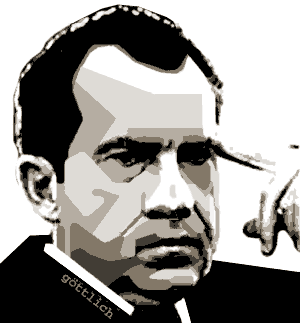
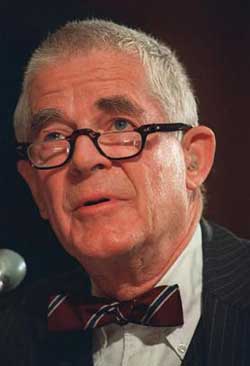
28, 1973
In
what was immediately called the "Saturday Night Massacre,"
President Nixon's Press Secretary, Ron Ziegler, announced that
Special Watergate Prosecutor Archibald Cox had been dismissed.
Cox had been investigating Nixon, his administration and re-election
campaign. Earlier in the day, Attorney General Richardson
had resigned, and Deputy Attorney General William Ruckelshaus
had been fired, both for refusing to dismiss Cox. Solicitor
General Robert Bork, filling the vacuum left by the departure
of his two Justice Department superiors, fired Cox at the
President’s direction.
Richard
Nixon
Archibald
Cox
October
29, 1940
First
compulsory peacetime draft in United States began.
October
29, 1966
National
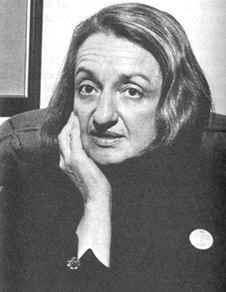
Organization for Women was founded in Washington, D.C. The
30 attendees at the founding meeting elected Betty Friedan,
author of “The Feminine Mystique,” as NOW's
first president.
read
about NOW
Betty
Friedan
October
29, 1969
One
hundred demonstrators disrupted the university’s ROTC
(Reserve Officer Training Corps) with "nonviolent ridicule,"
in Buffalo, New York. The urgency of opposition to the Vietnam
War made many otherwise legitimate military activities targets
of anti-war activity.
anti
ROTC demo
October
29, 1969
U.S.
Federal Judge Julius Hoffman ordered a defendant in his courtroom
gagged and chained to his chair during his trial after repeatedly
asserting his right to an attorney of his own choosing or
to defend himself.
The
defendant, Black Panther Party leader Bobby Seale, and seven
others had been charged with conspiring to cross state lines
"with the intent to incite, organize, promote, encourage,
participate in, and carry out a riot" by organizing the
anti-war demonstrations in Chicago during the 1968 Democratic
National Convention.
The
Chicago Eight included Seale, David Dellinger, Rennie Davis,
Thomas Hayden, Abbie Hoffman, Jerry Rubin, Lee Weiner, and
John Froines.
October
30, 1967
Martin Luther King, Jr., was arrested and jailed in Birmingham,
Alabama, on charges stemming from demonstrations in 1963.
October
30, 1983
500,000 Dutch took part in an anti-missile rally in the Netherlands’
capital city,
the
Hague.
October
30, 1995
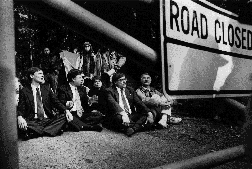
Over
80 people were arrested at Sugarloaf Mountain in southern
Oregon during a massive direct action to prevent corporate
clear-cutting of old-growth forests on public land.
read
more
October
31, 1950
Earl
Lloyd was the first African-American to play in the National
Basketball Association (NBA) when he started with the Washington
Capitols.
He
became the NBA's first African American Assistant Coach to
win an NBA Championship in 1955 as a member of the Syracuse
Nationals, which is now the Philadelphia 76ers.
Earl
Lloyd
October
31, 1952
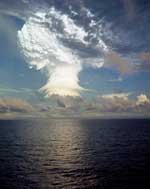
U.S.
successfully detonates "Mike," the world's first hydrogen
bomb, in the atmosphere at the Eniwetok Proving Grounds on the
Elugelab Atoll, part of the Pacific Marshall Islands.
Mike's
Mushroom cloud
The 10.4-megaton device was the first thermonuclear device built
upon the Teller-Ulam principles of staged radiation implosion.
The incredible explosive force of Mike was apparent from the
sheer magnitude of its mushroom cloud–within 90 seconds
the mushroom cloud climbed to 57,000 feet and entered the stratosphere
at a rate of 400 mph. One minute later it reached 108,000 feet,
eventually stabilizing at a ceiling of 120,000 feet. Half an
hour after the test, the mushroom stretched sixty miles across,
with the base of the head joining the stem at 45,000 feet.
read
more
October
31, 1978
Thirty
thousand Iranian oil workers went on strike against the repressive
rule of the U.S.-installed Shah and for democracy, civil and
human rights.
read
more
Striking
Iranian oil workers.
Photo:
December 1978 issue of Resistance.
A publication of the Iranian Students Association in the U.S.
(ISAUS)
October
31, 1984
Indian
Prime Minister Indira Gandhi was shot to death by Sikh members
of her own security guard while walking in the garden of her
New Delhi home. Gandhi's son, Rajiv, was sworn in as Prime
Minister following the assassination.
This
Week In History compiled by peacebuttons.info from various
sources
which are available upon request.
Submissions are always welcome. Please furnish sources. cb@peacebuttons.info
Reproduction
of this calendar for non-profit purposes
is permitted and encouraged. Please credit/link to www.peacebuttons.info








 Working
on Howl in San Francisco, circa June, 1956.
Working
on Howl in San Francisco, circa June, 1956.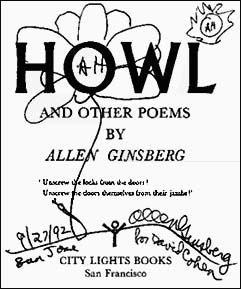 Autographed
City Lights Edition
Autographed
City Lights Edition


























 Garry
Trudeau,1976
Garry
Trudeau,1976 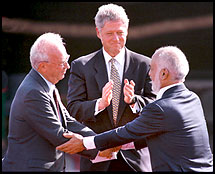





 Mike's
Mushroom cloud
Mike's
Mushroom cloud
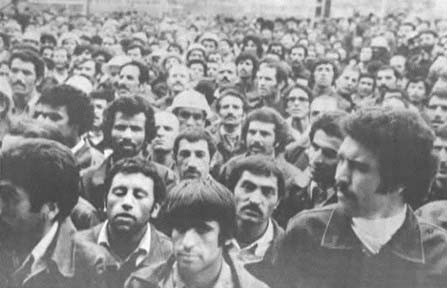 Photo:
December 1978 issue of Resistance.
A publication of the Iranian Students Association in the U.S.
(ISAUS)
Photo:
December 1978 issue of Resistance.
A publication of the Iranian Students Association in the U.S.
(ISAUS)